
Multiple Choice = Google

A few years ago, I ran across a tweet quoting Brian J. Nichols:

If you can Google it, it isn’t a good assignment.

Screen Shot 2017-03-26 at 9.18.13 PM

This short tweet shifted my world. I look at the work my kids bring home through a whole different lens. Not that I ever approved of assessments that were based on simple factual recall – when I was teaching 20 years ago, we never ever used bubble tests. Those were considered the lazy teacher option that didn’t test anything except who had the best memory. In 1990, I was telling my history students that I didn’t expect them to memorize all the dates and facts as long as they knew how to find it. Back then, finding the information meant looking it up in a physical encyclopedia.

My daughter just finished her sophomore year of high school, including a year of AP World History. In this class and in her biology class she took a  horrifying number of “Scantron” tests.  Of course, the kids never got the tests back (you see, they might pass the answers to someone else) and parents never got to see them. I finally requested to see the tests and had to make an appointment so I could look at them in the room with the teacher present.

Back to Google…..   After seeing the tests, I was so disappointed. They were 90% basic low level questions that could be easily answered using Google.

What about AP Tests?

A few months ago, I was asked to give a talk to a group of history and education majors at Carleton College about tech in education and how museums are using tech to work with the K12 audience. On a whim, thinking of my daughter’s tests, I looked for a sample AP test.
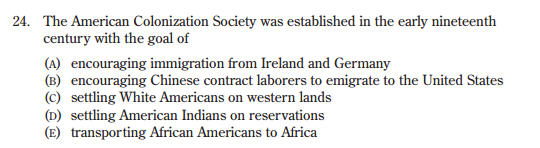
Question from Sample AP US History Test

Question from Sample AP US History Test

I took this  sample AP test and Googled the 40 questions exactly as written. It took about 2 seconds to find the answers – and that was checking a couple of pages to verify the answers. Thirty-five of the 40 questions were easily answered this way. The other five required information from a chart or photo.

I asked the students at Carleton to find the answers to a couple of these questions. Obviously, they had the same result. The students, many of whom had taken plenty of AP classes, were shocked. The professors were very amused.

A few weeks after this, I had the opportunity to talk with a history professor at Oberlin College, and asked him what he thought about this and AP in general. He said that they often need to reteach students how to read and study history when they arrive at Oberlin. Students who have been through AP classes are geared to read for minutae and minor detail. They haven’t been taught to read for concepts, context and the big picture.

AP Philosophy

In looking closely at the AP material online, it turns out that the multiple choice questions and the free response questions are each worth half of a student’s “grade” on the test.  There are 80 questions to be completed in 55 minutes. The free response questions, including primary source analysis and essay, takes 130 minutes.

This quote from the AP materials confuses me:

“Although there is little to be gained by rote memorization of names and dates in an encyclopedic manner, a student must be able to draw upon a reservoir of systematic factual knowledge in order to exercise analytic skills intelligently. Striking a balance between teaching factual knowledge and critical analysis is a demanding but crucial task in the design of a successful AP course in history .”

They admit that rote memorization isn’t necessary, yet fully one half of the test score is based on this skill. While I don’t disagree that a basic level of knowledge of factual knowledge is necessary, is it necessary to have grades depend on the skill of memorization when we now have access to encyclopedias of content in our pockets? There is no possible way we can have the entirety of knowledge memorized — we need to be able to find it. We need to teach students how to find this information.

In my daughter’s AP World History course, her assessment/grade was based on this skill of rote memorization: assessments were worth 60% of the grade, and these assessments were by far mostly multiple choice Scantron tests with a few writing assessments thrown in there. Any creative assignment that required critical thinking, creativity and communication was worth just a few points. The content, structure and assessment of the course is designed to heavily favor strong word-based learners. It does not allow for success of a visual learner.

Even Will Richardson dislikes Google Questions

At ISTE in June, Will Richardson shared a story about his high school daughter’s history final – 100 multiple choice questions. He thought that all but 5 could be answered using the phone.

“I’m a big advocate of open phone tests. If we’re asking questions we can answer on our phone, why are we asking the questions?”

I’m excited to have yet another awesome quote about the value (or lack of) low-level questioning.

I had a fun, quick Twitter interaction with him later — I just had to know what someone like him, who is so active in this community, so well respected, does when his own kid is given an assessment like this.
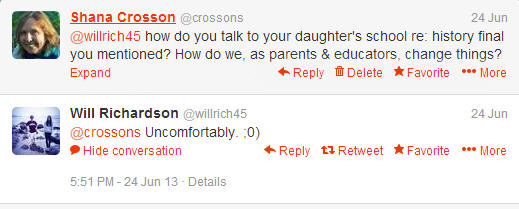
Watch Will’s talk. The history final story is at 12:30. Then don’t give any more tests that can be Googled.

Standardizing Intelligence

Ran across this interesting article about a new book, “Ungifted: Intelligence Redefined” by Scott Barry Kaufman.

I’ve only read the article (not the whole book) and am intrigued to read the book.

My only concern is the continued attack on “giftedness.” Having been active in supporting gifted learners, I am concerned (and disagree) with the concept that “all students are gifted.” Without reading the book, I agree with Kaufman that all students can achieve greatness, and definitely that society measures intelligence in only one way (more on that later.) However, I am concerned about not meeting the needs of kids who do measure gifted in the traditional manner. These kids have a different learning style that needs to be addressed/met in order for these kids to be able to achieve their potential. They need to be able to move quickly, learn deeply. It is an ongoing concern with the label “gifted.” I do wish there was a term that better defined this learning style.

Standardized Tests

That said, I agree wholeheartedly with the rest of this article. Why do we define intelligence based solely on test scores? Why are we such a text based society? Why isn’t intelligence in other areas valued in a similar manner?

…traditional metrics of intelligence are misguided and may even be detrimental to learning and development.

I see this all the time with my daughter. She struggles with tests and with “traditional” learning settings. Yet, allow her to express her knowledge in an appropriate setting, and she shines. Let her make a video,  write a short skit, give a speech – and her intelligence, communication skills, creativity and critical thinking skills shine.  Make her take a multiple choice test? Not so much.

I have had a couple of her teachers comment in the last few years about how she does on these types of projects. The engagement we see at home for these types of assessments is clearly different than what we see for multiple choice tests. In the long run, which skill set is more important? You know what I think….

Yet, she is being defined by these tests, and we see an increasing impact on her self-esteem and image. This is not to deter from the kids who do well on these tests. I just wish there was another measure that was valid. 

Kaufman says it better:

I am against standardizing minds and ignoring the fact that there are multiple paths to the same outcome and that engagement is an extremely important aspect of the equation.

As I’ve blogged before, my daughter’s school uses the exact same tests over and over and over again. Tests must be standardized so that all kids have the exact same assessment. Guess what, kids aren’t standard, nor are they the exact same.

I heard an anecdotal story about a teacher who allowed students to come up with their own project to express their learning. A parent complained because her student got a “B” and now this teacher isn’t allowed to do these types of assessments. Now he has to do tests. 

At the recent ISTE conference, I sat next to a high school teacher from St. Louis. As Adam Bellow showed his awesome video about shredding Scantron tests, he told me that his school got rid of their Scantron tests three years ago. Best move ever, he said.

Solutions

Kaufman is pretty clear about his solution – project based learning:

… allow students to express their knowledge of the material on their own terms, in their own unique voice, and at their own pace, I think we’d be setting up all students for the future much better, including those students we label gifted now.

No way this is going to happen at my daughter’s school. I’m not sure what the solution is for us, given she has two years left. My son will not be attending this school. 

ISTE13 – Chris Lehmann

I just returned from  at ISTE13.  I am fortunate and grateful that I am able to attend this conference. This is not yet my reflection post. I’m still processing and find I need space to do that. As always, I wrote a great deal on the flight home – it’s the best place to immediately process. I will be posting thoughts from the flight later.

The next few posts are a spot for me to store the video from the conference that I will reference later. I love that ISTE does video on demand. It’s impossible to get to all the sessions you want during the conference — especially when they schedule Will Richardson and Chris Lehmann at the same time!

Chris Lehmann

I’ve blogged about Chris many times. It was watching him at ISTE 2011 and online that really started me down this path. He talk at ISTE13 is no exception. I’m sorry I wasn’t there in person.

Take a look through this video. Think about the questions he asks. These questions would make a powerful faculty experience. I may, in fact, take the questions and write a session even for the staff where I work.

The questions he asks – and is looking for a 10 word answer – include (paraphrased):

  1. Schools should help students become?
  2. How does technology help this?
  3. What are your “Legacy Apps” and how do you change?
  4. What will you do to change in 2013-2014?

Look for the responses on Twitter, #istetransforms. Powerful.

I was also empowered by Chris’s reference to parents. ISTE doesn’t always mention parents as much as I think it should, and it is often about how to convince parents to like tech, to move away from traditional grading. But how about us parents who want our schools to move away? Chris uses the term, Parent Activist. I love it. He encourages these passionate educators to use their role as parents in their kids’ schools to become activists, to encourage change there as well.


Sugata Mitra Strikes Again

Another fabulous article about Sugata Mitra from The Guardian and his thoughts on education. It is going to be the basis for a much longer blog post — when I have a few minutes to write, which just might be on the plane to ISTE!

To entice you, here’s the first paragraph:

Would a person with good handwriting, spelling and grammar and instant recall of multiplication tables be considered a better candidate for a job than, say, one who knows how to configure a peer-to-peer network of devices, set up an organisation-wide Google calendar and find out where the most reliable sources of venture capital are, I wonder? The former set of skills are taught in schools, the latter are not.


Read the Rest. It’s worth it.

Redefine Cheating: MOOCs

Recent article in the Chronicle for Higher Education,“MOOC Teachers How to Cheat in Online Courses, with Eye to Prevention” brings up the need to redefine cheating and why we need to redefine education. The article talks about an online course (a MOOC) being taught by a Wisconsin professor all about how to “redesign learning environments.”

Let’s hope that’s what he focuses on.

The very last paragraph of the article defines cheating as “It’s meeting at Starbucks and taking a quiz together, or texting a friend….”

Seriously? Isn’t this really collaboration? We need to redefine assessment. Is the quiz about getting a right answer or about thinking through a problem? If it’s a basic multiple choice test, then getting the “right” answers from a friend may be cheating, but working through the problems with another person shouldn’t be.

Our assessments are what is wrong — not the collaboration. Students are by nature social creatures. The world works on teamwork and cooperation. Let’s reward that. Let’s nurture that -not criminalize it by calling it “cheating.” If our assessments rely on basic factual recall or some other simple form of grading to make things easier on the grader, than perhaps THAT is the problem. Not the fact that students collaborate.

I’m taking a MOOC right now. It’s not for credit, so it has a different tone and importance, I grant you that. However, I want to learn the content. I don’t care about my grade on the weekly quizzes. In this set up, you get 3 chances at a quiz. The best score is recorded. Each time to you take it, you have an opportunity to see the explanation for the answers. It doesn’t take much to figure out how to get a perfect score. The first time I took one, I felt horrible for using the answers (given to me) to get a perfect score. Then I thought again. This was about ME learning the content. Not about a grade, not about credit, so I feel no guilt. The questions are straight from the lecture or reading. There is little thought needed to answer them, no critical thinking. Just basic factual recall.

If, however, any online course was designed to give a grade or credit based on this type of quiz, that would be ridiculous. That type of assessment is ridiculous and shouldn’t be used. It is up to the educators to use assessments that are more creative, rely less on the straight factual recall, and demonstrate the ability to think, analyze, problem solve, cooperate, create, translate, etc. Look at the higher thinking skills on Bloom’s taxonomy.

Don’t criticize the students for cheating when you’re basically telling them to.

The Equalizer

The school district where I live has seen tremendous change in demographics in the last 10 years when my daughter started school. By the numbers, it’s about 44% free/reduced lunch, with one elementary school being nearly 90% ELL. The district has a significant (and growing) population of refugees – many of whom come to school literally days after arriving in the country. Many other students come from homes with lower incomes – whether formerly middle class families who have experienced job loss or other reasons.

If you evaluate the “achievement gap” by the numbers here, it’s truly scary. I sit on a district curriculum advisory committee, and have been able to look closely at the numbers. If our primary means of evaluating achievement is test results, then things look pretty bad. Students of non-majority ethnicities and lower incomes have significantly lower test scores.

I’d argue that things look even worse if we look at other indicators of achievement. I don’t know the numbers for graduation, or post-secondary education entry or completion. But I do know that the system is failing many of these kids in a crucial area: technology access.

In a Mindshift post this week, Tina Barseghian blogs about device access as the true equalizer. She has lots of statistics and more to support her argument. I just have anecdotal….

How do we expect students who never have access to devices of any kind to develop the digital literacy skills essential for success in post-secondary education? or in just about any workplace now? I dare you to find really any job that doesn’t use any technology. These students must have access to these devices and learn to use them responsibly in order to be functional in the bigger world.

A refugee family has many immediate needs to worry about: food, shelter, transportation, income. However, technology access should be an essential part of schooling, just like learning English.

Access doesn’t mean a computer lab in a school. Access means a personal device, or other immediate access. We all know that computer labs are taken up with testing now – there’s no room in the schedule to do other learning.

Access means teachers who feel comfortable with the technology, teachers who aren’t afraid to let it be used, to use it themselves.Teachers deserve access to training and tools in order to learn for themselves.

Access means a pedagogy in which teachers and administrators see themselves as guides, rather than solely content experts.

Access means devices. Here’s hoping my district can make that happen.

Responses to NO TECH

I’d like to thank Scott McLeod for yet another excellent post, this time addressing a concern of a school board member who opposed the use of technology. His post, “Which Students Don’t Get to Use Technology, Then?” makes some excellent points that I will read again and again as I gear up for more upcoming discussions about the lack of tech adoption in my kids’ schools. I’m hoping Scott doesn’t mind being a guiding light for me.

In my situation, as a parent, my questions and concerns are usually dismissed and I’m seen as a rabble rouser.  Since I work in the edtech field, I usually have significantly more knowledge about ed tech than most of the administrators at these schools. It helps immensely  when I can come in and refer them to real teachers and admins who blog about the concept and who are very well respected. So, thank you, Scott.

7. Take Credit

Following up in my recent post about Changemakers, I have been trying to view my work and schools frustrations through that lens. It has been a game changer for me, definitely for the positive.

A quick example happened in a meeting the other day when there was discussion about using a technology tool to deliver a specific set of programs. The program manager was very excited to step into this new delivery model, and expressed it as idea his team had developed.

This concept was, in fact, an idea I’d been pushing for at least three years. I’ve brought it up in meetings and in conversations, I’ve demonstrated it by showing it used by others, and modeled the technique with unrelated content. At first I was MIFFED and wanting to jump out of my chair saying FINALLY, that was my idea!! I then thought about the Changemaker concepts and realized that we were at #7 (for this particular idea) where they take the credit. I was thrilled. It’s working. It’s slow, painful and frustrating. But maybe it’s working.

I was excited to see this blog post from Indiana Jen about online and interactive museums for two reasons:

  1.  It’s what I do with my life! I work at a museum, and my work is all about bringing the collections, content, experience of the museum to schools, teachers and students through a digital experience. Museums have a wealth of resources and the digital tools now available mean we can empower educators to use the content in ways that best serve students. Or – students can be empowered to learn on their own.
  2.  I am giving a talk at a local college about this very topic, how museums can impact K-12 education through technology and 21st century skills. This is a great reference from the teaching world. Thanks, Jen!

Museums and Education

I’m prepping for a talk at a local college about how Museums can impact the future of K-12 education. I love the title: “Museum in Your Backpack: Museums, Technology, and the Future of K-12 Education. An Interactive Presentation .” (I didn’t come up with it.)

I plan to talk about museums and the future of education in general, as well as the work we’re doing. Here are a few of the resources I’m using, either sending to have a class read  and discuss, or will reference in my talk.