Getting Admin Buy In for Tech

Many thanks to Indiana Jen for her recent post, “How to Gain Parent Buy-In for Classroom Technology Integration” for inspiring this post!

I’m in the opposite situation: I’m a parent that trying to get administrators to pursue tech integration! I’ve been talking to the admin at both of my kids’ schools for the last two years about these issues. One kid is at a large first-ring suburban high school, the other kid is at a very small “hippy” private school.

While they sometimes humor me when I ask questions about why the philosophy and pace (or lack thereof) of tech integration, it is rare that I am taken seriously or given more than a token nod. To their credit, both schools are taking tiny baby steps to better understand the benefits of tech integration. I’m just incredibly impatient!

To that end, I have adapted Indiana Jen’s post to help parents get Administration’s buy-in for tech integration! The bold headlines are from Jen’s post (or slightly edited for my purpose), the content under the headings is solely mine. Don’t blame her for any of it!

Start Early 

Do your research: start talking to the principal, superintendant, school board, tech directors and more. Ask questions about how they plan to successfully integrate tech, and don’t take no for an answer! If they say they’re not moving in this direction, ask for clear reasons why not. Find the teachers in the system who are the thought leaders — there will be some. Find out what they’re doing and how the administration is supporting them — or not.

Emphasize Skills – and Job/College Readiness

As an employer, I often emphasize the skills I look for when hiring staff. I don’t care about staff who can take a multiple choice test. I want staff who can easily learn new skills, who can communicate in many ways: written, visual, spoken. Written communication in the working world is rarely (e.g. NEVER) a 5 paragraph essay. It’s an email with short, succinct arguments. It might be a business case or a white paper that incorporates research, facts and statistics. It is often a visual presentation, using a presentation software or a video.

By next year, it’ll be something else! I want staff that can be flexible, figure things out, know how to find and evaluate information. I want staff who can identify and solve problems, who can be creative in thinking of new products and services.

These are the skills that tech integration can teach when used appropriately.

Keep Communicating

I’ve had the opportunity to talk to superintendents, principals, teachers, tech directors and more about how to work with districts that are slow on the uptake. Their advice has always been to keep talking. Keeping telling the decision makers how important it is to move towards integration. How important it is to empower teachers to explore and make new choices. How important it is to prepare our children for 21st century skills, not the factory model.

That said, it doesn’t go over well when you tell an administrator that you think their philosophy of education is like a factory. I have found other ways to phrase this…. but I do keep up the communication. I am respectful of the fact that their plates are very, very full and that there are emergencies and immediate issues that need to be handled. I make sure I’m at events, that I send interesting articles (not too often), and that I take opportunities to connect with administrators where we’re not discussing tech issues.

Enlist the Aid of Other Parents

There is power in a group. The more parents you have asking the same questions and asking for the same things, the better. It’s hard to be taken seriously on your own. Yes, you often do have to educate other parents. People like to think of education staying the same as when they were in school. Not every parent will agree with you, but it is amazing how many do.

Provide Time in Class

In one school, I’ve been able to provide examples of the advantages of tech integration. In another, I was able to see examples of teachers doing great things with tech integration. Using these examples has been helpful to give a good illustration of the whole point of tech integration. I do things like not letting my kids print assignments – they turn them in electronically. I model how homework can be done with digital media.

Time. It takes a lot of time to convince people that something that we once thought was so evil (NO Cell phones in class!) can actually be a good thing.

Don’t Grade the Tech

I do think kids should get grades on tech skills. It’s something they’ll need throughout their life. There are kids who will just take off when allowed to explore with tech, and may find incredible new opportunities to shine. I do agree with Jen, however, that that shouldn’t be the focus especially at the beginning of tech integration.

As for getting buy-in with administration, this applies in don’t focus on the tech. It’s really not about whether you’re using an iPad, Chromebook, iPhone, Nexus tablet, whatever. It’s about how you think about information access, assessment and assignments. This is a paradigm shift, and it’s hard. Putting tech tools in kids’ hands but still focusing on the drill and kill testing, rote memorization and teacher-as-expert atmosphere will guarantee failure.

Conclusion

There are no guarantees that this will work. I have seen small, tiny, baby steps, and hopefully things keep moving. I can only keep asking the questions and give support when I can.

Thank you

Many thanks to Jennifer Carey for inspiring this train of thought for me. I hope I haven’t taken her original post out of context or offended.
What my Kids Deserve, Part 2

After attending the recent TIES conference, I have updated my list of things my kids – and all kids – deserve. I’ve kept almost everything from my earlier post. I’m just adding more!

My kids – and all kids today – deserve to experience a 21st century classroom.  As I’ve thought about this, I have created a list of things I think kids deserve.

  • My kids deserve to go to a school that prepares them for their future – not for the future as we saw it 50 years ago.
  • My kids deserve to go to a school that uses current tools and techniques. As one teacher said, you wouldn’t take your kid to a pediatrician that used 1970s tools. Remember, the pencil was once considered a radical idea.
  • My kids deserve to work with teachers and schools who are willing to step aside as the expert and become a guide.
  • My kids deserve teachers that become co-learners.
  • My kids deserve teachers who are willing to learn new things and new ways of doing things. That’s the way the world works. Just because it worked 20, 10 or even 5 years ago doesn’t mean it’s the best way now.
  • My kids deserve to learn in a place that understands that students don’t all learn the same way – that kids have different learning styles. Just because the teacher learns best by reading doesn’t mean my child does.  All kids benefit from learning by using different modalities.
  • My kids deserve to use tools that they use in the rest of their life. At home, my kids use the internet to find facts and resources. They use cameras and phones to communicate their ideas in many different ways. They deserve to be able to do that in school – and not in a lab. (See this excellent post, “Snapshot of a Modern Learner” by Mike Fisher.)
  • My kids deserve to be taught how to access and analyze information the way the world is moving, not the way the world used to be.
  • My kids deserve to be taught to be collaborative, like they are in the rest of their life, and like most of us do our work. My kids are social, they expect to be able to communicate with their friends and work together. Empower them to do this. Don’t call it cheating.
  • My kids deserve access to their learning 24/7, wherever they are. Make their class materials available. Make their assignments available online – not just when they’re in class.
  • My kids deserve to be able to express their learning in ways that fit them. Why can’t they do a documentary? Create a digital story?  Design an infographic? There’s no reason that the traditional ways of expressing knowledge are the only ways.
  • My kids deserve to have their learning assessed in ways that are applicable to the world outside of education. The world does not function with multiple choice tests. The world relies on oral and written communication, on visual expression, on analysis, problem identification and problem solving. It does not ever require a multiple choice test.
  • My kids deserve to learn higher level thinking skills, not rote fact memorization. The amount of information available is more than a human brain can contain. We have Google, smartphones, computers. To quote a teacher, “If you can find the answer to a test question on Google, it’s not a good test question.” Students need to be taught to find and analyze information –  NOT memorize it.
  • My kids deserve to learn skills that are in no way related to taking a standardized test. They deserve learning that isn’t just focused on that test. I have never taken a standardized test in my working life.
  • Above all, my kids deserve to find their passion. They deserve to be in a school that introduces them to a variety of subjects, of learning and of skills. They deserve to be allowed to explore, be curious, try new things without the fear of a test or a score limiting them.


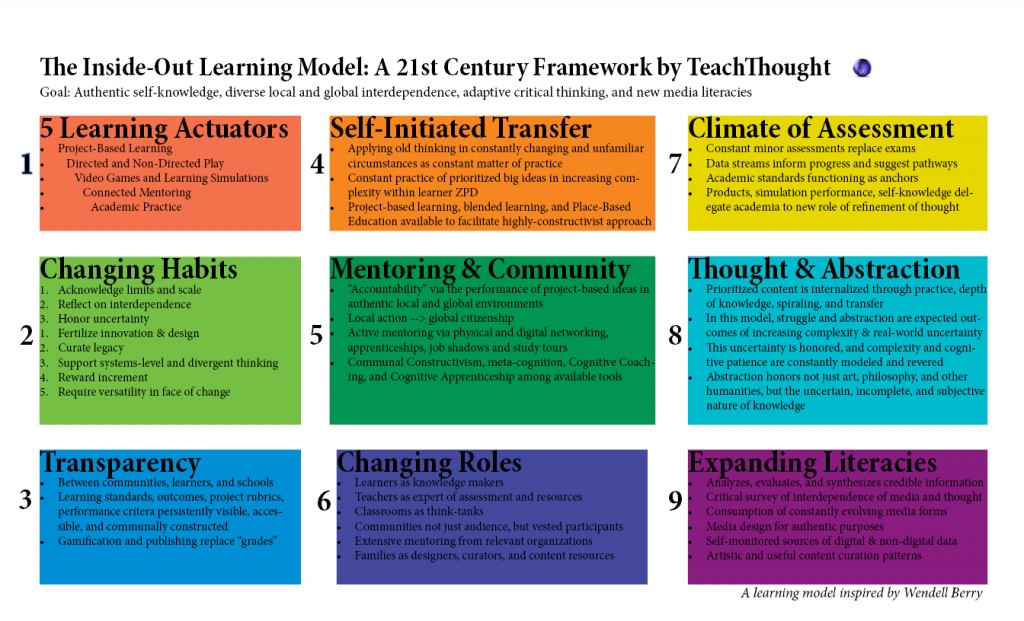
Ran across another great infographic and post, “The Inside-Out School: A  21st Century Learning Model,”  from Teachthought.com.

Here’s the infographic:

More on this later, but I particularly want to point out #7: Climate of Assessment. The first bullet point is, “Constant minor assessments replace exams.”

This is what I see happening in education reform – the move to continual formative assessments, rather than one big culminating assessment, such as an exam or final exam. I suppose people argue that the final exam is a way to make sure the student retains all the content from the term, but I wonder if this is ever really successful. I’d think a more successful model for ensuring a student retains content is to constantly build on it, week after week. Cramming for one exam doesn’t ensure that the content is learned beyond the exam. Yet, working with content, either building on it or doing more project based learning where the content is lived, may better ensure that the content sticks.


Do What you Love!

At the 2012 ISTE conference, the concept of “Passion” was prevalent. Kids should work on something they’re passionate about, as it leads to self-directed learning, and those 21st century skills.

I was thrilled to see this article in the StarTribune, “Stop being average and start being extraordinary.” It’s a conversation with Phil Cooke, who wrote, “One Big Thing: Discovering What You Were Born to Do.” Basically, he says to find the things you love to do, and quit spending time doing things because you think you’re supposed to do it.

His example is to think about what you enjoyed doing when you were 10. While you might be able to make a living doing exactly that, you should be able to find something from that.

It makes me think about my kids and their friends. Some of them work so hard on things that they don’t like, but the whole college admissions thing makes them think they have to do so. Do they really need all those AP classes? Don’t get me wrong, that is exactly what some kids love to do, so they should. But not all kids.

My daughter is currently making some decisions about classes: stay in the AP classes, how much math/science to take, etc. While I won’t make a decision based on one article, this article would seem to support not doing that, and instead spending time on what feeds her passion: music, artc, creativity, etc. I’d be ok with that.

Here are his points for doing what you love:

  • Stop focusing on your flaws.
  • Don’t let others tell you what you should do.
  • Embrace change.
  • Don’t burn bridges.

Then there certainly are some adults I know who should also think about this!

Crash Course

Ok, how have I not seen these Crash Course in World History videos before? These are truly magnificent. I think I learned more about the Industrial Revolution in this 10 minute video than I ever learned in a college class…. or at least this video made it more memorable!

These videos are a brilliant example of how to engage 21st century learners:

  • The videos are obviously very visual, relying on sophisticated graphics and historical imagery.
  • They are short, only 10 minutes. (They sure pack a punch in 10 minutes!)
  • They relate the past to the present, creating a real world learning situation.
  • The videos ask critical thinking questions that could lead to class discussion and more.

I could so easily see how these could be incorporated into history classes. The content is delivered very rapidly, and is actually a pretty good level. You could use these with middle school with support, and easily with high school.

World History Textbook

Does this look enticing for a 21st century visual learner?

Remember when I posted pictures of the textbook my daughter is going to use in her World History this year?

I’m not saying these videos should be the sole curriculum of the class, but geez, which method of learning do you think most students would engage with more? I certainly hope that I hear that her AP World History class is using other media BESIDES the photo at right.

21st Century Learners: Videos

I am doing a presentation about 21st century learners to a group of museum professionals. They likely will not have had much exposure to the concept, so we’re starting at a very basic level.

I will, of course, include interactive elements in the session, including digital tools like Poll Everywhere, and plain old group conversations.

I’m also looking for some short videos that illustrate some of the concepts of the 21st century learner. Since I’m always looking for good videos about this, I thought I’d make a post linking to them.

This is just a quick start. I know there are more. I would love suggestions!

1. A Vision of K-12 Students Today
I think this is one of the first ones I saw. It’s getting a little dated (it’s only 5 years old!) but does clarify some of the basic concepts.

2. Rethinking Learning: The 21st Century Learner – The MacArthur Foundation

This is a trailer for a 60-minute documentary about 21st Century Learners from PBS.

Quote: “Part of the opportunity here is learning the content, which is very much the 20th century idea of education. In the 21st century it’s learning the tools and the skills of remaking that content and becoming the creator and the producer.”

Thought: Museums can be part of the informal learning to link to the formal learning.

Students prefer Print?

Great post by Technology in Music Education today about a study that shows that college students prefer print books to e-textbooks. I attended a session at the MN e-Learning Summit in July presented by the folks at the U of M that shared the same impressions – that students didn’t use the interactive features, they preferred print, etc.

I have two main comments:

  1. What was not shared in the Chronicle article (and another summary article I saw about this but can’t find at the moment) is that the folks at the U has similar thoughts to what Chris expressed in his post: students and professors haven’t been exposed to these tools, and need to learn how to use them. I was happy to hear the U folks saying this, because it’s SO totally true.
  2. The U of M folks also expressed that the e-textbooks they used were not, perhaps, quite ready for primetime. There were some issues with the reader and it sounded like the e-texts were pretty much pdfs online, with minimal interactivity.

Students

As Chris said, students and professors tend to stay with the familiar. These college students were trained in school to learn with certain tools. They know these tools, that’s their comfort zone. I saw this in an experience I had with an undergrad class last year. In a group of about 40 students, not a single student used a device to take notes. They actively expressed skepticism about e-texts — until they did more research and watched 6th grade students using our iPad app!

I also see this with my kids and their friends – both the 7th grader and the 10th grader. Kids stick with what they know and how they’ve been taught. I’ve asked high school kids if they want digital curriculum, and they have all the same reasons we hear that they don’t: not everyone has a device, they prefer print, etc. We can’t always rely on the students to lead. Sometimes, they need to be taught – shown – different ways of learning. In my cynical state, it’s just a sign of how they are trained in our current educational system.

E-Texts

I totally concur that the e-text industry isn’t ready for prime time. I’ve done a great deal of looking at digital textbooks and curriculum. I have yet to see tools that really take advantage of the medium and aren’t basically moving print to digital. Fortunately, not all are just pdfs online, but they still have a ways to go.

Learning for Yesterday

I popped into a virtual conference today to hear a keynote by Mark Prensky. He was his usual irreverent self. I do enjoy his keynotes, and appreciate his commitment to education and his ability to justify the use of technology.

For example, he said that denying a student’s use of technology is denying the child’s birthright as a 21st century citizen. Why? We sure don’t deny adults the tools, so why should adults deny a student?

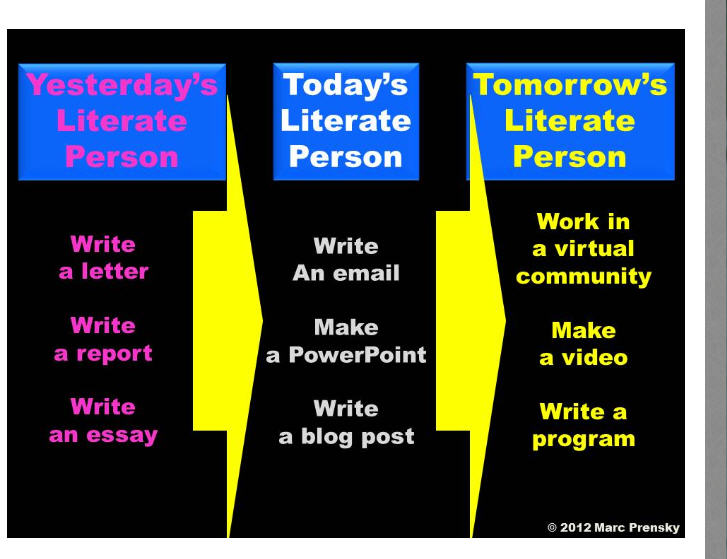
I also loved this slide showing the evolution of a literate person. I concur. If I was hiring staff today, would I look for the highest test score? Would I look for the best 5-paragraph essay? Nope. I’d look for the person who could create a video, deliver content visually, could be creative and think differently. Making a video requires even higher developed critical thinking skills, it means the student has to think not only in text, but in visuals. It’s far more difficult than that 5-paragraph essay. Bring it on!

Marc Prensky’s vision of a Literate Learner. Don’t teach for yesterday. Teach for tomorrow.