Jobs and Why we NEED Tech in Schools

Very interesting article in Quartz by Christopher Mim today, “How the Internet is Making us Poor” about how jobs are changing due to technology changing. While this is nothing new (such as the examples about agriculture and manufacturing jobs), the pace at which this is happening with technology is significantly faster.

What’s changing? Society is basically dividing into two groups,  “People who tell computers what to do, and people who are told by computers what to do.” Mim goes on to explain why this is decimating the middle class, etc. In fact, he points out, many of the jobs where people are told what to do are disappearing as well (he uses Amazon as an example.)

My point with this is then why schools must start using technology – and not just using tech. They must start teaching differently so these kids are prepared to be those who tell computers what to do. This isn’t learned by taking standardized tests, either.

I had a great conversation with a decision-maker at my local district today. I am thrilled to report that the district has taken great strides to incorporate tech, and for the right reasons. High on the list was a way to equalize the playing field. This district has changed quite a bit in the last few years, and there are many refugees and families on free/reduced lunch. Kids who do not have access to tech at home deserve to learn it in school.

All kids deserve to be learning this way in school, or we’ll have more and more of those people who are told what to do by computers.
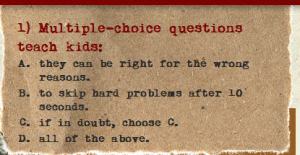

No More Bubbles!

Image from Beyond the Bubble

I have previously expressed my dismay with the amount of multiple choice tests I see at my daughter’s high school — the “Scantron” tests. Even then name says something…..  Tron? Seriously?

I’d post some of the questions from her tests, but the tests aren’t allowed out of the classroom! When I have seen them, the vast, vast  majority of the questions are, as described below, random fact recall. When I’ve asked teachers why they need to ask these questions, it’s because the “kids need to know this by memory to access higher level classes.” Wow – I’m doing professional history, and I couldn’t answer some of the definitions/rote memory questions on those tests, yet I am successful. I could, however, find those answers in seconds because I know where/how to look, how to analyze sources and how to think creatively.

It was with great pleasure that I found  Beyond the Bubble today. This is an alternative history assessment concept, based on Library of Congress primary sources. I have to dig a little deeper, but at first glance, I love the concept. Assessment based on direct primary source analysis, not rote random fact recall.

Check out their amusing little video:


Bring Your Own Learning Technology – or Pencil

Bring Your Own Learning Technology

I saw that phrase in an article from the Columbus, Ohio paper about schools using cell phones in class. It’s a great way to set an atmosphere in a school about cell phone use.

I’m sure not seeing this in my kids’ schools yet. One district is moving in that direction – they have a draft of a BYOT policy, and plans to move that way. However, in talking to my daughters 5 teachers this trimester, it is very obvious that the mindshift that has to happen has not.

There are signs posted in each classroom about no cell phones. Teachers talk about how they confiscate phones that are out. When asked, teachers only talk about the distraction factor. (hmmm – maybe their class is boring?)

I also asked if they post class materials and schedules online. Wow. One teacher said he didn’t know how to, he’d never been trained. (Failure on the school’s part.) Another teacher told me – brace yourself – that it was important for students to learn to WRITE DOWN the assignments to get ready for college.

That shocked me to say the least. So, I got online and messaged a couple of friends who are professors. Yes, real professors at real community colleges, small liberal arts schools, and major universities. Guess what. ALL OF THEM use online course management tools. Every one of them posts class information, resources, schedules and more online. It is expected. Students manage to manage their learning – even with the horrible crutch of having the material online. I guess this high school teaching students to write things down – as opposed to teaching them to manage their learning online – is really getting them ready for college (uh, sarcasm mine.)  


Visual Delivery of Information should be the new 5 Paragraph Essay

In a recent post, I lamented my pathetic design skills. It is sad, and I truly wish I had a better sense of design, an ability to turn information into a visualization. I see many places where this would be an incredibly useful skill, both  in my job and in my volunteer work. Even in low-key meetings, using visuals can be far more powerful than a bunch of words  or a long talk. Yet, my presentation skills are amateurish at best. It’s rather embarrassing.

Our society has shifted tremendously to using visuals, and students need to know how to interpret them and create them. It’s going to be at least as important, if not more important, that writing the ubiquitous 5-paragraph essay.

Of course, content is king – it always will be – but presentation is becoming more and more essential. There are many other ways besides the written word to communicate ideas. Video, photography, art, infographics.

The tools are there, we just need to let the kids use them.  I have powerful photo and video editing software on my iPhone. Tools like iBooks Author, Keynote, Prezi and more are there to make polished looking presentations. Here’s a great post by Larry Ferrlazo about resources for creating infographics. Teach kids about the basic principals of design. Hire more art teachers to help. Let kids practice, experiment, fail, and succeed.

Make sure you show design-inept kids, like me, how to be successful. I was incredibly good at those 5-paragraph essays. I could whip them up in a heartbeat, probably never getting less than an A-.  In a world based on visual delivery of information, I’d have been a C student at best. Huh. Guess intelligence sometimes depends more on perspective than reality.

Visual Literacy

I just had the opportunity to review a presentation a colleague will show at a meeting tomorrow. He’s a visual artist, and it shows. He took a concept (a simplified content development process) and presented it using words and charts. It is powerful in its simplicity.

Why? Because of the visual impact of the simple, clean design. The choice of font and spacing makes a difference. The simple lines of the chart are more powerful than 1000 words.

This is exactly why the current educational system must move to teaching visual literacy as well as traditional literacy. Writing a five-paragraph has merit – to a point. But it must go further. The essay teaches how to format an argument. But now, just delivering an argument or content in words isn’t enough. Society has changed to rely on visuals more than just words. Our kids deserve to learn how to deliver content visually as well as with words.

Think about it. The content from this presentation will be delivered very effectively  in perhaps 5 minutes. What would happen if it was presented in a written form? Would you read it???

What My Kids Deserve

I attend ISTE for professional reasons because I develop digital content resources for students and teachers. I attend ISTE as a way to learn from the masters: from the teachers who are really cutting edge, who are leading the way in terms of building 21st century classrooms.

This year, I couldn’t help looking at ISTE as a parent, too.

My kids go to great schools, but they are schools in a very different places than the ones I hear discussed at ISTE. I go to ISTE and hear all these amazing, awesome teachers and what they’re doing in the classroom. I hear from the innovative administrators who are encouraging their teachers to think differently.  I then think about the situations where my kids are at: no phones in school, slow adoption of collaborative tools such as Google Apps, a few laptop carts or overbooked computer labs.

My kids – and all kids today – deserve to experience a 21st century classroom.  As I’ve thought about this, I have created a list of things I think kids deserve.

  • My kids deserve to go to a school that prepares them for their future – not for the future as we saw it 50 years ago.
  • My kids deserve to work with teachers and schools who are willing to step aside as the expert and become a guide.
  • My kids deserve teachers that become co-learners.
  • My kids deserve to learn in a place that understands that students don’t all learn the same way – that kids have different learning styles. Just because the teacher learns best by reading doesn’t mean my child does.  All kids benefit from learning by using different modalities.
  • My kids deserve to use tools that they use in the rest of their life. At home, my kids use the internet to find facts and resources. They use cameras and phones to communicate their ideas in many different ways. They deserve to be able to do that in school – and not in a lab. (See this excellent post, “Snapshot of a Modern Learner” by Mike Fisher.)
  • My kids deserve to be taught how to access and analyze information the way the world is moving, not the way the world used to be.
  • My kids deserve to be taught to be collaborative, like they are in the rest of their life, and like most of us do our work. My kids are social, they expect to be able to communicate with their friends and work together. Empower them to do this. Don’t call it cheating.
  • My kids deserve access to their learning 24/7, wherever they are. Make their class materials available. Make their assignments available online – not just when they’re in class.
  • My kids deserve to be able to express their learning in ways that fit them. Why can’t they do a documentary? Create a digital story?  Design an infographic? There’s no reason that the traditional ways of expressing knowledge are the only ways.
  • My kids deserve to learn skills that are in no way related to taking a standardized test. They deserve learning that isn’t just focused on that test.
  • Above all, my kids deserve to find their passion. They deserve to be in a school that introduces them to a variety of subjects, of learning and of skills. They deserve to be allowed to explore, be curious, try new things without the fear of a test or a score limiting them.

I plan to take these concepts to the school board and administrators. I want to build a positive relationship where these concepts can be discussed.

My thanks to the many ISTE teachers, administrators and bloggers who have modeled this type of education with your passion and curiosity. You’ve helped me develop these concepts and have helped give me the confidence to ask for these things for my kids – and all kids. You have set an example for others. Thank you.

Finally!

This year, my son is taking an Astronomy class at a three-week summer program. It’s intense – they are doing some tough stuff during these three weeks. My son loves it.

On the first day, he was so excited to tell me that the teacher told them to USE their camera on their cell phones/iPods!! The teacher told them to take pictures of the activities they do in class. Wow. He gets it!!

The kids are going to use the pictures to create a slide show for the Open House night  on the second-to-last day of camp. I think this is brilliant. Instead of the teacher taking all the pictures, let the kids! That way you see the class through their eyes – not the teachers. The kids have a task, a responsibility.

The teacher also encouraged the kids to show their parents the pictures. So my son does. It’s been a great way to get past the “What did you do today. Nothing.” conversation. Instead, I ask him to show me the pictures he took that day. We’ve had some great conversations, he’s talked a ton more than he would otherwise, and I’ve learned something. It would have been much harder to explain some of what they did without the pictures.

So, besides learning incredible stuff about astronomy, the kids are also learning digital citizenship, and 21st century skills such as communication and collaboration. In addition, they are using visual media to communicate – and since over 60% of this generation are visual learners, this fits right in.

So, thank you, Mr. Bullard. You get it.


Researching Searching

Ran across this study about how undergraduate students use online resources. No surprise – they found that students “…shop around for digital texts and videos beyond the boundaries of what professors assign them in class.”

Students are heavily accessing additional content – beyond the assigned content, and usually from “approved” types of sites, such as other universities or Khan Academy. But they often find them through Google, and prefer to find things on their own rather than ask librarians or teachers.

I’ve been researching how teachers think K-12 students find information. I see some of what this study says: kids look for videos and additional information as well as students using Google.

I’d be very interested in a study such as this on middle and high school students!