BYOD Discussed

Another interesting discussion on the ISTE Ning about students using their own devices in school.

There is good, healthy debate about this topic as I’ve been watching education reform and educational technology discussions over the last year. The “no way” arguments focus on the fact that not every has the tool, that there is no way to control distraction. When I bring up the topic with some schools (teachers, administrators, parents and yes, even students)  who do not encourage/allow device use, they all bring up these arguments. There is certain validity to these concerns.

However, whenever I’ve talked to a school who has moved in the direction of allowing/encouraging mobile devices or laptops, whether it is school provided or BYOD, I hear only good things and positive results. Sure, there are issues, but no issues that can’t be resolved, or that are new.

I don’t think I’ve run across reports of schools/districts who have discontinued allowing mobile devices or laptops because they found them too distracting or not serving the educational goals. One district I know of discontinued a laptop program for budget reasons, and the teachers and students were all very upset.

This school year will be telling, as it seems many many schools are moving to iPads. I will be watching closely for reports of schools/districts who back out of the 1:1 set-up and their reasons why.



Mobile Research

I watched a webinar yesterday by Shelley Terrell (@ShellTerrell) about using mobile devices for research. She had great tips and tools, a couple of which I knew about, and a couple of news ones I’m testing out. (The webinar was from SimpleK12, and I expect it’ll be up on their webinar archive soon.)

Some of the ones I’m familiar with include EasyBib, Posterous, Instapaper, DropBox, Wikipedia and Show Me. (These are all available for iOS and Android.)

New ones I’m testing include LinoIt and Newsy. I’ll also test Wikitude on my phone.

Ran across this  quote this morning, and it fits perfectly:

Students are “asked to do research on a desktop computer that absolutely has less processing power than the computer in their pocket.”

From “To Ban or Not to Ban: Schools Weigh Cell Phone Policiesby Audrey Watters on Mindshift.

But they’re Digital Natives!

Do we need to teach students about technology since they are digital natives?

Check out the discussion on iste.org.

I have to say I agree with the gist of most of the comments, and love this quote:

“Calling students ‘digital natives’ is an excuse for not actually teaching them about technology.”

Just because a child has grown up around these tools doesn’t mean they always know how to use them.

From watching my kids and their friends, it is obvious that kids have very different levels of fluency with technology, just like us “digital immigrants.”

BYO – 2011 Style

The thought of letting kids bring their own technology to school is enough to cause panic in most teachers, parents, technology staff — and even students.

Perhaps by listening to districts where they have these policies in place, we all can learn lessons.

In this blog post, Ken Royal interviews Jeff Crawford, Manager of Networking and Security at East Grand Rapids Public Schools, MI. The East Grand Rapids schools have had a bring your own devices program for many years. He discusses technical details, pitfalls and distinct benefits.

I was most impressed by Jeff’s statement that allowing student to bring their own devices allows students to use the tools that let them learn best. Students are given responsibility to determine the best way to demonstrate their knowledge, and to determine their own tools.  Isn’t that what will develop responsible, capable adults in the long run?

Adding up the Numbers

Two interesting sources of information about student use of technology floated across the social media channels today.

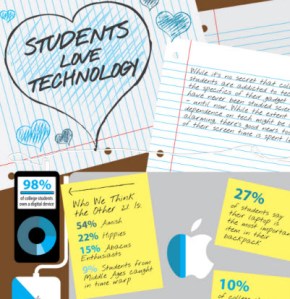
Student Technology Use Inforgraphic

Source: Mashable and onlineeducation.net

First, an infographic from Mashable about How Students use Technology. This one surveyed college students.

Second, a report commissioned by CDW about tech use in high schools.

They both say similar things: students are using technology – a lot. Most high school students use quite a bit more outside of school than in school. College students seem to be on some digital device over 9 hours a day.

We know that teens/young adults text like crazy. Neither group seems to use the tools they use to communicate with each other to communicate with their teachers. Only 14% of high school students use technology to communicate with teachers. About 90% of college students have emailed their teacher, but only 13% have contacted teachers with their cell phones. They must text each other, but rely on that old-fashioned technology of email to contact teachers.

The high school study asked students, teachers and IT staff for input. Some interesting changes in the last year include teachers identifying wireless internet as essential – does that mean a shift to allowing student-owned devices? laptops? tablets?

The number of schools currently using digital content (textbooks) is pretty low. The percent of schools evaluating using digital texts is much higher. It will be interesting to see how quickly that number goes up.

More on Facebook

Another great blog postby Chris Wejr (@mrwejr) about why your school should be on Facebook. He also refers to a book for principals, Communicating & Connecting with Social Media, on managing social media.The arguments are compelling.

Go check out the Facebook presence for New Milford High School. The principal is Eric Sheninger (@NMHS_Principal) is honest about his transformation to embracing social media. Look closely at that Facebook presence. It doesn’t look that hard once you take a look, does it?

No, you won’t reach every parent or student using Facebook. But do you reach everyone using paper? email? Probably not.

I’m just one example, but I know I’d see communications from Facebook much more reliably and quickly than I’d see paper notes. I could be notified instantly if there were a crisis at school. I would appreciate a reminder about conferences and concerts. I’d love to hear about other things going on — with a child at a big high school, there’s a lot I don’t know.