Taking Standardized Tests for a Living

No one I know takes standardized tests for a living. So, why are we using standardized tests to see if you’re going to be good when we don’t have standardized tests after you take them?

…It’s infected the entire ecosystem of education.

If we can get parents and kids and teachers and administration to talk about it…then change will start to happen.

-Seth Godin

This is a powerful quote for me to see today, as I’m heading off to a district curriculum meeting (a parent “advisory” committee, where, honestly, parent input is sought because they legally have to. I don’t think it makes one whit of difference, but if I don’t participate, I don’t get a voice.)

Tonight, we’re reviewing proposed Advanced Placement courses. I will likely be skewered when I say that I disagree with this approach. I don’t like AP classes because – and this is fully acknowledged – they are teaching to a test. AP classes give a set curriculum to schools that cannot be changed. AP classes are a mile wide and a centimeter deep. As a professional historian, I have worked against courses like this my entire professional life because students take these broad history survey courses and don’t like them. Thus, they think they don’t like history.

OK, that’s a blog for another post. This one is about standardized testing.

I’m an excellent test taker. Give me a standardized test about anything – nuclear physics, calculus, English literature, whatever. I could take it and probably do pretty welll. Do I know anything about the subject? Nope. But I can take tests.

I love this quote from Seth Godin. Check out the entire video posted in a blog by Josh Gans, “Learning Should Fit the Child.” (As Gans acknowledges, the video is by Ericsson and is a little bit marketing, but hey, it still has excellent content.) The video is worth your 20 minutes.

The blog post is worth your time, too. Memorizing isn’t useful. Learning how to find the information is useful.

Power


Unlearning Academic Writing

In this recent blog post, “Blogging is the New Persuasive Essay,” Shelly Wright argues that learning how to write for blogs is just as important (if not more so) as learning to write the ever-present 5-paragraph persuasive essay. I was cheering as I read this post!

Unteaching

In the last few years, I have spent quite a bit of time “unteaching” academic writing. My previous job was training people to maintain websites. Much of the coaching was about how to write for the web. The staff I work with are all college-educated, very well versed in that 5-paragraph persuasive essay. But guess what? That doesn’t work online, as Wright suggests.

Academic writing is the antithesis of good online writing. As Wright says, good blog – or web – writing has short, succinct paragraphs. Quotes and references can be just links. It’s important to not be long-winded. I’m famous around work for the saying: “Write it. Cut it in half. Cut it in half again.” (I cannot take credit for this saying. Credit goes to Ginny Reddish.) You need to think about how you write link text — it is NOT ok to write “click here.”

Images

Digital communication gives us many more tools with which to express our meaning, including images. It is important to include images to convey meaning or to add context to online communications. (I fully admit my blog is not a good example of this. I am a text-based learner, and am trying very hard to add visuals!)

This addition of visual communication opens up the world to many more learning styles. A student who may not be good at stringing words together may be brilliant at conveying meaning by putting visuals together, making a movie, or through music. Expressing meaning through these other modalities is no less complex – I would argue it involves far more higher level thinking skills than just writing a 5-paragraph essay. A documentary requires a script, visuals, and music. The same process has to happen: picking a point, forming a thesis, and supporting your thesis with evidence.

Responsibility

So why limit students to the 5-paragraph essay? I would like to hear a rationale for limiting a student’s means of expression to text when all these other tools are available. The excuse of “we’re preparing them for college” doesn’t hold water anymore (I’ve heard this excuse with my own kids.

It’s the opposite. We owe it to these kids to teach them to express themselves in many modalities. Yes, they should write 5-paragraph essays. They should also be assigned visual ‘persuasive essays,’ such as documentaries, photo essays, exhibits, speeches, etc.

As an employer/employee, I can’t say I’ve written many 5-paragraph essays in the last 25 years. Have I had to “persuade” someone about something? Of course. Have I had to support a point in a meeting or presentation? Of course. The skills of a 5-paragraph essay are essential – but so is learning to present it in 21st century communication styles.

Visual Learning is OK

I think one of the problems with moving to a more integrated technology framework at schools is that people think it implies that students don’t learn like they did before. Kids don’t read. Kids don’t focus. Kids don’t write. Kids don’t….. etc.

Somehow, there is the attitude that if kids aren’t learning like kids learned 20, 30, years ago, then it’s not valid.

But really, do any of us learn and consume information like we did 10, 20 years ago? I doubt it.

Look at newspapers – even if you read a printed paper (and I do – I get two papers delivered to my door every day), the newspaper is different than it was 30 years ago and certainly different than it was 50, 75, 100 years ago. Pictures were non-existent and very rare. Articles were much longer. Print was much smaller. That’s how people got information. Not now – photographs are prevalent, stories are shorter, fonts are bigger, infographics and maps visually represent information that wasn’t possible to communicate before.

How about YouTube? The viral nature of some videos is amazing. If you need to know how to do something? Kids will check YouTube before looking anywhere else. How to tie a tie? Much easier to communicate if you have a video than to describe in a book. Cooking? Same thing. Building something? Same thing. The instructional possibilities of using video are huge.

RSA Animate is a good example. These are excerpts from thought leaders with intricate drawings. Do the visuals detract? Absolutely not. They are a huge plus. Are they popular? You bet. TED Talks are another example. Video of thought leaders giving short, powerful talks.

The list could go on. How about art history classes? Are they still making slides? Or using collections found on many museum sites to build lectures?

So, why are schools (not every school/teacher, thankfully!) so resistant to meeting students’ learning needs through visuals? Why has coursework not moved in the direction of working with increasing visual learning? Why still rely on heavy print texts and assignments?

Moving to visual does not mean dumbing down.

Open Internet Tests

When I was in high school, we lived in fear of open book tests. They were  much harder than “regular” multiple choice tests. The teachers that gave them were also well known for asking us to really think and analyze.

Now, there are open internet tests! Seriously – what a great idea. This post by Jonathan Martin shows exactly why. A theater history teacher did an open internet test with great results. See the post for student comments – seems they all thought it was harder — and better.

…taking the time to think through as a teacher what kind of questions can we ask which will continue to be meaningful assessments when Google and Wolfram Alpha are available is, I think, a highly productive exercise, and, of course, will generate a more authentic assessment experience far more well aligned with the real world of professionals for which we are preparing our students

The teacher’s rationale for doing this test:

did I really need the students to regurgitate information or could I ask them to utilize  Internet resources and their class notes to compose essays based on questions that they helped craft?


It’s a great idea. It’s more closely aligned to what will be expected of them — yes, in college, and ultimately, in the working world. It’s teaching critical thinking, analysis, digital literacy, writing. The list gets long…. much better test of what students know and how they think than picking a letter on a multiple choice test.


The Positive Side of Dyslexia

Thanks to Diane Ravitch for the link to this great article about dyslexia. Many thanks to the author, Steve Dingledine.

The current movement towards using appropriate tools in the classroom, whether it is an iPad, Chromebook, laptop, whatever, is a step in the right direction of allowing students with dyslexia — or any other learning disability, difference, or even just students who learn best in different modalities (visual, auditory, kinesthetic, etc.) — the chance to really be successful in school. A learning difference should not equate not being successful at school and in life.

…many dyslexics have other cognitive skills in abundance, including visualization and intuition. They can also see problems and solutions in the big-picture frame and can detect obscure patterns in unique and, at times, revolutionary ways.

The education system owes it to these kids – those with dyslexia or any other sort of learning difference – to adapt the SYSTEM to the kids. The kids shouldn’t have to suppress or ignore their natural skills in order to learn.

Dyslexics and other non-conformists need time and space to grow within school contexts. Their creative genius and divergent thinking needs to be incorporated into classrooms and not stifled.Their teachers need to have the flexibility and freedom to nurture their strengths and talents while helping them to reach their potential on their terms.

Like the author of the post, I am a textual learner. His wife is dyslexic. My daughter has not been diagnosed with dyslexia, but has considerable trouble with text based learning. She is a strong visual learner. I really appreciated this thought:

Our society, unbeknownst to me beforehand, is heavily geared to text-based learning and work activities. The emphasis on reading text, which creates “winners” and “losers” through standardized tests and entrance exams…

My (many) previous posts about my daughter’s choice for an advanced social studies course next year have focused on the responsibility of the schools to provide an adequate education for all learners — not just text based learners. It’s going to be a struggle to get them to accomodate my daughter’s needs, but why should just the kids who are text based learners have access to the advanced content and be considered “smart?”

Hopefully we’ll see things changing as schools move more towards allowing and encouraging students to make use of technology tools and the paradigm shifting that happens (or should.)

Visual Learners and Digital Storytelling

The other 3 (human) members of my household are all visual learners. They see everything from numbers to dates to stories in their heads as pictures. My daughter sees all numbers, letters, days of the week, months, etc., as color. This is odd to me, as I am very much a word person. I don’t see pictures – I see words. (You’ll notice my blog is far more words than visuals.)

Yet, for my daughter especially, school is very much a word based place. She works twice as hard as a word based person to read – every word is turned into a picture.  Her move to the high school has just exacerbated this problem. If you’ve read previous posts, she wants to take Pre-AP World History next year.
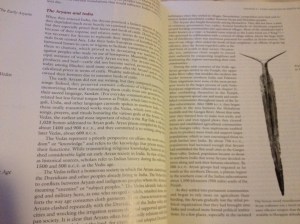
Does this look enticing for a 21st century visual learner?

We looked at the book – it’s deadly. Print. Pages and pages of tightly spaced words with no visuals. Class assessments are totally writing based – essay, tests, etc.

The teacher told me it was because it would be what the kids would find in college. I don’t disagree with the need to learn how to read advanced texts and be able to write essays. But is that really the only way to learn content and demonstrate understanding? Why does a high level history class have to focus on words only? Where are the visuals?

There are others who feel visual learning is valid. I just read a blog post about a teacher who has his students study a painting and read it as an essay about the time in which is was made:

He challenged students to think of a painting as an essay – in the sense that it captures not in words, as an essay does, but through a visual image, some aspect(s) of the life, history, and culture of a particular historical period from the point of view not of a writer but of an artist.

Awesome idea, and certainly a very valid way to learn concepts and history.

Another blogger wrote about the digital storytelling assignments she does with her high school students. In this case, students are given a topic and have about a week to put together a two minute digital presentation. Kids can use iMovie, Keynote, etc., anything that let’s them express their understanding of the topic in a digital mode. Visuals are considered key.

I would argue that these projects are a better assessment of a student’s understanding of a topic than a mere essay. If you check her rubric and watch the samples, you’ll see that the students aren’t slacking. They do have to write: no digital storytelling project would be complete without a script. They have to organize their thoughts in a storyboard. They have to also find appropriate visuals to express their ideas. They have to cite all sources. Some of the samples are more narrative or biographical, but you certainly could make these projects into something like a 5-paragraph essay with a strong thesis and supporting arguments. Like those who argue that giving students a public audience for blogs, the whole class watches the videos and is even quizzed on the content!

Digital storytelling can be used with all ages and subjects. The product doesn’t have to be a polished 2- or 10-minute video. Shelly Terrell writes about an online course she’s teaching (to 250 people!) about digital storytelling. She lists a number of quick ways to get started (such as having students pull out their cell phone and tell/write a story about a picture on their phone) and a myriad of resources for building digital stories.

I can easily see the problems in assigning a digital project like this: access to a computer lab, teaching students about the software, etc. But why not make it an option?

I know my daughter will gravitate to study fields that are more visual and less towards the word based content. I’m sorry that history, which she really enjoys, won’t be an option if her classes continue to be offered in these exclusively text based formats. The teacher next year thinks he’s really helping her by teaching her how to learn the way he thinks she needs to. I think he’d do her a lot more good by letting her express her understanding in a format that makes more sense to her.

Tough Choices

A follow-up to a previous post about my 9th grade daughter’s choices for classes for next year. Should she take Honors World History or the regular class?

The teachers had a curriculum night last week. It was a good chance to meet a couple of teachers and to take a look at the books used for the two options. I found out that the Honors class is basically an Advanced Placement class, but they can’t call it that. The books are both REALLY big and heavy (no wonder kids have back problems). The Honors book is very text based, and I think is a college level text. The class involves a good deal of reading, note taking, writing and tests. The class is like any AP class, preparing kids for the AP tests.

The book for the regular class included many more visuals, including graphics and photographs. I didn’t get many details about how this class functions, as the teacher who was there was an Honors teacher.

Neither course includes any online textbook, and the honors class uses very little outside resources (online or otherwise) and certainly never includes projects. In fact, the teacher looked down his nose at me when I even suggested such a thing. The online textbook will change probably for the class after my daughter, as I know the district is replacing its Social Studies curriculum. However, that doesn’t help her!

So, what to do? I need to email the teacher to get the textbook titles/publishers to see if we could find used copies or a digital version. If she had her own copy of the book, at least she could write in the book and wouldn’t have to carry the huge thing back and forth. My daughter loves history and social studies, and does very well. She deserves to have access to the higher level content of the Honors class. Yet, she’s not a kid that does well with strict, linear, traditional teaching. I’m not sure she’ll do well in an AP setting that is so focused on intense reading and regurgitating history facts and concepts.

She’s a visual learner who can express her learning much better in projects, like movies, performances, presentations than she does in tests. While yes, she needs to learn to write, does she need to learn to write for an AP test? Is this really a 21st century skill that will serve her best in her life? Are colleges really that focused on that kind of learning? Given what I’ve been studying for the last year, I’m not convinced that this is the best course.

Decision to be posted later.

eWriting

One of the criticisms people launch against using technology in schools is that kids aren’t writing or reading anymore. However, once you start looking at it, kids ARE writing and reading all the time. It just looks different from what the parents are used to seeing.

Yup, it looks different. Texting looks different. Facebook looks different. Blogging looks different. But kids are constantly consuming and creating content with these tools. It is up to adults: teachers, parents and others, to make sure kids know how to use critical thinking skills when interacting with this content. We need to teach it using the tools the kids are using all the time.

I recently heard about a current events class being taught at a local high school. What a great opportunity to teach reading, writing and critical thinking skills using newspapers, blogs, Twitter, YouTube,  etc., etc.! Yet, it turns out this class uses few online sources. I’m not sure why. Is it that the teachers aren’t comfortable with the tools/sources? That the administrators aren’t supportive? That the computer labs are so tied up with testing and other classes that they can’t get in? I’m not sure, but what a disservice to these kids.

In the last couple of weeks, I’ve seen quite a few posts about writing: blogging, eBooks, etc. Perhaps by showing more evidence of the value of online sources actually promoting reading and writing rather than detracting, we can get more adoption and inclusion of online sources.

Here are a few examples:

Langwitches Blog: This blog writes extensively about reading and technology. Here are a couple recent posts:


Creating iBooks or eBooks  from “Learning and Teaching with iPads”