
Contradiction

Last week, I experienced a morning of contradictions.

I was asked to present at an Apple iPad event that happened to be hosted by our school district. I presented about the work I’m doing with digital content.

The audience included all the administration folks I’ve been (unsuccessfully) talking to about allowing personal devices, integrating technology into the classroom, and strengthening 21st century skills.

The opening talk illustrated my contradiction. The Apple education rep gave a motivating presentation about exactly why devices should be part of the classroom. She focused on the learning, not on any devices.

She talked about the reasons for needing change. The learning style of millennials: immediate, random, social, collaborative, experiential, exploratory. She talked about gamification, and how it impacts education with its reward – not punishment – of failure. How do we learn games? By failing. We try again, and again.

She referenced the eSchoolNews from Sept 2011, about what kids want from school:
5. To work with interactive tech
4. Their teachers to be mentors
3. Learning to be interesting
2. To have choice
1. To do real and relevant work

I was so very happy to have all these administrators at the session. Hopefully, hearing this from “legit” people – not someone who is just a parent – will help. Keeping my fingers crossed.
Independent Study?

As I struggle with what I see happening in education through my work as compared to what I see happening in my daughter’s classes, I have to come to some place of peace. It isn’t easy to hear about kids doing video lab reports, and then seeing my daughter’s fill in the blank worksheets.

She’s frustrated too, although for a different reason. She is not the kid they built traditional schools for. She thinks and communicates in pictures, not words. She sees all the letters, days of the week, and months in color. To her, numbers have spatial relativity. While I don’t know if her synesthesia has any impact on how she learns, I can’t imagine it helps in a world based on print and linear thinking.

We came up with an action plan that feels right to both of us, at least for one class.

She is taking French 2 right now. Tests and based on minute concepts in grammar. Points are taken off for spelling or accent errors. Vocabulary is a game of rapid memorization. These are not her strength. Yet, we know she can learn new language quickly and easily, as she has done repeatedly. She frequently sings in other languages, usually its Latin, French, German or Italian.

We have decided that she’ll do the 2nd trimester (at her school 2 tris of a class equal a full year) of French as independent study. I was a licensed French teacher, and can easily help and direct her. We have already identified community and online resources that can help her learn. We have project ideas that are engaging, use new language concepts, reinforce vocabulary and grammar, as well as use all four language components: speaking, listening, reading and writing.

Now, the challenge will be to get cooperation from the school. Fortunately, there is a law in our state that allows partial homeschool based n curriculum review. Allowing independent study means the district keeps all her money. If they don’t allow that, then we’ll go the partial homeschool route – which they cannot deny – and they lose state payment for that course.

Will keep you posted.

It’s all about the Points

It’s nearing the end of the trimester at my daughter’s school. She is diligently, if reluctantly, looking through the online grading system to see where she’s at. It’s been a difficult trimester academically.

The conversation is always about getting her grades up – a good thing? I suppose. But the conversation is never about learning. It’s all about getting points. School focuses on the need to get grades up, not on learning.

No More Bubbles!

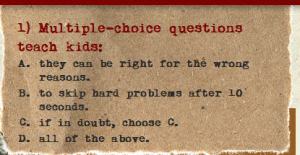
Image from Beyond the Bubble

I have previously expressed my dismay with the amount of multiple choice tests I see at my daughter’s high school — the “Scantron” tests. Even then name says something…..  Tron? Seriously?

I’d post some of the questions from her tests, but the tests aren’t allowed out of the classroom! When I have seen them, the vast, vast  majority of the questions are, as described below, random fact recall. When I’ve asked teachers why they need to ask these questions, it’s because the “kids need to know this by memory to access higher level classes.” Wow – I’m doing professional history, and I couldn’t answer some of the definitions/rote memory questions on those tests, yet I am successful. I could, however, find those answers in seconds because I know where/how to look, how to analyze sources and how to think creatively.

It was with great pleasure that I found  Beyond the Bubble today. This is an alternative history assessment concept, based on Library of Congress primary sources. I have to dig a little deeper, but at first glance, I love the concept. Assessment based on direct primary source analysis, not rote random fact recall.

Check out their amusing little video:


Pic Monkey

I found a new friend to make my life easier.

I do a fair amount of simple photo editing, like resizing, cropping, etc., for the various websites I help manage. It is not always convenient to go to my main computer to launch Photoshop, and who can afford to have Photoshop installed on all devices? 

Don’t get me wrong. I do love my Photoshop. But you don’t always need layers, effects and so on. However, some of the other “simple” photo editors don’t let me do the resizing and cropping the way I want. I want pixels, dammit! Don’t talk to me about 3 x 5 prints!

Pic Monkey to the rescue. A Chrome add-on or stand alone, Pic Monkey gives me pixels! Lets me resize, crop and edit happily.

I’m happy.


Link

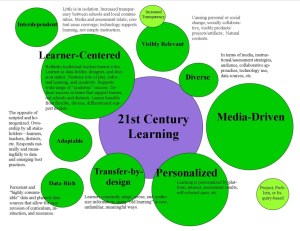
9 Characteristics of 21st Century Learning

Awesome blog post, “9 Characteristics of 21st Century Learning” today.

I am presenting a session at a museum conference about 21st century learners. This post is perfect! You can bet I’ll be referring to it (with attribution, of course.)

This infographic is excellent:

Infographic about 21st Century Learners

Infographic about 21st Century Learners. By Terry Heick, TeachThought. Blog post at http://www.teachthought.com/learning/9-characteristics-of-21st-century-learning/.

Off on our DIsruptive Adventure

Last spring, my husband and I decided that we would get our son (7th grade this fall) an iPad to have at school. His school has made some steps in the right direction: Google Apps, laptops for the teachers (FINALLY), but most important, their pedagogy is already in the right place – for the most part.

His school is very much about student centered curriculum, with students constantly creating things, working in collaborative groups, and building critical thinking skills through mostly project based curriculum. There are few tests, and he took his first standardized test in 6th grade – just to give them some practice. These things I like, and it is why we keep him there.

However, there is a pervasive attitude of NO CELL PHONES (yet a huge percentage of kids have them) and that technology is bad. While they did purchase a few iPads for teachers to work with this year, there was little, if any, professional development. One teacher told me he liked using it, but couldn’t possibly see how students would use it. Oh my. 

There is no official “BYOD” policy, but many kids do just that. So, we are going to as well. It’ll be an iPad.

I’ve told my son that by getting this device, he agrees that he will experiment with doing assignments differently than he’s told. (For a rule follower, this will be hard!) We’re going to work together on some homework, and if we feel that more learning would happen using the iPad, we’ll do that.

He’s also agreed to let me blog about it. So, here’s to more posts about our new disruptive adventure. 

Learning 2.0 Conference

Awesome conference this week — it’s FREE and VIRUTAL, so no need to travel. I’ve listened to a couple of sessions and keynotes while doing other work. 

While the live sessions are the best, the sessions are all recorded so you can listen to the ones you miss. (It’s a long conference!) 

I watched Marc Prensky’s keynote on Tuesday. He was, as usual, full of good quips:

  • everyturned off device is a turned off mind


  • every day we discourage use of tools is a day we deny kids their birthright as 21st century citizen.

I also participated in a great session by Peter Young at San Jose State University about research he’s doing on effective digital content delivery. It was a fun session with fun conversation and questions. There isn’t much solid research about effective delivery, so it is great to have this resource. For example, do you know the optimal podcast length and why that is?

Learning without Tests

Can kids learn without having to take a test to prove it? In spite of what No Child Left Behind has us believe, yes, yes they can.

I recently had the pleasure of being a little involved with a theater project for high school students.  It was ambitious: pull together two very different groups of kids and have them produce a play. The two groups included recent arrivals to the U.S. and American-born teens. 

The refugee kids have been in the U.S. for a year or less, and many speak very little English. They have some horrific stories to tell. The American-born kids have their own stories to tell. Can these two groups possibly work together to not only make a production, but to also learn something?

The production ended up being quite good. Was it polished and professional? Of course not. Was it still an amazing show? You bet. But more important than the fact that they did end up with a great final product, the process was an incredible learning experience, with learning that could never ever be measured with a standardized test.

What did they learn? You name it: communication, creativity, cooperation, critical thinking, empathy. The kids had to communicate without having common oral language. They had to cooperate to create scenes, lines and a coherent story. They had to be creative to do all this without props or sets. They had to tell a story without using their own language.

There were some poignant scenes: how many languages do the refugee kids speak? How about the American-born kids?  What foods do these kids like? How can anyone not like pizza? How would you survive if you were stranded on an island? 

Think about this — if you asked these kids in 5 or 10 or 15 years, which experience do you think they’ll remember and think had an impact? This theater experience, or a class filled with tests?

I know which one I’d rather have my for my kids. Participating in the arts is an amazing learning opportunity that teaches skills kids need throughout their life, not things they learn and forget the day after the test.

The Modern Learner

I’ve posted quite a bit about the 21st century learner – -traits we all see: visual, social, bits of information, etc.

Here’s a great description of a fictional “modern learner” by Mike Fisher.

Outside of school, he doesn’t separate technology from other activities. For him, it is air or water, something that he doesn’t really think about because it’s always available.

Go read the full post.