
Had a wonderful conversation about iPads with a couple of moms today…. putting this link here just so I remember to send it along: http://edudemic.com/2012/11/ipads-in-classrooms/
Finals
Posting this quote today for my high school age daughter who is taking a number of long multiple choice finals this week.
I guarantee that she will not remember what she learned for these tests more than a short time. If, however, she was able to build projects, research, create and communicate content, then she has a fighting chance to not only retain the content but to have learned a skill she can use with other content.
Make any book an Audio Book
Ran across this interesting video about making any iBook into an audio book.
Infographic of 21st Century Skills
Found this infographic from Med Kharbach of Educational Technology and Mobile Learning about 21st skills for students:
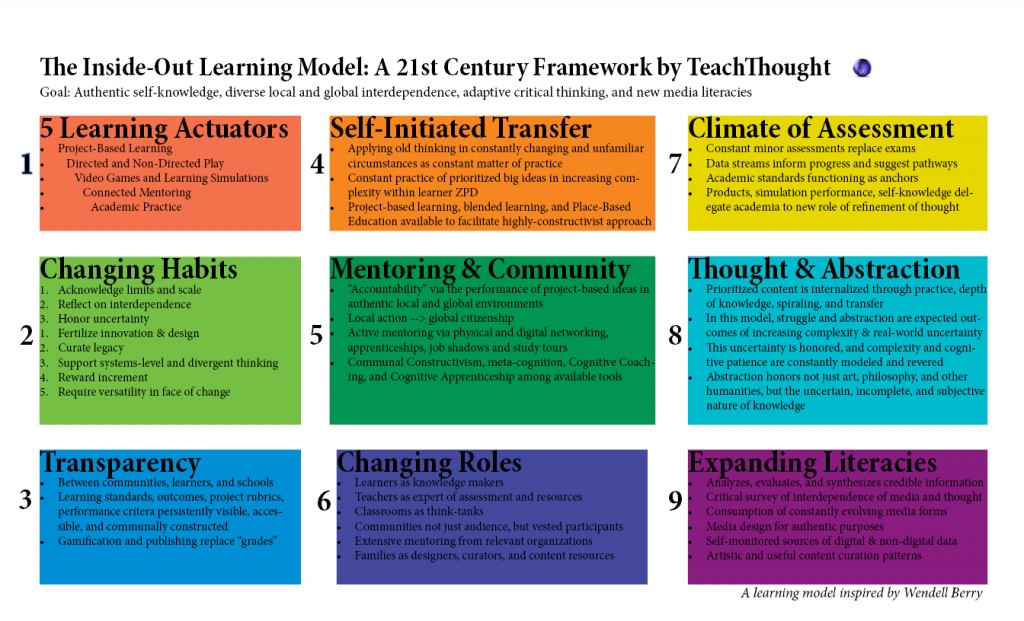
Ran across another great infographic and post, “The Inside-Out School: A 21st Century Learning Model,” from Teachthought.com.
Here’s the infographic:
From Terry Heick, TeachThought.com.
http://www.teachthought.com/learning/inside-out-school-21st-century-learning-model/
More on this later, but I particularly want to point out #7: Climate of Assessment. The first bullet point is, “Constant minor assessments replace exams.”
This is what I see happening in education reform – the move to continual formative assessments, rather than one big culminating assessment, such as an exam or final exam. I suppose people argue that the final exam is a way to make sure the student retains all the content from the term, but I wonder if this is ever really successful. I’d think a more successful model for ensuring a student retains content is to constantly build on it, week after week. Cramming for one exam doesn’t ensure that the content is learned beyond the exam. Yet, working with content, either building on it or doing more project based learning where the content is lived, may better ensure that the content sticks.
Contradiction
Last week, I experienced a morning of contradictions.
I was asked to present at an Apple iPad event that happened to be hosted by our school district. I presented about the work I’m doing with digital content.
The audience included all the administration folks I’ve been (unsuccessfully) talking to about allowing personal devices, integrating technology into the classroom, and strengthening 21st century skills.
The opening talk illustrated my contradiction. The Apple education rep gave a motivating presentation about exactly why devices should be part of the classroom. She focused on the learning, not on any devices.
She talked about the reasons for needing change. The learning style of millennials: immediate, random, social, collaborative, experiential, exploratory. She talked about gamification, and how it impacts education with its reward – not punishment – of failure. How do we learn games? By failing. We try again, and again.
She referenced the eSchoolNews from Sept 2011, about what kids want from school:
5. To work with interactive tech
4. Their teachers to be mentors
3. Learning to be interesting
2. To have choice
1. To do real and relevant work
I was so very happy to have all these administrators at the session. Hopefully, hearing this from “legit” people – not someone who is just a parent – will help. Keeping my fingers crossed.
Independent Study?
As I struggle with what I see happening in education through my work as compared to what I see happening in my daughter’s classes, I have to come to some place of peace. It isn’t easy to hear about kids doing video lab reports, and then seeing my daughter’s fill in the blank worksheets.
She’s frustrated too, although for a different reason. She is not the kid they built traditional schools for. She thinks and communicates in pictures, not words. She sees all the letters, days of the week, and months in color. To her, numbers have spatial relativity. While I don’t know if her synesthesia has any impact on how she learns, I can’t imagine it helps in a world based on print and linear thinking.
We came up with an action plan that feels right to both of us, at least for one class.
She is taking French 2 right now. Tests and based on minute concepts in grammar. Points are taken off for spelling or accent errors. Vocabulary is a game of rapid memorization. These are not her strength. Yet, we know she can learn new language quickly and easily, as she has done repeatedly. She frequently sings in other languages, usually its Latin, French, German or Italian.
We have decided that she’ll do the 2nd trimester (at her school 2 tris of a class equal a full year) of French as independent study. I was a licensed French teacher, and can easily help and direct her. We have already identified community and online resources that can help her learn. We have project ideas that are engaging, use new language concepts, reinforce vocabulary and grammar, as well as use all four language components: speaking, listening, reading and writing.
Now, the challenge will be to get cooperation from the school. Fortunately, there is a law in our state that allows partial homeschool based n curriculum review. Allowing independent study means the district keeps all her money. If they don’t allow that, then we’ll go the partial homeschool route – which they cannot deny – and they lose state payment for that course.
Will keep you posted.
It’s all about the Points
It’s nearing the end of the trimester at my daughter’s school. She is diligently, if reluctantly, looking through the online grading system to see where she’s at. It’s been a difficult trimester academically.
The conversation is always about getting her grades up – a good thing? I suppose. But the conversation is never about learning. It’s all about getting points. School focuses on the need to get grades up, not on learning.
No More Bubbles!
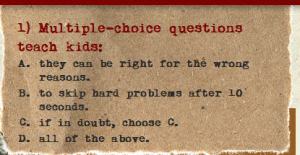
Image from Beyond the Bubble
I have previously expressed my dismay with the amount of multiple choice tests I see at my daughter’s high school — the “Scantron” tests. Even then name says something….. Tron? Seriously?
I’d post some of the questions from her tests, but the tests aren’t allowed out of the classroom! When I have seen them, the vast, vast majority of the questions are, as described below, random fact recall. When I’ve asked teachers why they need to ask these questions, it’s because the “kids need to know this by memory to access higher level classes.” Wow – I’m doing professional history, and I couldn’t answer some of the definitions/rote memory questions on those tests, yet I am successful. I could, however, find those answers in seconds because I know where/how to look, how to analyze sources and how to think creatively.
It was with great pleasure that I found Beyond the Bubble today. This is an alternative history assessment concept, based on Library of Congress primary sources. I have to dig a little deeper, but at first glance, I love the concept. Assessment based on direct primary source analysis, not rote random fact recall.
Check out their amusing little video:
Do What you Love!
At the 2012 ISTE conference, the concept of “Passion” was prevalent. Kids should work on something they’re passionate about, as it leads to self-directed learning, and those 21st century skills.
I was thrilled to see this article in the StarTribune, “Stop being average and start being extraordinary.” It’s a conversation with Phil Cooke, who wrote, “One Big Thing: Discovering What You Were Born to Do.” Basically, he says to find the things you love to do, and quit spending time doing things because you think you’re supposed to do it.
His example is to think about what you enjoyed doing when you were 10. While you might be able to make a living doing exactly that, you should be able to find something from that.
It makes me think about my kids and their friends. Some of them work so hard on things that they don’t like, but the whole college admissions thing makes them think they have to do so. Do they really need all those AP classes? Don’t get me wrong, that is exactly what some kids love to do, so they should. But not all kids.
My daughter is currently making some decisions about classes: stay in the AP classes, how much math/science to take, etc. While I won’t make a decision based on one article, this article would seem to support not doing that, and instead spending time on what feeds her passion: music, artc, creativity, etc. I’d be ok with that.
Here are his points for doing what you love:
- Stop focusing on your flaws.
- Don’t let others tell you what you should do.
- Embrace change.
- Don’t burn bridges.
Then there certainly are some adults I know who should also think about this!
 My Wired Life