
Adolescence is an Opportunity

Great video from another 21st century learning organization, Born to Learn.

What if schools could teach through play? If adolescents could learn through doing things and creating things, rather than sitting in rows of desks?

From the minute my oldest child started kindergarten, it seemed so obvious to me that the model of age-based, teacher-led classrooms was outmoded. Why should kids sit quietly in neat rows? My son once observed that the biggest thing he learned in kindergarten was how to walk in lines. Huh.

My 14-year old daughter had a great opportunity to volunteer at a local children’s museum this summer. She learned more about herself, about child development, confidence and potential life skills than she’d ever learn in a regular classroom. Why can’t more opportunities like this exist?
Adding up the Numbers

Two interesting sources of information about student use of technology floated across the social media channels today.

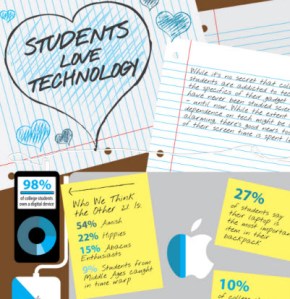
Student Technology Use Inforgraphic

Source: Mashable and onlineeducation.net

First, an infographic from Mashable about How Students use Technology. This one surveyed college students.

Second, a report commissioned by CDW about tech use in high schools.

They both say similar things: students are using technology – a lot. Most high school students use quite a bit more outside of school than in school. College students seem to be on some digital device over 9 hours a day.

We know that teens/young adults text like crazy. Neither group seems to use the tools they use to communicate with each other to communicate with their teachers. Only 14% of high school students use technology to communicate with teachers. About 90% of college students have emailed their teacher, but only 13% have contacted teachers with their cell phones. They must text each other, but rely on that old-fashioned technology of email to contact teachers.

The high school study asked students, teachers and IT staff for input. Some interesting changes in the last year include teachers identifying wireless internet as essential – does that mean a shift to allowing student-owned devices? laptops? tablets?

The number of schools currently using digital content (textbooks) is pretty low. The percent of schools evaluating using digital texts is much higher. It will be interesting to see how quickly that number goes up.

All Children Left Behind

The No Child Left Behind law has, according to many teachers and administrators I’ve talked to, directly impacted the type of education in public schools. For example, one school I’m familiar with used to have a staff person who coordinated a series of arts residencies, assemblies, and a creative, innovative program that encouraged kids to explore different, unfamiliar topics. This staff person now works ONLY on coordinating testing. No more arts residencies. Many many fewer arts related assemblies. No more creative, innovative exploration outside of the traditional classroom structure.

I was pleased to see that Minnesota is applying for a waiver for NCLB. At first I was REALLY excited — no more NCLB! Well, it’s not that great. It’s only because Congress can’t agree on reform of the law. Many schools run the risk of penalties or closure — many GOOD schools are in danger because of this crazy law that mandates test, test, test. Maybe these waivers will highlight some other, more effective tools for accountability so NCLB can finally go away!

I’d love to see the whole darn thing dismantled and let schools be more creative. Teachers spend hours teaching kids to succeed on tests.  Those hours could much better be used teaching kids to think. Can’t remember the last test I took in my daily life…..

More on Facebook

Another great blog postby Chris Wejr (@mrwejr) about why your school should be on Facebook. He also refers to a book for principals, Communicating & Connecting with Social Media, on managing social media.The arguments are compelling.

Go check out the Facebook presence for New Milford High School. The principal is Eric Sheninger (@NMHS_Principal) is honest about his transformation to embracing social media. Look closely at that Facebook presence. It doesn’t look that hard once you take a look, does it?

No, you won’t reach every parent or student using Facebook. But do you reach everyone using paper? email? Probably not.

I’m just one example, but I know I’d see communications from Facebook much more reliably and quickly than I’d see paper notes. I could be notified instantly if there were a crisis at school. I would appreciate a reminder about conferences and concerts. I’d love to hear about other things going on — with a child at a big high school, there’s a lot I don’t know.

Who’s on Facebook?

Is your school on Facebook?

Why not?

Eric Sheninger thinks you should think again. He went from a strong no social media policy two years ago to fully embracing it. He speaks eloquently (at last week’s #140edu conference) about why your school should also be there.

  • Communications: makes it far easier to communicate with stakeholders, such as parents, community, students
  • Public Relations: way easier to toot your horn on Facebook than to get an article in the paper. There might be negative comments? Well, of course. Those conversations are already happening. Wouldn’t you rather they happened where you can address rumor and misinformation or explain the situation?
  • Student Engagement: he tells of significantly increased student engagement and performance in classes where social media and technology are being used. Don’t worry, everything being done MUST be based on sound pedagogy – it doesn’t mean just bells and whistles.
Check out The Nerdy Teacher’s blog post about Eric’s talk at the #140edu conference. Do what he says – watch Eric starting at 1:14:30. It’s worth your time.

We Want Change

“Can We Try It?”

A simple question from a group of kids resulted in this awesome video. A class of  middle school kids in Texas (see edevolution for more background) came up with the idea after reading a book, and asking a different question: “Could children, using the internet, have a dramatic impact on the world around them? ”

And, here’s their product: kids asking for change. It’s saying all the things I’ve been hearing: classrooms are like they were 100 years ago, kids want to collaborate, kids want technology.

This project in itself is a great illustration of what they are talking about: creativity, collaboration, communication. If you read through their blog, you can see how they put the project together. It empowered the kids, gave them “agency” – they feel like they could have an impact. Publishing to the public is an amazing motivator, and has proven to increase the quality of student work, and I think we see that here.

I agree wholeheartedly with them that they aren’t blaming teachers or any person in particular, but rather the “system.” It’s not one person’s fault, it’s a systemic problem. It takes a whole lot of energy to shift the movement of an elephant. But it has to start somewhere, and I thank these kids for doing this.

Kudos to the teacher and administration for being the guides and mentors to these kids.

Watch the video and read their blog. Then go show it to someone else and start a conversation.

(Hat tip to Sir Ken Robinson for tweeting this video.)

Teaching Responsibility

This follows from my previous post about schools needing to start teaching digital literacy/online responsibility, but now my thoughts are supported by others in the education community.

In their commentary, “Moving From ‘Acceptable’ to ‘Responsible’ Use in a Web 2.0 World” posted on Education Week, Jim Bosco & Keith Krueger encourage schools to move from the common “Acceptable Use” policies to a “Responsible Use” concept.

This concept would have districts rethinking how they incorporate and utilize these new technologies to “expand and enrich learning for our students.” They concur that there are many concerns, and that yes, students need to be kept safe online.  Yet, by refusing to allow students to work online in school, students are not afforded the incredible opportunity to learn to be responsible and critical thinkers of a tool that they use constantly outside of school, and will be using long after their formal learning is over. We owe it to our children to have school — the place we accept as where they learn and grow to become productive adults – also be a place that can help them learn to responsibly navigate the online world.

Banning mobiles etc., certainly is one way to keep kids safe. But truly, is that wise? Kids use them outside of school, and will use them once they are out of school. We are truly missing out on an incredible opportunity — not only to take full advantage of all the great things these digital tools offer, but to teach our kids how to avoid dangerous situations online and how to use critical thinking skills to determine what informaiton is accurate and what is not.

The authors refer districts to CoSN’s guide to Acceptable Use Policies – it is worth reading.

I close with the words of the authors that perfectly summarize this concept:

The great educational philosopher John Dewey gave us important advice: “If we teach today’s students as we did yesterday’s, we are robbing them of tomorrow.” Responsible use of the Internet is a critical aspect in the lives of our students today, as well as a vital ingredient in how they will live their lives after their formal schooling is done. The best we can do for students is to empower them to function responsibly in a world where they will have many choices.

Matt Damon Talks

This is hitting the rounds, but had share it here, too.

Matt Damon supports teachers!

His mom talks about the support Matt and his brother had for creativity at school. Where would they be today, had they been in a standardized testing environment?

I think I might follow his mom’s lead: refuse to let my kids talk standardized tests. It probably wouldn’t have an impact, but someone has to stand up.

Matt’s talk on YouTube