Doors Slamming Shut

Once again, Will Richardson’s blog inspires me. Well, it makes me mad – not at him, but again, at the public school system.

I’ve been saying for years that if you’re in education and you’re not feeling uncomfortable right now, you’re not paying attention. Our collective discomfort with the system should be growing. And the window for action is closing pretty quickly.

I have been uncomfortable with education for many years. Like Mr Richardson, I have two teenagers about to head out into the world. One graduates from high school in a matter of days. The window for her in K-12 is closed. It slammed shut a couple of years ago, although in retrospect, it had been slowly closing since entering public school. (It is one of my biggest regrets that we kept her in this school and didn’t move her. We first seriously considered moving her in 3rd grade. Oh, how I wish we had.)

The damage – and it is significant – has been done. Because she doesn’t learn in a way that fits the traditional mold, the message has been pretty loud and clear that she doesn’t measure up. I, however, see her as a creative, insightful person who has tremendous gifts. I can only hope her next stage of life rewards this instead of snuffing it out.

Teachers as Learners, not Teachers

Will Richardson is one of my favorite thought leaders in the education world. He has a new book out, which I will have to purchase and read. (“From Master Teacher to Master Learner.”)

Quick quote from his new book, as previewed on his blog:

Teachers must move their own practice in transformative ways toward a focus on learning, not knowing. That’s not to say that the need for knowing isn’t still important. (Though there’s a strong argument that there’s way too much curriculum to know.) But it does suggest that to best help our students become powerful learners in the modern world, they need teachers who are master learners as well.

Grade Level

Recent Huff Post article by Dan Peters, “Smart Shaming: Sorry but Your Child is Too Bright to Qualify for Help” hit home.

I get the limited amount of money, I really do. I also get that there are kids who need services “more” than others.

The real issue for us wasn’t so much the “services.” We were able to get a 504 with accommodations. We weren’t asking for anything that cost money or took any staff time. The problem was the pedagogy, assessment and expectations.

Most of the struggles came from doing tasks that will not be needed elsewhere: memorizing facts and spitting them back on tests, writing structured 5 paragraph essays and doing detailed math problems. There was little struggle in class discussion, creative projects or similar assignments.

Yet, the cumulative effect of failure or poor performance on the “essential” elements of how schools measure kids had a significant impact. She shut down. Motivation was gone. You can beat someone down for so long. That in itself is a disability and hurdle to overcome, along with everything else.

#ThanksJohnOliver

Long but very worthwhile piece about standardized testing and the role big $ corporation plays in it.

Our family has opted out of testing. My daughter did not take the standardized tests last year as a junior, and my son attends a private school that does not do testing. I will continue to voice my opposition to these tests even though my kids are done with them.

Why Do We Hold Students to Higher Expectations Than Adults?

This is a very well said observation. As a parent, I see that my kids need these breaks, yet school doesn’t give many – and certainly not in a way the kids can control. Breaks are on the school or teacher’s schedule. Why do we expect kids to always follow the adult schedule?

Pernille Ripp's avatarPernille Ripp

I told one class today that I was not there for their sheer entertainment.  I didn’t raise my voice, nor did I yell.  I simply stated it and asked them to step it up, to show engagement, to show me that what we were doing mattered to them because I could tell they were checked out and it made me unhappy.  And then we continued on with what we were doing.  Just another moment teaching 7th grade.

Yet, as it popped back into my mind, a seemingly insignificant moment from my day, I now see what a missed opportunity it was.  Not for another lecture, but instead to realize that these are kids that I am teaching.  Kids that we hold to insanely high expectations every single day.  Every single day, we expect full commitment in every subject matter.  We expect passion.  We expect interest.  We expect a willingness to…

View original post 468 more words

FAIL!

Anyone in this education 2.0 world knows the theories that gaming brings out a whole different approach to learning. My kids recently watched a TED talk (I think by Jane McGonigal) about gaming not actually being a waste of time. 🙂

IMG_1953Here’s a screenshot from a popular game my kids play. I don’t even know what it’s called, but I do see them trying over and over and OVER again to get past certain levels. While failure at school means a bad grade and the implied NO COLLEGE FOR YOU, failure at these games means pick yourself up and try, try again.

My daughter worked for six weeks to get past one level. She just kept trying different strategies and approaches. Talk about scientific method. Try one way, if it doesn’t work, try another until you get it to work. Was she frustrated? Sure. Did she give up – nope. She kept coming back until she figured it out.

I admit it cracked me up to see that FAIL! screen come up over and over again. It just so strongly flies in the face of the traditional approach to education. This tenacity of trying over and over again is never rewarded at school. I know the practical reasons, but I don’t like the outcome and what that teaches kids.

iPad Music

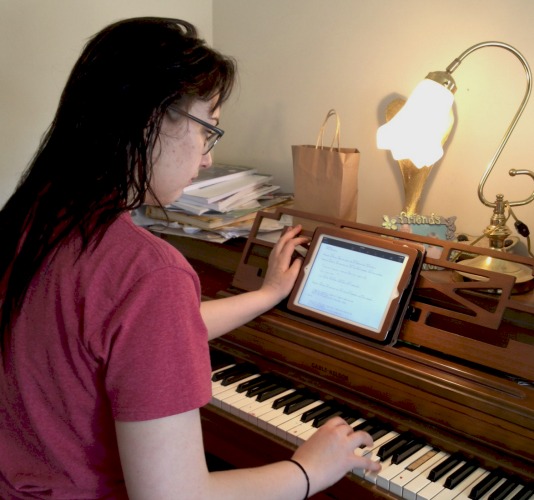
My daughter, a soon-to-graduate senior in high school, is taking a well-deserved change this last trimester. We purposefully encouraged her to cut back formal high school learning (which she eagerly accepted) and instead, to set up a trimester learning about things she wants to in ways that work for her. (Perhaps I will blog more on this plan in the future.) Less homework and less structured activities has not, as I feared, led to a rampant increase in Netflix.

One of her goals was to increase time at the piano. She’s no longer taking formal lessons, but loves to play on her own and work through piano and vocal pieces.  She’s been playing over an hour a day – which never would have been possible with a super busy high school schedule. This is good not only for her as a musician, but good for her mind and soul. It’s good for creativity. It feeds an area of her that is not met in formal school

pianoipadI heard her playing something this morning that I didn’t recognize. As I walked into the living room, I see her with her iPad on the piano. She found an app that had guitar chords and the lyrics for hundreds (probably thousands) of songs. She was taking this info and playing them on the piano. She was having to refresh her music theory skills to remember all the chords, figure out the melodic line and then make the songs more complex by changing the chords.

Definitely a worthy learning experience, and a lovely accompaniment on a Sunday morning!

Rising Testing Opt-Out Movement

The Opt-Out or Refusal movement is gaining traction. According to this article by Laura McKenna in The Atlantic, nearly 5% of students in some districts are refusing to take the tests.

She relates a personal story about students becoming part of the movement. Of course kids are going to ask parents to let them miss the test. This is excellent — as long as students know why they are refusing the test. It’s not to have a morning off. It’s to let decision makers (which usually is not at the district level. It’s at a state and national level) know that students want education that does not fit into a standardized test.

Students AND parents need to be part of the conversation about testing. It is not up to the companies that profit from it, and who do you think has better access the legislators?

These protests should also serve as a reminder for decision-makers that parents and students are stakeholders in education policy and that community outreach must be part of any reform.

Then, too, they must justify WHY we need the tests. What do they prove? What benefit do students gain from them?

Legislators should not be the ones making the decision alone — or with the testing companies.

Learning without Testing? Can it be so?

I’m taking another MOOC – big surprise! It’s about Content Strategy – one of my favorite concepts. It’s not a class about education – it’s a professional development class, with content that directly relates to the work I do.

Quote from the first lecture:

Since it is for professionals, there will be no grades and no tests. It’s not a college course. It’s a program for you as a professional to master, and then be able to use what you learn here and take it back to work. It’s knowledge that will improve your effectiveness….

Yes, you really CAN learn even if there are no tests or grades. Imagine that.