“Informal” Learning

My daughter despises her science classes at school. She’s never liked them. I had assumed it was the subject. But I’m not so sure.

Turns out she watches science videos on YouTube — for fun. For example, she loves the ASAP Science Series. Go ahead – watch and test your hearing.

Maybe it’s not the subject so much as the atmosphere….. Filling in the bubbles on tests, memorizing a bunch of random information and having to write meticulous, pre-scripted lab reports isn’t exactly exciting.

I don’t Like Testing

I don’t. I don’t like the reliance on standardized tests. I don’t like that my kids have to spend so much time “prepping” for tests. I see on my district calendar that kids are already testing…. I don’t like the fact that schools/districts have to have a staff person to coordinate the testing  – money that could be fund other types of staff, like teachers! I don’t like that my children are defined by the scores they get on the test.

I appreciated this article yesterday in Salon, “America’s Toxic Culture of Testing” by Luba Vangelova. I love the main quote:

Our country’s testing obsession benefits corporations, not kids.

That pretty much sums it up, although she has a number of other excellent points:

  • test prep eats time that could be used for other things – such as play
  • costs a great deal of money
  • teaches students that they can’t be “wrong”
  • labels kids
  • leads to a less creative environment

Just read the article.

Video

The Learning Revolution

I had the honor of hearing Jonathan Mooney speak recently. This is an excellent quick peek at his message of the need for a different look at education. We can no longer define intelligence as just reading, as the good kid is the one who sits still.

Just watch it. It’s only 7 minutes.

Extracurriculars

I ran across two things with opinions about “extra” curricular activities yesterday. I have lots of opinions about extracurriculars!

Yes, academics are important, but are they everything? I don’t think so. In my experience, it seems some of the better life learning lessons come from the extras. Like what? Like how to work hard, how perseverance pays off, team work, critical thinking, thinking on your feet, planning, and on and on. No, it’s not learning how to solve a calculus equation or what battles were in the Civil War or how to write a 5-paragraph essay. Those are important, but so are the other lessons that come from the extras.

First thing I saw yesterday was a blog post, “9 Ways a Theater Degree Trumps a Business Degree.” I don’t know this blogger, but I certainly liked what he had to say. Skills learned from a theater degree are definitely applicable in the “real” world. Being on time. Thinking on your feet. Being resourceful. Being a team player. and more.

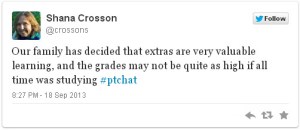
Second thing yesterday was #ptchat (a chat on Twitter. super fun.) The topic for yesterday was the balance between leisure and academics. The twitterverse lit up! I was happy to see lots of support from the teachers/admins in the chat for the extras. I was a little concerned by some of the emphasis on academics — that those always have to come first. There was some good conversation. (See the archives for all the tweets)

My input below:
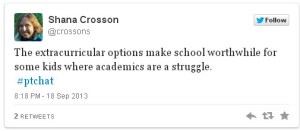
tweet1

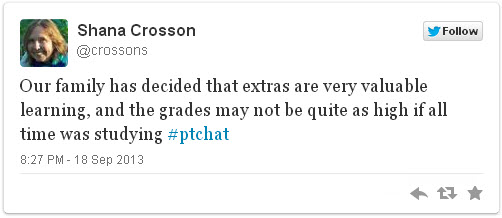
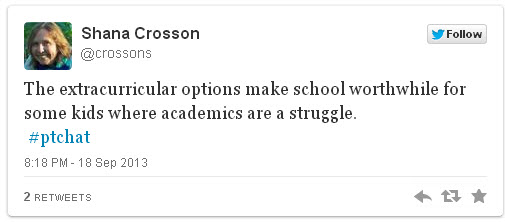
tweet2tweet3

More Thoughts about Multiple Choice

After my rant about multiple choice tests, I’ve noticed a number of other blog posts about multiple choice tests.

  • “In Defense of Multiple Choice Tests” by Natalie Barlett on Edudemic talks about the need to make choices in all aspects of our lives. She addresses a study that shows that multiple choice is a good tool to help students remember new and old info. She outlines a number of ways that well written multiple choice questions can be used in classrooms. 

    I don’t disagree with this — what I don’t like about the current multiple choice assessments is that there is so much weight put on these assessments, and that they are almost the sole measure of a student’s learning.

  • In “The Real Problem with Multiple Choice Questions” by Terry Heick on TeachThought, the issue is that they create the illusion of right v. wrong. In a world changing at a rapid pace, Heick sees this as the true problem with these questions.

…when a multiple-choice question is given to a student in hopes of measuring how well he or she understands something, it manufacturers the illusion of right and wrong, a binary condition that ignores the endlessly fluid nature of information.


Maps

Just a link to this great blog post about maps that has been circulating on Facebook for the last few days: 40 Maps that will Help you Make Sense of the World

I particularly like this quote acknowledging visual learners:

If you’re a visual learner like myself, then you know maps, charts and infographics can really help bring data and information to life. Maps can make a point resonate with readers and this collection aims to do just that.

Sacrifices

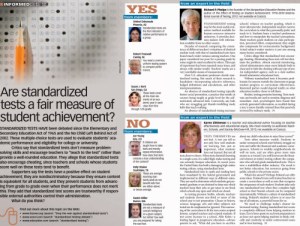
I read a fascinating discussion about standardized tests in an unexpected place — the Costco Connection. They asked the question, “Are Standardized Tests a Fair Measure of Student Achievement?”  (This issue also includes an article about Sal Khan and Khan Academy.)

Article from the August 2013 edition of Costco Connects

Article from the August 2013 edition of Costco Connection

The “expert” argument against the question was by a teacher and author, Karen Zittleman. I was particularly drawn to her argument that the pressure and reliance on the tests is unwarranted and is actually damaging.

She quotes Alfie Kohn, suggesting that parents question the level of standardized test by asking,

“What did you have to sacrifice about my child’s education to raise those scores?”

This is a perfect question. After hearing about three weeks being spent on test prep, computer labs restricted to testing and more, guess what I’ll be asking this year!!

Will Smartphones replace our Memory?

After my post about Google and multiple choice tests, I was pointed to this article by David Pogue in the Scientific American Magazine, “Smartphones Mean You Will No Longer Have to Memorize Facts.”

I’ve been challenged on the thought that I’ve said that kids don’t need to memorize facts. (I never actually said that — just said that memorizing facts shouldn’t be how we base assessment.) I do love this quote from Pogue,

As society marches ever forward, we leave obsolete skills in our wake. That’s just part of progress. Why should we mourn the loss of memorization skills any more than we pine for hot type technology, Morse code abilities or a knack for operating elevators?

He also talks about the rise of calculators in math classrooms. I remember that paradigm shift distinctly. In junior high and high school, we were absolutely NOT allowed to have calculators. My dad had an early calculator (I believe it was a Texas Instruments and cost about $75) that I thought was awesome, so I’d use it at home — but never ever would’ve brought it to school. A couple of years ago, I had to buy my daughter a $100 graphing calculator. They never go to math class without it after about 7th grade. I will NOT be buying one for my son – he can get a $1.99 app for his iPad that does more than the $100 calculator.

Memorizing? Yes, we do need to have some basic facts in our brains. No argument. But should all our assessment be based on this? Should kids be taught to analyze and find facts, rather than recall? Can you learn facts (relevant facts) better by solving problems and creating projects than random, out-of-context multiple choice tests? You can answer for yourself.