
“We don’t look at a computer as a necessary evil; we look at it as a window of opportunities for our students.”
—Peter DeWitt, Connected Education is Elementary
21st Century Skills
Visual Delivery of Information should be the new 5 Paragraph Essay
In a recent post, I lamented my pathetic design skills. It is sad, and I truly wish I had a better sense of design, an ability to turn information into a visualization. I see many places where this would be an incredibly useful skill, both in my job and in my volunteer work. Even in low-key meetings, using visuals can be far more powerful than a bunch of words or a long talk. Yet, my presentation skills are amateurish at best. It’s rather embarrassing.
Our society has shifted tremendously to using visuals, and students need to know how to interpret them and create them. It’s going to be at least as important, if not more important, that writing the ubiquitous 5-paragraph essay.
Of course, content is king – it always will be – but presentation is becoming more and more essential. There are many other ways besides the written word to communicate ideas. Video, photography, art, infographics.
The tools are there, we just need to let the kids use them. I have powerful photo and video editing software on my iPhone. Tools like iBooks Author, Keynote, Prezi and more are there to make polished looking presentations. Here’s a great post by Larry Ferrlazo about resources for creating infographics. Teach kids about the basic principals of design. Hire more art teachers to help. Let kids practice, experiment, fail, and succeed.
Make sure you show design-inept kids, like me, how to be successful. I was incredibly good at those 5-paragraph essays. I could whip them up in a heartbeat, probably never getting less than an A-. In a world based on visual delivery of information, I’d have been a C student at best. Huh. Guess intelligence sometimes depends more on perspective than reality.
The Modern Learner
I’ve posted quite a bit about the 21st century learner – -traits we all see: visual, social, bits of information, etc.
Here’s a great description of a fictional “modern learner” by Mike Fisher.
Outside of school, he doesn’t separate technology from other activities. For him, it is air or water, something that he doesn’t really think about because it’s always available.
Go read the full post.
What My Kids Deserve
I attend ISTE for professional reasons because I develop digital content resources for students and teachers. I attend ISTE as a way to learn from the masters: from the teachers who are really cutting edge, who are leading the way in terms of building 21st century classrooms.
This year, I couldn’t help looking at ISTE as a parent, too.
My kids go to great schools, but they are schools in a very different places than the ones I hear discussed at ISTE. I go to ISTE and hear all these amazing, awesome teachers and what they’re doing in the classroom. I hear from the innovative administrators who are encouraging their teachers to think differently. I then think about the situations where my kids are at: no phones in school, slow adoption of collaborative tools such as Google Apps, a few laptop carts or overbooked computer labs.
My kids – and all kids today – deserve to experience a 21st century classroom. As I’ve thought about this, I have created a list of things I think kids deserve.
- My kids deserve to go to a school that prepares them for their future – not for the future as we saw it 50 years ago.
- My kids deserve to work with teachers and schools who are willing to step aside as the expert and become a guide.
- My kids deserve teachers that become co-learners.
- My kids deserve to learn in a place that understands that students don’t all learn the same way – that kids have different learning styles. Just because the teacher learns best by reading doesn’t mean my child does. All kids benefit from learning by using different modalities.
- My kids deserve to use tools that they use in the rest of their life. At home, my kids use the internet to find facts and resources. They use cameras and phones to communicate their ideas in many different ways. They deserve to be able to do that in school – and not in a lab. (See this excellent post, “Snapshot of a Modern Learner” by Mike Fisher.)
- My kids deserve to be taught how to access and analyze information the way the world is moving, not the way the world used to be.
- My kids deserve to be taught to be collaborative, like they are in the rest of their life, and like most of us do our work. My kids are social, they expect to be able to communicate with their friends and work together. Empower them to do this. Don’t call it cheating.
- My kids deserve access to their learning 24/7, wherever they are. Make their class materials available. Make their assignments available online – not just when they’re in class.
- My kids deserve to be able to express their learning in ways that fit them. Why can’t they do a documentary? Create a digital story? Design an infographic? There’s no reason that the traditional ways of expressing knowledge are the only ways.
- My kids deserve to learn skills that are in no way related to taking a standardized test. They deserve learning that isn’t just focused on that test.
- Above all, my kids deserve to find their passion. They deserve to be in a school that introduces them to a variety of subjects, of learning and of skills. They deserve to be allowed to explore, be curious, try new things without the fear of a test or a score limiting them.
I plan to take these concepts to the school board and administrators. I want to build a positive relationship where these concepts can be discussed.
My thanks to the many ISTE teachers, administrators and bloggers who have modeled this type of education with your passion and curiosity. You’ve helped me develop these concepts and have helped give me the confidence to ask for these things for my kids – and all kids. You have set an example for others. Thank you.
Unlearning Academic Writing
In this recent blog post, “Blogging is the New Persuasive Essay,” Shelly Wright argues that learning how to write for blogs is just as important (if not more so) as learning to write the ever-present 5-paragraph persuasive essay. I was cheering as I read this post!
Unteaching
In the last few years, I have spent quite a bit of time “unteaching” academic writing. My previous job was training people to maintain websites. Much of the coaching was about how to write for the web. The staff I work with are all college-educated, very well versed in that 5-paragraph persuasive essay. But guess what? That doesn’t work online, as Wright suggests.
Academic writing is the antithesis of good online writing. As Wright says, good blog – or web – writing has short, succinct paragraphs. Quotes and references can be just links. It’s important to not be long-winded. I’m famous around work for the saying: “Write it. Cut it in half. Cut it in half again.” (I cannot take credit for this saying. Credit goes to Ginny Reddish.) You need to think about how you write link text — it is NOT ok to write “click here.”
Images
Digital communication gives us many more tools with which to express our meaning, including images. It is important to include images to convey meaning or to add context to online communications. (I fully admit my blog is not a good example of this. I am a text-based learner, and am trying very hard to add visuals!)
This addition of visual communication opens up the world to many more learning styles. A student who may not be good at stringing words together may be brilliant at conveying meaning by putting visuals together, making a movie, or through music. Expressing meaning through these other modalities is no less complex – I would argue it involves far more higher level thinking skills than just writing a 5-paragraph essay. A documentary requires a script, visuals, and music. The same process has to happen: picking a point, forming a thesis, and supporting your thesis with evidence.
Responsibility
So why limit students to the 5-paragraph essay? I would like to hear a rationale for limiting a student’s means of expression to text when all these other tools are available. The excuse of “we’re preparing them for college” doesn’t hold water anymore (I’ve heard this excuse with my own kids.
It’s the opposite. We owe it to these kids to teach them to express themselves in many modalities. Yes, they should write 5-paragraph essays. They should also be assigned visual ‘persuasive essays,’ such as documentaries, photo essays, exhibits, speeches, etc.
As an employer/employee, I can’t say I’ve written many 5-paragraph essays in the last 25 years. Have I had to “persuade” someone about something? Of course. Have I had to support a point in a meeting or presentation? Of course. The skills of a 5-paragraph essay are essential – but so is learning to present it in 21st century communication styles.
Finally!
This year, my son is taking an Astronomy class at a three-week summer program. It’s intense – they are doing some tough stuff during these three weeks. My son loves it.
On the first day, he was so excited to tell me that the teacher told them to USE their camera on their cell phones/iPods!! The teacher told them to take pictures of the activities they do in class. Wow. He gets it!!
The kids are going to use the pictures to create a slide show for the Open House night on the second-to-last day of camp. I think this is brilliant. Instead of the teacher taking all the pictures, let the kids! That way you see the class through their eyes – not the teachers. The kids have a task, a responsibility.
The teacher also encouraged the kids to show their parents the pictures. So my son does. It’s been a great way to get past the “What did you do today. Nothing.” conversation. Instead, I ask him to show me the pictures he took that day. We’ve had some great conversations, he’s talked a ton more than he would otherwise, and I’ve learned something. It would have been much harder to explain some of what they did without the pictures.
So, besides learning incredible stuff about astronomy, the kids are also learning digital citizenship, and 21st century skills such as communication and collaboration. In addition, they are using visual media to communicate – and since over 60% of this generation are visual learners, this fits right in.
So, thank you, Mr. Bullard. You get it.
-

- A look at Venus through a telescope, taken on a field trip.

-

- Telescopes that the kids used on their field trip.

-
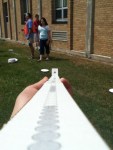
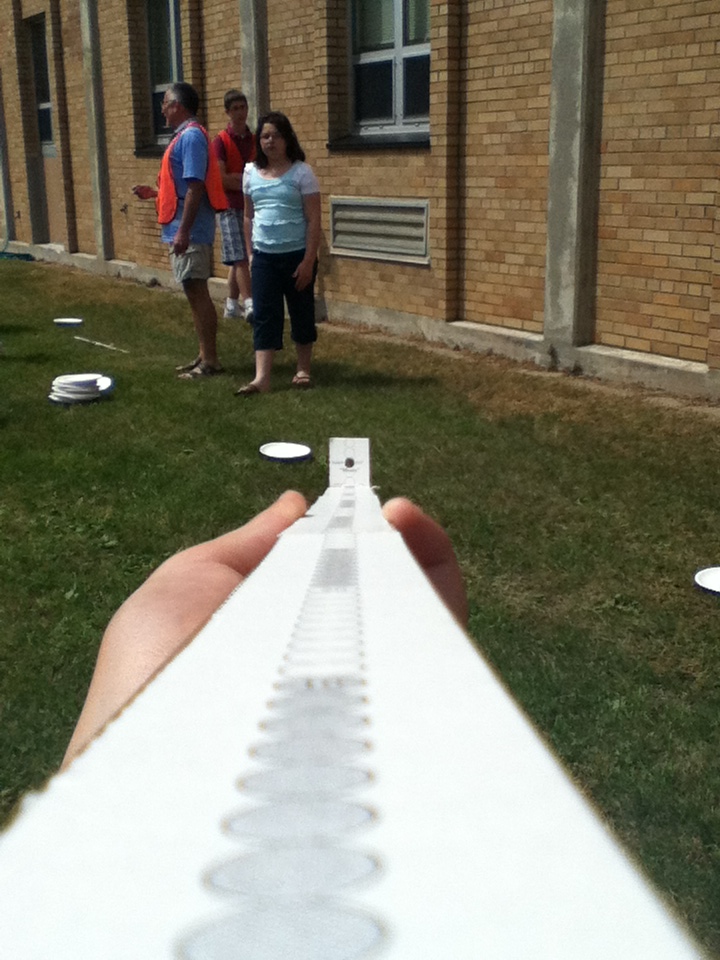
- The kids made a Moon Ruler to measure how far away the moon was. This was much easier to explain having a picture!
Another Texting Tale
Today, my son was fortunate to spend the entire school day out in a park on the river. It was a gorgeous day, perfect weather. They spent the entire day searching for snakes, frogs, bugs. They identified plants. They climbed around in the woods. I was jealous!
The bus back to school was late. That’s not the problem. The problem was that when I texted him to find out where he was (because he wasn’t at our usual meeting spot…) I didn’t hear back. Two texts, nothing back.
Long story short: I finally found out the bus was late, and they finally showed up. When we were driving away, he apologized for not texting me telling me where they were. He was afraid to text me back because he thought he’d get in trouble.
Whoa. I was furious. His school has a blanket no phones policy. If a teacher sees a phone, they can take it. Since he was sitting by some teachers on the bus, he was too scared of getting in trouble to text me back.
This is crazy. Guess what the kids do? Most of them have phones, of course. They go into the bathroom to text. Great. That’s a super healthy way of teaching kids appropriate behavior.
I popped off another email to the principal explaining my position. I was clear that by banning the phones, adults are not taking responsibility for teaching students responsible use of phones and communication. It is essential that teachers and adults teach kids appropriate use of phones and devices, and you can’t do that when they are forbidden.
I’m sure it won’t make a bit of difference, and I’ll get that same old line back…. we can’t allow phones because it’s not equitable because not everyone has them. The kids will cheat. The kids might text in class. The kids will bully each other.
Get real. Kids already cheat – without phones. Kids bully each other now. And yes, they might text in class. That’s exactly why it is our responsibility – -the adults — to teach them how to use these tools appropriately.
I’ll keep being a broken record. Someday……
Current Events Reports: Updated!
How have I missed the Google Zeitgeists? These are powerful year-in-review videos from Google (I assume based on searches? Or not?)
Having posted in the past about a current events class at a local high school that is not using social media or many online tools, I had to post this. I can only imagine the creative assignments students could do based on this model. It wouldn’t have to be current events, obviously. This could be a powerful history project, a book review for an English class, a lab report for chemistry, etc.
Doesn’t look much like the current events projects I had to do, and that’s fabulous.
Teaching Parents about 21st Century Learning
How do schools help parents understand 21st century skills? There are definitely parents who don’t agree and don’t understand why a school would be actively using social media to foster global communication, encouraging collaboration over memorization, and assigning creative projects instead of long tests.
I ran across two great examples yesterday.
First, Eric Sheninger has a blog post, “How can schools engage parents in 21st Century Skills.” His points are simple: the school administration needs to be a role model for using the tools, and invite parents in. Be transparent. Use the tools. Demonstrate why schools need to do this. His school regularly uses open houses and conferences to demonstrate areas of learning that are incorporating these skills. If you follow Sheninger at all, you know he is a champion of 21st century learning.
Second, A little closer to home, I see that the Edina Public Schools are taking a similar approach. They have a morning workshop devoted to showing parents “…how technology unleashes students’ passion for learning….” Knowing a bit about their district, I’m sure there will be many kids there demonstrating how they learn 21st century skills in schools.
Edina is also doing something I’ve strongly encouraged my kids’ schools to do. They are doing a survey of families to learn about the technology at home. This is an essential step schools need to take in order to go to the next level, and also to start getting parents on board understanding 21st century learning. I often hear that the district can’t do tech in schools because kids don’t have tech at home. I think they’d be surprised…. and if kids don’t, what better reason to have schools using 21st century skills at school and support it however they can.
I’m so impressed by these approaches to teach parents and include parents as part of their childrens’ education. There are definitely schools and districts that aren’t at this place yet — in that case, I’d love to see those teachers and administrators attending these sessions.
Creative Choices
For the last couple of days, my daughter and I have been weighing the good and bad points about taking an AP World History class. It seems like everywhere I turn, the signs are against it.
I guess it depends on your values and what you think matters. Whenever I ask the school, it’s all about getting kids ready for COLLEGE. OK, yes, that is valid. But truly, is that it? Is that all that high school is for? for COLLEGE? Are colleges really that myopic that they only want kids who do the traditional academic course? Is college admission and prep really all there is?
What about LIFE? Isn’t that more of a goal? What does the traditional AP type course really prepare you for? Reading heavy tomes of content and spitting it back on a test? Let me think how many times since college that I’ve taken a test. That would be ZERO. Never. Not once. How many times have I made a presentation? Many. How many times could I present information in ways besides a test? Always.
Which brings me to this great video about creativity that I ran across today. I’m just not sure rushing through a ton of content to spit it back is worth it. Take more time. Be creative. That will likely take you further.
 My Wired Life