Changemaker

I ran across an article that I didn’t even know I needed to read until I read it….. “On Being a Changemaker” by Karen Pryor.

It hit hard. So THIS is what I’ve been doing, and WHY it’s been so incredibly hard. I’m making things change (well, I’m trying…. not succeeding yet.) The phases of change she defines fit perfectly. The reactions from people around me are exactly as she describes. I know, however, that my reactions have not been as effective as they could be, so my goal is to take her ideas as my guide. This applies both to my work and to the advocacy I do (or try to do) with my children’s schools.

With full credit to Karen Pryor, here are her steps of what people do when faced with change:

  1. Ignore you
  2. Pretend to agree, but actually do nothing
  3. Resist, delay, obstruct
  4. Openly attack you (the dangerous phase, but also a sign that change is starting)
  5. Absorb
  6. Utilize
  7. Take credit
  8. Proselytize

Read the rest of the article for more details, but I am especially struck by her effective responses. I need to internalize them. The one I am very much looking forward to is the last:

They’re taking credit for your idea? By all means let them; your goal is the change. Credit is a low-cost reinforcer and people who want it don’t satiate. Give it away in buckets.

I can’t wait until that day. So far, I don’t see it, but I welcome it!The process of change is hard.

For my reference, here is Karen Pryor’s complete list of effective reactions:

  1. When they ignore you, find allies and persist.
  2. Don’t be misled by lip service. Find allies and persist.
  3. Meet resistance with persistence. Move around the resistance; try other avenues.
  4. The stage of open attack is a touchy time. People can get fired, for example. Keep your head down, but persist. Don’t take the attack personally, even if it is a personal attack. Attack is information; it tells you:
    a) You’re getting somewhere: change IS happening, causing extinction-induced aggression.
    b) Your attacker is frightened. Empathize.
    c) Your attacker still believes in the efficacy of aversives.
  5. Absorbing and utilizing: this stage can last a year or more. Maintain generous schedules of reinforcement.
  6. They’re taking credit for your idea? By all means let them; your goal is the change. Credit is a low-cost reinforcer and people who want it don’t satiate. Give it away in buckets.
  7. Are they pitching the change? Good. If you want to change something else, you now have new allies.

– With credit to the Minnesota Council for the Gifted & Talented, where I first saw the story, and to MinnPost, Nov. 13, 2012, for the reference to Karen Pryor’s blog.

New History

Ran across this interesting post, “The History Curriculum in in 2023” about needing new ways to teach history.

I agree. Totally and wholeheartedly. I am looking forward to his additional posts explaining the 4 Ms: Making, Mining, Marking and Mashing.

I can’t comment directly on these things, but given the tone of this post and the one previous, “History on Thin Ice,” I think I have a good sense where he’s going.

I have been in the history education biz for 25 years, first as a high school/middle school teacher, then now as a museum professional for the last 20+ years where I’ve worked as an interpreter (taking the public through museums/historic sites), a program and exhibit developer, a website developer, and now as a digital curriculum developer. In the museum world, we frequently hear visitors say  how surprised they are that history is so interesting, because it was so awful in high school!

How do we make history interesting? We tell stories. We make it relevant. We connect people to their history, and help them see how it impacts their world today. We talk about how people lived, what they ate, what they did. We find objects, documents, photos, maps that show real people, telling real stories.

What do I see in my kids’ history classrooms? Tests, lectures, and pages and pages of dense text. This wasn’t interesting 30 years ago when I was in school, and it certainly isn’t interesting to today’s students. History isn’t a multiple choice test — history is people, things, places and stories.

These history classes cover an enormous period of time and an enormous geographic area. There is no room to dig deep, to learn more than a few dates or names of “important” people then move on to the next big war or emperor.

My son’s school is different. To be fair, they are not beholden to the (ridiculous) standards expecting them to teach an unreasonable amount of content. (They also don’t have to give up nearly three weeks for standardized tests.) Instead, they use that time to dig deep. For example, they spent an entire month – yes, four weeks – studying an incident in Minnesota history that very few schools even mention, much less spend time on it. They examined primary source documents, including treaties, newspaper articles, testimonies, court documents and more. They examined reactions to the incident over the last 150 years. They had to take the raw materials of history (from a pool of resources the teachers pulled together – they were only 11 and 12 year olds, after all!) like an historian does, and put them together in various ways to make arguments and present information. I would guarantee you that these 11 and 12 year olds knew more about this incident than the vast majority of adults.

It’s pretty clear which approach I prefer, and I’m looking forward to the upcoming blog posts about how he envisions the new teaching of history!

Aha! Here are the four posts:

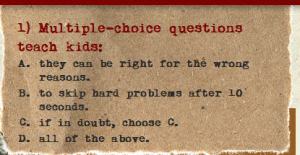
No More Bubbles!

Image from Beyond the Bubble

I have previously expressed my dismay with the amount of multiple choice tests I see at my daughter’s high school — the “Scantron” tests. Even then name says something…..  Tron? Seriously?

I’d post some of the questions from her tests, but the tests aren’t allowed out of the classroom! When I have seen them, the vast, vast  majority of the questions are, as described below, random fact recall. When I’ve asked teachers why they need to ask these questions, it’s because the “kids need to know this by memory to access higher level classes.” Wow – I’m doing professional history, and I couldn’t answer some of the definitions/rote memory questions on those tests, yet I am successful. I could, however, find those answers in seconds because I know where/how to look, how to analyze sources and how to think creatively.

It was with great pleasure that I found  Beyond the Bubble today. This is an alternative history assessment concept, based on Library of Congress primary sources. I have to dig a little deeper, but at first glance, I love the concept. Assessment based on direct primary source analysis, not rote random fact recall.

Check out their amusing little video:


Do What you Love!

At the 2012 ISTE conference, the concept of “Passion” was prevalent. Kids should work on something they’re passionate about, as it leads to self-directed learning, and those 21st century skills.

I was thrilled to see this article in the StarTribune, “Stop being average and start being extraordinary.” It’s a conversation with Phil Cooke, who wrote, “One Big Thing: Discovering What You Were Born to Do.” Basically, he says to find the things you love to do, and quit spending time doing things because you think you’re supposed to do it.

His example is to think about what you enjoyed doing when you were 10. While you might be able to make a living doing exactly that, you should be able to find something from that.

It makes me think about my kids and their friends. Some of them work so hard on things that they don’t like, but the whole college admissions thing makes them think they have to do so. Do they really need all those AP classes? Don’t get me wrong, that is exactly what some kids love to do, so they should. But not all kids.

My daughter is currently making some decisions about classes: stay in the AP classes, how much math/science to take, etc. While I won’t make a decision based on one article, this article would seem to support not doing that, and instead spending time on what feeds her passion: music, artc, creativity, etc. I’d be ok with that.

Here are his points for doing what you love:

  • Stop focusing on your flaws.
  • Don’t let others tell you what you should do.
  • Embrace change.
  • Don’t burn bridges.

Then there certainly are some adults I know who should also think about this!

Seth Godin = Awesome

Take 15 minutes out of your day to watch Seth Godin at a recent TEDx talk. He’s inspirational. He makes sense. He has great points. Watch it:

Here are a couple of quotes:

“Open Book. Open Note. All the time. There is zero value in memorizing anything ever again. Anything worth memorizing is worth looking up. So we shouldn’t spend any time teaching people to memorize stuff.”

“Measure experience instead of test scores.”

“No more multiple choice exams. Those were invented to make them easier to score. Computers are smarter than that now.”

“Cooperation instead of isolation. Why do we do anything when we ask them to do it all by themselves, then we put them in the real work and ask them to cooperate.”


One Vision

Stumbled across the news that my old stomping grounds school district is moving to a 1:1 iPad initiative in some grades. A little internet digging, and I found some impressive information about their program. They’ve really thought this through, they’ve articulated WHY the technology is being used, and what the learning outcomes will be.

  • My Way
    Basic information about the project
  • My Way Presentation
    PDF of what I assume is a presentation they use for parents, school board, etc.

A few quotes and thoughts from the presentation:

  • “Each student has access to digital curriciulum via essential personal mobile learning device.” (empahsis mine)
  • Strong emphasis on personalized learning:  “The paradigm shift to a personalized learning experience is the process of contouring learning to individuals, recognizing that individuals inherently have different strengths and weaknesses, interests and ways of learning.” – Sir Ken Robinson
  • “1 to 1 programs provide for digital access and learning opportunities regardless of socioeconomic status”
  • “Providing all students with 21st century skills and making education relevant to today’s world are critical to closing both the achievement gap and the global competition gap.” — Public Opinion Strategies and Peter D. Hart Research Associates (2007)
  • To be really effective, teachers need to use the technology to achieve things they could not do without it.” –Ruben R. Puentedura

Huh. Makes me even more frustrated with what I’m seeing on a daily basis from my kids’ schools, and with the pushback I get from the schools when I ask about this stuff.

Crash Course

Ok, how have I not seen these Crash Course in World History videos before? These are truly magnificent. I think I learned more about the Industrial Revolution in this 10 minute video than I ever learned in a college class…. or at least this video made it more memorable!

These videos are a brilliant example of how to engage 21st century learners:

  • The videos are obviously very visual, relying on sophisticated graphics and historical imagery.
  • They are short, only 10 minutes. (They sure pack a punch in 10 minutes!)
  • They relate the past to the present, creating a real world learning situation.
  • The videos ask critical thinking questions that could lead to class discussion and more.

I could so easily see how these could be incorporated into history classes. The content is delivered very rapidly, and is actually a pretty good level. You could use these with middle school with support, and easily with high school.

World History Textbook

Does this look enticing for a 21st century visual learner?

Remember when I posted pictures of the textbook my daughter is going to use in her World History this year?

I’m not saying these videos should be the sole curriculum of the class, but geez, which method of learning do you think most students would engage with more? I certainly hope that I hear that her AP World History class is using other media BESIDES the photo at right.

ISTE, Of Course.

The flight home from San Diego and the ISTE conference allows for time for reflection (and sleep!) The conference was, as always, an overwhelming experience full of inspiration, information and new connections.

The view from the San Diego Convention Center

Passion and Creativity: Big ideas for the conference, for me, were passion and creativity. Educators wanting students to find their passion, as passion fuels learning. Both keynotes discussed passion, and it came up in a number of sessions. Sir Ken Robinson reflected on how standardized tests create linear, one-size-fits-all schooling that stifles creativity and passion. Students aren’t all the same size. Check out the keynotes by Sir Ken Robinson (be sure to zip ahead to the keynote part)  and Yong Zhao (short clip and full keynote.).

Quote from one person watching Dr. Yong Zhao: “The focus on standardized testing is usually at the detriment of innovation, creativity and entrepeneurship.”

I know for my kids, passion is truly the motivator for learning. With passion flamed by the right content, an awesome teacher, or some personal motivation, learning can bloom. When passion is not fostered, learning is a chore and not done well.

Taking a Stand: I was inspired to take a stand by Sir Ken Robinson’s talk, as well as Adam Bellow’s Ignite bit. I can’t help bringing my personal life to this conference –  I am “just” a parent wanting my kids’ schools to move to incorporate technology. I’m often dismissed and not taken seriously. It gets discouraging. This conference has inspired me to stand up again. I’ve already drafted a letter to the superintendant, which I’ll post here once it’s done. I’ll also post the response. That could be interesting.

In addition, I was inspired by the number of “technology coaches” I saw and talked with. It seems that this is an increasing field, where experienced teachers/tech directors are going out and consulting with other schools. I’ve decided that I’m no longer just the parent bugging them, but a technology coach and advisor. How can I approach things differently? I’m going to offer my services to one school (working with a teacher) as a tech integration specialist for a few hours a week.

Education Reform: I sometimes wonder if ISTE is about technology or about education reform. Maybe it should be ISRE – international society for the reform of education. There are very few sessions that don’t have some element doing things differently, of changing that “factory model” of education. While not all sessions are as drastic as Sir Ken Robinson’s keynote or Will Richardson’s session on change, even the basic “list 100 apps” sessions talk about how to do education differently.

I find this encouraging and hopeful. The change is all about doing our best for students.

The view from our condo. Made for a great Sunday afternoon hang out to watch the Padres game!

Connections: Since I’m not a teacher, but a content provider, sometimes I don’t have a “group” at ISTE. Yet, this year I told myself I was going to work much harder at making connections, and I did. I made a number of professional connections that could have real impact on the projects we have planned at work. It could lead to some powerful partnerships that could help us achieve our goals to deliver the best digital content, in ways that teachers and students really can use.
In addition, I found I had a much easier time just talking to people, whether it was someone waiting in line to get into a session, sitting at a table quickly eating lunch, or sitting by me in the Blogger Cafe. These quick conversations were always interesting and truly did help me feel connected (although I still wish I had a better answer for the inevitable “where do you teach” question.)

The really fun connections? I saw all these people I “know” from blogging. Of course, I don’t really know any of them and they don’t know me at all. I just read all the stuff they post. I was beside myself to be sitting by a table with Audrey Watters, Jerry Blumgarten, George Couros, Patrick Larkin and more. I was far too shy to say anything – why would they talk to me? Then I attended a session with Will Richardson…. And I even talked to him! Later that night, I saw Jeff Bradbury and Steve Anderson at a party. I had had a glass of wine, so was a little more confident. I just went up and introduced myself. Today, the ultimate: I walked right by Chris Lehmann as I was leaving. I just went up to him and introduced myself. We had a very nice conversation, and he even invited me to come talk more up in the Blogger Café. I was beside myself! How exciting! Too bad I was on my way out. Dang. It just MADE MY CONFERENCE!

Parents: I’ve been thinking…. One voice that is absent from this whole conversation – not just at ISTE – is parents. Students are a small voice – they should have a much bigger voice, and I know they do at smaller conferences. But parents need some voice in this as well. I appreciate hearing from the administrators about how they bring parents on board when the school is driving the change. It is immensely helpful to hear about parent tech nights, different modes of communication, and happily, the lack of parent resistance to the changes. When I do speak to my kids’ schools, it helps to have these ideas from these great leaders. Yet, parents are not part of the conversation at ISTE. Should they be? I’m not really sure, but it’s worth asking.

Thanks ISTE for another overwhelming and thought-provoking few days. This year, I leave confirmed that professionally, we’re on the right track with our digital content projects, even though I have a lot of work cut out for me in moving others in the organization along the path. Personally, I am even more frustrated by the situations my kids face at their schools. I have been inspired and will pick up my advocacy at these schools. Wish me luck.

A Program that Works

My son is in a summer program that has the kids taking one class for three weeks. It’s a challenging academic program that pushes the kids to look really deeply at one area. They’re able to really explore the topic through a variety of activities – mostly through project-based, hands-on experiences. No testing, no rote memorization, no routine classroom stuff. Teachers have planned activities and they have lectures, but kids are able to pursue their own interests and work quickly on project and through content.

My kids have done this program for six years, and each time they come away asking why regular school can’t be more like this program. I often wonder the same question. They learn so much during this program, they LOVE going every day. It’s challenging – there’s no slacking during these three weeks. Yet, the kids want more and more.

Why can’t regular school be like this?