“Informal” Learning

My daughter despises her science classes at school. She’s never liked them. I had assumed it was the subject. But I’m not so sure.

Turns out she watches science videos on YouTube — for fun. For example, she loves the ASAP Science Series. Go ahead – watch and test your hearing.

Maybe it’s not the subject so much as the atmosphere….. Filling in the bubbles on tests, memorizing a bunch of random information and having to write meticulous, pre-scripted lab reports isn’t exactly exciting.

Opting Out

I was sent an article from our local paper about a family that is opting out of the state standardized tests. WOW! “Process is more important than filling in circles.”

I am excited. I will be calling the district first thing tomorrow to do the same. Interestingly, last year I was told we couldn’t opt out of the MCA’s (state tests) because they were required for graduation. I believe they actually were then — but the legislature passed revisions in the spring.

I can’t find anything about this on the state education site or our district site. Here’s what the state site says:

Based on new legislation, the graduation assessment requirements have changed. Additional information will be provided as soon as possible once a comprehensive review of the new requirements is completed.  cite

I might go so far as to contact the reporter. Wouldn’t it be awesome to get a group of parents together to talk about opting out of these tests?

Update

I’ve tried calling the district. No response. I’ll keep trying, then will perhaps try to find my way through the maze of the Dept. of Ed to get an answer.

The scarier part for me was talking to my daughter about this. She’s a junior, so would be up for the Math MCA. If it’s true that they no longer need it to graduate, there is no benefit to her of taking the test. I proposed the idea of opting out. She did not like the idea, I think because it would make her different. It would rock the boat, yes. But it is a bigger concern to me that she’s been “brainwashed” into doing whatever the school says without questioning why.

Video

The Learning Revolution

I had the honor of hearing Jonathan Mooney speak recently. This is an excellent quick peek at his message of the need for a different look at education. We can no longer define intelligence as just reading, as the good kid is the one who sits still.

Just watch it. It’s only 7 minutes.

Getting Through

Parents and teachers should do everything possible to help kids get through high school without hating it.

-Gary Stager

Saw a recent tweet from Scott McLeod referencing this post by Gary Stager.

Wow. That is exactly what I’m facing right now with my 16-year old. How can this be? How can Gary Stager know this?

I don’t know the context of the entire post (great bits of wisdom he is sharing with parents from a Colorado school) but this bit really hit home. While I’m grateful that it appears that I’m not the only one in this situation, it is dreadfully sad that this is even an option!

My daughter (a junior) already hates high school. And honestly, who can blame her? Her every movement is questioned, regulated and controlled. She is told what she is supposed to learn, how she should learn it and how she has to demonstrate that learning. It’s even worse that the type of learning/assessment expected is largely rote, heavy reading and standardized multiple choice testing — all of which is difficult/boring for most kids, not to mention kids with attention deficits and dyslexia. For creative kids, this is enough to suck the soul out of learning and kill their spirit.

Yet, she’s blamed for not working hard enough.

Huh — have you ever seen her work on the lines to a play? unwrap a very difficult passage in a choral piece? curate visuals for her blog or develop a playlist? Watch her taking pictures sometime. She can work, she can focus. She just can’t do it on stuff that isn’t interesting. But she’s told that all the things she finds stimulating aren’t valid. Not explicitly, but truly, that’s what traditional schooling tells us all the time, everytime you enter a class, take a test or do homework.

I don’t blame the teachers. Most of them have their heart in the right place. They just have unrealistic workloads, too many standards to teach, and ridiculous pressure for these tests. Please give them some space to do what they want to do, why most of them went into the profession.

So, Gary Stager, how do I get my daughter through these last two years of high school?

Extracurriculars

I ran across two things with opinions about “extra” curricular activities yesterday. I have lots of opinions about extracurriculars!

Yes, academics are important, but are they everything? I don’t think so. In my experience, it seems some of the better life learning lessons come from the extras. Like what? Like how to work hard, how perseverance pays off, team work, critical thinking, thinking on your feet, planning, and on and on. No, it’s not learning how to solve a calculus equation or what battles were in the Civil War or how to write a 5-paragraph essay. Those are important, but so are the other lessons that come from the extras.

First thing I saw yesterday was a blog post, “9 Ways a Theater Degree Trumps a Business Degree.” I don’t know this blogger, but I certainly liked what he had to say. Skills learned from a theater degree are definitely applicable in the “real” world. Being on time. Thinking on your feet. Being resourceful. Being a team player. and more.

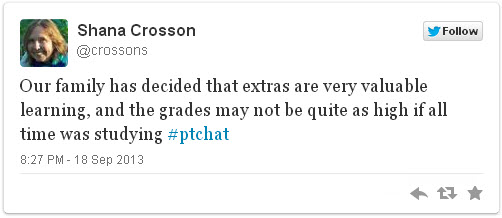
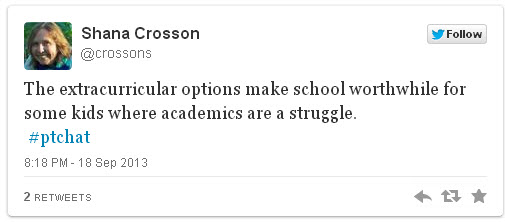
Second thing yesterday was #ptchat (a chat on Twitter. super fun.) The topic for yesterday was the balance between leisure and academics. The twitterverse lit up! I was happy to see lots of support from the teachers/admins in the chat for the extras. I was a little concerned by some of the emphasis on academics — that those always have to come first. There was some good conversation. (See the archives for all the tweets)

My input below:

tweet1

tweet2tweet3

Sacrifices

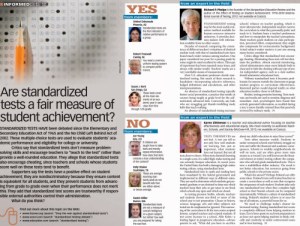
I read a fascinating discussion about standardized tests in an unexpected place — the Costco Connection. They asked the question, “Are Standardized Tests a Fair Measure of Student Achievement?”  (This issue also includes an article about Sal Khan and Khan Academy.)

Article from the August 2013 edition of Costco Connects

Article from the August 2013 edition of Costco Connection

The “expert” argument against the question was by a teacher and author, Karen Zittleman. I was particularly drawn to her argument that the pressure and reliance on the tests is unwarranted and is actually damaging.

She quotes Alfie Kohn, suggesting that parents question the level of standardized test by asking,

“What did you have to sacrifice about my child’s education to raise those scores?”

This is a perfect question. After hearing about three weeks being spent on test prep, computer labs restricted to testing and more, guess what I’ll be asking this year!!

Will Smartphones replace our Memory?

After my post about Google and multiple choice tests, I was pointed to this article by David Pogue in the Scientific American Magazine, “Smartphones Mean You Will No Longer Have to Memorize Facts.”

I’ve been challenged on the thought that I’ve said that kids don’t need to memorize facts. (I never actually said that — just said that memorizing facts shouldn’t be how we base assessment.) I do love this quote from Pogue,

As society marches ever forward, we leave obsolete skills in our wake. That’s just part of progress. Why should we mourn the loss of memorization skills any more than we pine for hot type technology, Morse code abilities or a knack for operating elevators?

He also talks about the rise of calculators in math classrooms. I remember that paradigm shift distinctly. In junior high and high school, we were absolutely NOT allowed to have calculators. My dad had an early calculator (I believe it was a Texas Instruments and cost about $75) that I thought was awesome, so I’d use it at home — but never ever would’ve brought it to school. A couple of years ago, I had to buy my daughter a $100 graphing calculator. They never go to math class without it after about 7th grade. I will NOT be buying one for my son – he can get a $1.99 app for his iPad that does more than the $100 calculator.

Memorizing? Yes, we do need to have some basic facts in our brains. No argument. But should all our assessment be based on this? Should kids be taught to analyze and find facts, rather than recall? Can you learn facts (relevant facts) better by solving problems and creating projects than random, out-of-context multiple choice tests? You can answer for yourself.

Vacation Learning

We’re recently back from a 10-day, 2000 mile road trip. Officially, it was a vacation, including visiting with family, picking up my daughter from camp and staying with friends. We had a lovely, relaxing time – even if the weather wasn’t always fully cooperative!

As I think about all we did over the 10 days, there was a tremendous amount of learning along with the fun. And guess what — the learning was FUN!

  • Geography We drove from Minnesota to Michigan and back, taking different routes there and back. We had the 13-year old do some of the navigating. He kept the maps (yes, real paper, fold-out maps) in the back with him and kept an eye on where we were going and what we were passing. He also used our iPhones to help find routes and restaurants. One afternoon, we saw three Great Lakes within a couple of hours.
  • History Since I am a historian, I talked about what I knew about the history of the areas we drove through. (I just can’t help it.) Not that I knew specifics about the area, but I knew general concepts about the fur trade, the reservation system, etc. We visited a couple of local museums that certainly helped put the details in the right place.
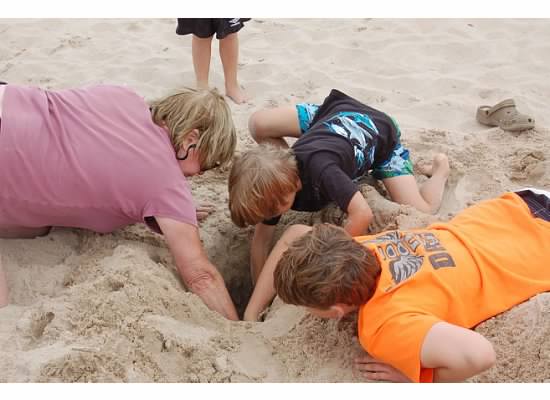
  • Science SandcastleWe walked through sand dunes, forests and beaches,looking at trees, rocks and critters. The weather was a significant factor in our adventures, meaning the kids had to be observant and think ahead. We built sand castles, exploring the powers of sand, water and gravity.
  • Art I learned long ago to bring a camera on hikes and activities. It can often engage a reluctant teen. Fortunately, I didn’t have a reluctant teen, but the camera was put to good use throughout the trip. We also built cairns of rocks, made sand castles and drew pictures with sticks on the beach.
  • Language Arts With hours in the car, we listened to two different books. One book had themes that were similar to another book, so we spent time discussing the similarities and differences, and the motivations of the authors. I wish I had gotten the kids to blog about the trip, but alas, that didn’t happen.
  • Music Music happens anywhere my kids go, and this trip was no exception. I had asked my 13-year old to make some good playlists for the drive, and we discussed why he had picked certain songs. My daughter was returning from a musical theater camp, so we discussed things learned.
  • Phy Ed Lots of hiking, swimming, and games!

Certainly not all our learning fell into these neat subject categories! You can’t learn about the geography of the Great Lakes without learning about history and science. Sand castles are as much art as science, as well as phy ed.

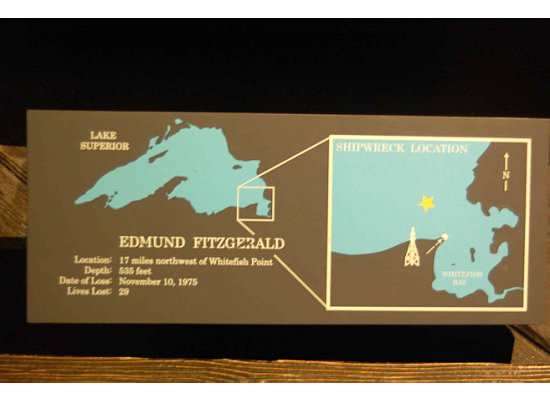
Exhibit label at the Great Lakes Shipwreck Museum

Exhibit label at the Great Lakes Shipwreck Museum

We took a special trip to learn about the sinking of the Edmund Fitzgerald. We saw objects, videos, photos. We were on the edge of the U.S., close enough to see Canada. We spent time in the car tracking the Arthur M. Anderson, the last ship to see the Edmund Fitzgerald. It just happened to pass the museum while we were out watching. It also happened to get into port in Superior shortly before we got there. (Freaky!) We tracked the ship’s path, learned about knots and UTC (shipping time.)

What else? Lots of free exploring and inter-generational experiences. The kids were creative. They got “bored” and had to find something to do. They were active, cooperative and collaborative.

While I won’t tell the kids, it seems to me that this vacation was as much about learning as it was about relaxing and having a great time. What a great way to learn!