In writing the previous post, I was looking at Will Richardson’s blog. His last two posts hit really close to home for me, as I too have a daughter about to enter her junior year of high school.
“What Are We Doing to Our Kids”, based on a post by Cathy Davidson about the average GPA of entering freshman at UC Irvine being 4.1, comments on the fact that the expectation for kids to be PERFECT in order to get into college is getting out of hand. It’s true – very true. I’ve seen kids this year with 4.0+ and near perfect SATs not get into colleges. It’s crazy.
I admire Mr. Richardson for his response that his daughter has a balanced life, doing things outside of school, not focusing on all honors classes. It is a model we have followed as well, and will continue, for a couple of reasons.
I wholeheartedly agree that there is more to life – way more – than the academics in class. The life skills learned in extracurriculars often far outweigh the details about cell respiration, who fought the War of 1812, and where Jay Gatsby may have lived.
Per my previous post, if academics are so driven by standardized tests, the content and skills they learn are basically useless.
My daughter is a visual learner. She thinks and process information in pictures and color. Traditional school does NOT reward this type of thinker. Yet, once she’s out of school, these skills will be incredibly valuable.
I am grateful for Richardson’s previous post, “It’s the Assessments, Stupid,” he has a link to SAT -optional colleges.
This short tweet shifted my world. I look at the work my kids bring home through a whole different lens. Not that I ever approved of assessments that were based on simple factual recall – when I was teaching 20 years ago, we never ever used bubble tests. Those were considered the lazy teacher option that didn’t test anything except who had the best memory. In 1990, I was telling my history students that I didn’t expect them to memorize all the dates and facts as long as they knew how to find it. Back then, finding the information meant looking it up in a physical encyclopedia.
My daughter just finished her sophomore year of high school, including a year of AP World History. In this class and in her biology class she took a horrifying number of “Scantron” tests. Of course, the kids never got the tests back (you see, they might pass the answers to someone else) and parents never got to see them. I finally requested to see the tests and had to make an appointment so I could look at them in the room with the teacher present.
Back to Google….. After seeing the tests, I was so disappointed. They were 90% basic low level questions that could be easily answered using Google.
What about AP Tests?
A few months ago, I was asked to give a talk to a group of history and education majors at Carleton College about tech in education and how museums are using tech to work with the K12 audience. On a whim, thinking of my daughter’s tests, I looked for a sample AP test.
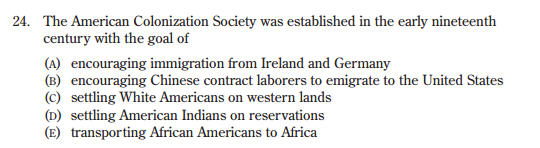
Question from Sample AP US History Test
I took this sample AP test and Googled the 40 questions exactly as written. It took about 2 seconds to find the answers – and that was checking a couple of pages to verify the answers. Thirty-five of the 40 questions were easily answered this way. The other five required information from a chart or photo.
I asked the students at Carleton to find the answers to a couple of these questions. Obviously, they had the same result. The students, many of whom had taken plenty of AP classes, were shocked. The professors were very amused.
A few weeks after this, I had the opportunity to talk with a history professor at Oberlin College, and asked him what he thought about this and AP in general. He said that they often need to reteach students how to read and study history when they arrive at Oberlin. Students who have been through AP classes are geared to read for minutae and minor detail. They haven’t been taught to read for concepts, context and the big picture.
AP Philosophy
In looking closely at the AP material online, it turns out that the multiple choice questions and the free response questions are each worth half of a student’s “grade” on the test. There are 80 questions to be completed in 55 minutes. The free response questions, including primary source analysis and essay, takes 130 minutes.
This quote from the AP materials confuses me:
“Although there is little to be gained by rote memorization of names and dates in an encyclopedic manner, a student must be able to draw upon a reservoir of systematic factual knowledge in order to exercise analytic skills intelligently. Striking a balance between teaching factual knowledge and critical analysis is a demanding but crucial task in the design of a successful AP course in history .”
They admit that rote memorization isn’t necessary, yet fully one half of the test score is based on this skill. While I don’t disagree that a basic level of knowledge of factual knowledge is necessary, is it necessary to have grades depend on the skill of memorization when we now have access to encyclopedias of content in our pockets? There is no possible way we can have the entirety of knowledge memorized — we need to be able to find it. We need to teach students how to find this information.
In my daughter’s AP World History course, her assessment/grade was based on this skill of rote memorization: assessments were worth 60% of the grade, and these assessments were by far mostly multiple choice Scantron tests with a few writing assessments thrown in there. Any creative assignment that required critical thinking, creativity and communication was worth just a few points. The content, structure and assessment of the course is designed to heavily favor strong word-based learners. It does not allow for success of a visual learner.
Even Will Richardson dislikes Google Questions
At ISTE in June, Will Richardson shared a story about his high school daughter’s history final – 100 multiple choice questions. He thought that all but 5 could be answered using the phone.
“I’m a big advocate of open phone tests. If we’re asking questions we can answer on our phone, why are we asking the questions?”
I’m excited to have yet another awesome quote about the value (or lack of) low-level questioning.
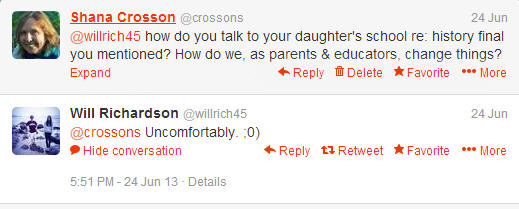
I had a fun, quick Twitter interaction with him later — I just had to know what someone like him, who is so active in this community, so well respected, does when his own kid is given an assessment like this.
Watch Will’s talk. The history final story is at 12:30. Then don’t give any more tests that can be Googled.
I’ve only read the article (not the whole book) and am intrigued to read the book.
My only concern is the continued attack on “giftedness.” Having been active in supporting gifted learners, I am concerned (and disagree) with the concept that “all students are gifted.” Without reading the book, I agree with Kaufman that all students can achieve greatness, and definitely that society measures intelligence in only one way (more on that later.) However, I am concerned about not meeting the needs of kids who do measure gifted in the traditional manner. These kids have a different learning style that needs to be addressed/met in order for these kids to be able to achieve their potential. They need to be able to move quickly, learn deeply. It is an ongoing concern with the label “gifted.” I do wish there was a term that better defined this learning style.
Standardized Tests
That said, I agree wholeheartedly with the rest of this article. Why do we define intelligence based solely on test scores? Why are we such a text based society? Why isn’t intelligence in other areas valued in a similar manner?
…traditional metrics of intelligence are misguided and may even be detrimental to learning and development.
I see this all the time with my daughter. She struggles with tests and with “traditional” learning settings. Yet, allow her to express her knowledge in an appropriate setting, and she shines. Let her make a video, write a short skit, give a speech – and her intelligence, communication skills, creativity and critical thinking skills shine. Make her take a multiple choice test? Not so much.
I have had a couple of her teacherscomment in the last few years about how she does on these types of projects. The engagement we see at home for these types of assessments is clearly different than what we see for multiple choice tests. In the long run, which skill set is more important? You know what I think….
Yet, she is being defined by these tests, and we see an increasing impact on her self-esteem and image. This is not to deter from the kids who do well on these tests. I just wish there was another measure that was valid.
Kaufman says it better:
I am against standardizing minds and ignoring the fact that there are multiple paths to the same outcome and that engagement is an extremely important aspect of the equation.
As I’ve blogged before, my daughter’s school uses the exact same tests over and over and over again. Tests must be standardized so that all kids have the exact same assessment. Guess what, kids aren’t standard, nor are they the exact same.
I heard an anecdotal story about a teacher who allowed students to come up with their own project to express their learning. A parent complained because her student got a “B” and now this teacher isn’t allowed to do these types of assessments. Now he has to do tests.
At the recent ISTE conference, I sat next to a high school teacher from St. Louis. As Adam Bellow showed his awesome video about shredding Scantron tests, he told me that his school got rid of their Scantron tests three years ago. Best move ever, he said.
Solutions
Kaufman is pretty clear about his solution – project based learning:
… allow students to express their knowledge of the material on their own terms, in their own unique voice, and at their own pace, I think we’d be setting up all students for the future much better, including those students we label gifted now.
No way this is going to happen at my daughter’s school. I’m not sure what the solution is for us, given she has two years left. My son will not be attending this school.
Thankfully, I was able to see half of this keynote before I had to go to the airport. Powerful stuff. I had seen him throughout the conference with the Google Glass — very fun to see his video of his experience — and a video of his experience delivering the keynote!
The messages from the keynote were obviously powerful for his fellow educators — the tweets and blog posts following the keynote are amazing.
For me, the important pieces were:
The Scantron video (Adam with a “new” machine to read Scantron tests — a shredder!!!) This starts at about 39:40. He has a strong anti-testing theme.
His admission that he new little about Minecraft until this conference.
Message of change
Power of visual communication. Bellow is a master at slides, and it makes a difference.
“Technology can’t be the icing. It’s in the dough.”
20% time — he thinks this is low. Kids should be passionate all throughout school.
If the video starts at the beginning, go to 23:00 to start with Adam. The rest isn’t essential.
I just returned from at ISTE13. I am fortunate and grateful that I am able to attend this conference. This is not yet my reflection post. I’m still processing and find I need space to do that. As always, I wrote a great deal on the flight home – it’s the best place to immediately process. I will be posting thoughts from the flight later.
The next few posts are a spot for me to store the video from the conference that I will reference later. I love that ISTE does video on demand. It’s impossible to get to all the sessions you want during the conference — especially when they schedule Will Richardson and Chris Lehmann at the same time!
Chris Lehmann
I’ve blogged about Chris many times. It was watching him at ISTE 2011 and online that really started me down this path. He talk at ISTE13 is no exception. I’m sorry I wasn’t there in person.
Take a look through this video. Think about the questions he asks. These questions would make a powerful faculty experience. I may, in fact, take the questions and write a session even for the staff where I work.
The questions he asks – and is looking for a 10 word answer – include (paraphrased):
Schools should help students become?
How does technology help this?
What are your “Legacy Apps” and how do you change?
What will you do to change in 2013-2014?
Look for the responses on Twitter, #istetransforms. Powerful.
I was also empowered by Chris’s reference to parents. ISTE doesn’t always mention parents as much as I think it should, and it is often about how to convince parents to like tech, to move away from traditional grading. But how about us parents who want our schools to move away? Chris uses the term, Parent Activist. I love it. He encourages these passionate educators to use their role as parents in their kids’ schools to become activists, to encourage change there as well.
I recently attended a workshop for parents of kids with ADHD and/or dyslexia. We are dealing with a recent diagnosis in one of our kids — and it’s a whole new road to travel.
Jonanthan Mooney was inspiring and motivating. He talked about his experiences as a kid with ADHD and dyslexia. He talked about how important people in his life lifted him up and empowered him to take control to eventually graduate from Brown, write two books and be a founder of a non-profit. I do think he needs to give himself a little more credit – -he has an amazing resolve and motivation to do things right.
His message about “disabilities” in school was profound, being new to this world. He talked at length about the “disability” of ADHD/Dsylexia being a disability only in certain places, like school. In other settings, it’s an asset.
Four major takeaways for me:
Rebuild a child’s self-esteem. The child isn’t disabled — it’s everyone else’s attitude towards these kids that is the problem.
Play to their strengths, don’t remediate the weaknesses.
Find advocates, mentors.
Intelligence is defined as ability to read. This is not the only way to measure, demonstrate intelligence.
While I was at this session purely for personal reasons as a parent of a child with ADHD and dyslexia, I was struck by the similarities in his advocacy for children with “disablities” and the messages I know well from the education technology movement.
He has a profound dislike of standardized tests
Sitting still shouldn’t get you good grades
Need to teach collaboration and critical thinking above memorization
Use the tools we have (TECHNOLOGY) to access content. TEACH kids to think, not memorize.
Very interesting article in Quartz by Christopher Mim today, “How the Internet is Making us Poor” about how jobs are changing due to technology changing. While this is nothing new (such as the examples about agriculture and manufacturing jobs), the pace at which this is happening with technology is significantly faster.
What’s changing? Society is basically dividing into two groups, “People who tell computers what to do, and people who are told by computers what to do.” Mim goes on to explain why this is decimating the middle class, etc. In fact, he points out, many of the jobs where people are told what to do are disappearing as well (he uses Amazon as an example.)
My point with this is then why schools must start using technology – and not just using tech. They must start teaching differently so these kids are prepared to be those who tell computers what to do. This isn’t learned by taking standardized tests, either.
I had a great conversation with a decision-maker at my local district today. I am thrilled to report that the district has taken great strides to incorporate tech, and for the right reasons. High on the list was a way to equalize the playing field. This district has changed quite a bit in the last few years, and there are many refugees and families on free/reduced lunch. Kids who do not have access to tech at home deserve to learn it in school.
All kids deserve to be learning this way in school, or we’ll have more and more of those people who are told what to do by computers.
I’d like to thank Scott McLeod for yet another excellent post, this time addressing a concern of a school board member who opposed the use of technology. His post, “Which Students Don’t Get to Use Technology, Then?” makes some excellent points that I will read again and again as I gear up for more upcoming discussions about the lack of tech adoption in my kids’ schools. I’m hoping Scott doesn’t mind being a guiding light for me.
In my situation, as a parent, my questions and concerns are usually dismissed and I’m seen as a rabble rouser. Since I work in the edtech field, I usually have significantly more knowledge about ed tech than most of the administrators at these schools. It helps immensely when I can come in and refer them to real teachers and admins who blog about the concept and who are very well respected. So, thank you, Scott.
Over the last few years, I have been studying how schools adapt to the 21st century through technology implementations. It’s all over the board: 1:1, BYOD, classroom sets, iPads, Chromebooks, iPods, laptops, etc.
The one thing I have really noticed is that while any technology (used appropriately, and not just for substitution) is a great step, the real power is when students have their own personal device. It doesn’t matter if it’s a school owned device or their own device — but that it is theirs alone to use. To personalize, to explore and to use how they use it best. This has been clear at the couple of schools who are, in my mind, the front runners of this device adoption.
I’ve seen it at my house. We bought my 7th grader an iPad to use at school this year. His school was going no where when it came to tech integration, and it made me furious. Because they had no policy about devices, there was no reason he couldn’t bring it, so we sent it. Within a week, I could see the real power in making it his own tool.
He explored a variety of apps, and figured out what worked best. He played with different planner apps, notetaking tools and email apps. He found a blogging platform that worked for his journal. The power really was in his being able to make it his own.
He was able to select his own wallpaper, put his own apps that work for him. He organizes his apps in folder very differently than I do. It’s quite fascinating, and it works because it’s his own.
I’ve been saying this to both my kids’ schools – but as I’ve posted previously, it falls on deaf ears. Perhaps I’m too pushy, perhaps they aren’t ready to go this way. BUT – I was so thrilled to see this post from Tony Vincent’s blog “Learning in Hand” about a study in Scotland (key findings of the study) which comes right out and says that personal ownership of the device is the number one factor in determining the successful use of the technology.
Read it for yourself, but in a nutshell, he’s supporting those teachers who feel like they’re tryng, trying to move along a path, but are still stuck in the same schools, traditions, processes and bureaucracy as always.
While I’m no longer teaching, I am a parent who has been advocating for this education paradigm shift. And I’m getting no where. In fact, the other day after yet another offer to do something for my child’s school was rejected (this time was to teach a parent technology class, or a teacher class) I was tempted to email and ask why they will not work with me.
I know why, though. I’m way ahead of them and they aren’t ready to go there. It’s not their priority yet. In the meantime, they’ll keep making decisions about technology without thinking it through.


 My Wired Life