Sugata Mitra Strikes Again

Another fabulous article about Sugata Mitra from The Guardian and his thoughts on education. It is going to be the basis for a much longer blog post — when I have a few minutes to write, which just might be on the plane to ISTE!

To entice you, here’s the first paragraph:

Would a person with good handwriting, spelling and grammar and instant recall of multiplication tables be considered a better candidate for a job than, say, one who knows how to configure a peer-to-peer network of devices, set up an organisation-wide Google calendar and find out where the most reliable sources of venture capital are, I wonder? The former set of skills are taught in schools, the latter are not.


Read the Rest. It’s worth it.

Redefine Cheating: MOOCs

Recent article in the Chronicle for Higher Education,“MOOC Teachers How to Cheat in Online Courses, with Eye to Prevention” brings up the need to redefine cheating and why we need to redefine education. The article talks about an online course (a MOOC) being taught by a Wisconsin professor all about how to “redesign learning environments.”

Let’s hope that’s what he focuses on.

The very last paragraph of the article defines cheating as “It’s meeting at Starbucks and taking a quiz together, or texting a friend….”

Seriously? Isn’t this really collaboration? We need to redefine assessment. Is the quiz about getting a right answer or about thinking through a problem? If it’s a basic multiple choice test, then getting the “right” answers from a friend may be cheating, but working through the problems with another person shouldn’t be.

Our assessments are what is wrong — not the collaboration. Students are by nature social creatures. The world works on teamwork and cooperation. Let’s reward that. Let’s nurture that -not criminalize it by calling it “cheating.” If our assessments rely on basic factual recall or some other simple form of grading to make things easier on the grader, than perhaps THAT is the problem. Not the fact that students collaborate.

I’m taking a MOOC right now. It’s not for credit, so it has a different tone and importance, I grant you that. However, I want to learn the content. I don’t care about my grade on the weekly quizzes. In this set up, you get 3 chances at a quiz. The best score is recorded. Each time to you take it, you have an opportunity to see the explanation for the answers. It doesn’t take much to figure out how to get a perfect score. The first time I took one, I felt horrible for using the answers (given to me) to get a perfect score. Then I thought again. This was about ME learning the content. Not about a grade, not about credit, so I feel no guilt. The questions are straight from the lecture or reading. There is little thought needed to answer them, no critical thinking. Just basic factual recall.

If, however, any online course was designed to give a grade or credit based on this type of quiz, that would be ridiculous. That type of assessment is ridiculous and shouldn’t be used. It is up to the educators to use assessments that are more creative, rely less on the straight factual recall, and demonstrate the ability to think, analyze, problem solve, cooperate, create, translate, etc. Look at the higher thinking skills on Bloom’s taxonomy.

Don’t criticize the students for cheating when you’re basically telling them to.

Two Movements, Same Message

I recently attended a workshop for parents of kids with ADHD and/or dyslexia. We are dealing with a recent diagnosis in one of our kids — and it’s a whole new road to travel.

Jonanthan Mooney was inspiring and motivating. He talked about his experiences as a kid with ADHD and dyslexia. He talked about how important people in his life lifted him up and empowered him to take control to eventually graduate from Brown, write two books and be a founder of a non-profit. I do think he needs to give himself a little more credit – -he has an amazing resolve and motivation to do things right.

His message about “disabilities” in school was profound, being new to this world. He talked at length about the “disability” of ADHD/Dsylexia being a disability only in certain places, like school. In other settings, it’s an asset.

Four major takeaways for me:

  • Rebuild a child’s self-esteem. The child isn’t disabled — it’s everyone else’s attitude towards these kids that is the problem. 
  • Play to their strengths, don’t remediate the weaknesses.
  • Find advocates, mentors.
  • Intelligence is defined as ability to read. This is not the only way to measure, demonstrate intelligence.

While I was at this session purely for personal reasons as a parent of a child with ADHD and dyslexia, I was struck by the similarities in his advocacy for children with “disablities” and the messages I know well from the education technology movement.

  • He has a profound dislike of standardized tests
  • Sitting still shouldn’t get you good grades
  • Need to teach collaboration and critical thinking above memorization
  • Use the tools we have (TECHNOLOGY) to access content. TEACH kids to think, not memorize.

Here’s his message in a TED Talk nutshell:

The Equalizer

The school district where I live has seen tremendous change in demographics in the last 10 years when my daughter started school. By the numbers, it’s about 44% free/reduced lunch, with one elementary school being nearly 90% ELL. The district has a significant (and growing) population of refugees – many of whom come to school literally days after arriving in the country. Many other students come from homes with lower incomes – whether formerly middle class families who have experienced job loss or other reasons.

If you evaluate the “achievement gap” by the numbers here, it’s truly scary. I sit on a district curriculum advisory committee, and have been able to look closely at the numbers. If our primary means of evaluating achievement is test results, then things look pretty bad. Students of non-majority ethnicities and lower incomes have significantly lower test scores.

I’d argue that things look even worse if we look at other indicators of achievement. I don’t know the numbers for graduation, or post-secondary education entry or completion. But I do know that the system is failing many of these kids in a crucial area: technology access.

In a Mindshift post this week, Tina Barseghian blogs about device access as the true equalizer. She has lots of statistics and more to support her argument. I just have anecdotal….

How do we expect students who never have access to devices of any kind to develop the digital literacy skills essential for success in post-secondary education? or in just about any workplace now? I dare you to find really any job that doesn’t use any technology. These students must have access to these devices and learn to use them responsibly in order to be functional in the bigger world.

A refugee family has many immediate needs to worry about: food, shelter, transportation, income. However, technology access should be an essential part of schooling, just like learning English.

Access doesn’t mean a computer lab in a school. Access means a personal device, or other immediate access. We all know that computer labs are taken up with testing now – there’s no room in the schedule to do other learning.

Access means teachers who feel comfortable with the technology, teachers who aren’t afraid to let it be used, to use it themselves.Teachers deserve access to training and tools in order to learn for themselves.

Access means a pedagogy in which teachers and administrators see themselves as guides, rather than solely content experts.

Access means devices. Here’s hoping my district can make that happen.

Project Based Learning

Great post by Nicholas Provenzano (aka @thenerdyteacher), “I’ve got 99 Problems, but a Test Ain’t One

Nick writes extensively about his experiments with project-based learning, and the huge successes he’s seen. He also writes about tech integration and the advantages, even though his school isn’t 1:1. He just has a classroom set of iPads. He’s a huge Evernote fan. (No, I’ve never met him, although I have seen him at ISTE.)

I appreciate his thoughtfulness about why he moved away from multiple choice tests: “Remembering the character’s hometown was nice, but demonstrating the importance the hometown played in the story is far more important.” He acknowledges that writing a good multiple choice test is difficult, and it was more about a reading check rather than a check for understanding.

I appreciate how his classes are set up for the benefit of the student, taking advantage of their natural inclinations,

Students are yearning to show their teachers their talent and knowledge. They are bursting at the seams to show the world what they can do. The traditional classroom of lecture and test does not allow them to do that though. The minute I started to let my students choose their projects and express their knowledge in different ways, engagement and the overall energy of the students went through the room.


I sit on a district curriculum committee. The focus of everything is on test scores. It’s all about bringing up the scores. There’s no room even to ask about the value of the standardized tests – it’s just taken for granted. My daughter’s grades are heavily dependent on tests, the tests get far more weight than other work that may require more thought. I’ve had a chance to look at some tests (only a few because they don’t allow the tests out of the room!!) Most of the tests are basic factual recall. Even the teachers admit that they aren’t asking many higher level questions. Why aren’t the tests allowed out of the classroom? Because kids might cheat. And they can cheat because it’s all straight factual recall. There’s very little cheating possible in a project based classroom.

Says Nick:

Somewhere along the way, education lost its way and started to focus heavily on memorization of facts and not the actual act of learning. To me, MC tests, fill in the blank exams, etc. as the only means of assessment are a symptom of that larger problem.


AP Revisited

I’ve had the chance to look closer at AP history offerings lately and do additional research into the detractors. From my admittedly limited observations of my daughter’s AP World History course, here’s what I see:

  • huge scope of content
  • no depth
  • no primary sources
  • assessment is by far memorization through multiple choice exams
  • no creativity in assessment
  • no formative assessment
  • teaching to a specific test
  • no relation to current events
  • little evidence of teaching historical skills – it’s just memorization of content

I’m sure some AP courses involve primary source, creativity, and in-depth anaysis of historical evidence, but not this one.

But hopefully, there will be changes. A recent article in Education Week, College Board Improves AP Exams & Supports For Deeper Learning & College Readiness, by Tom Vander Ark, discusses proposed changes for AP exams:

“The redesigned AP exams are increasing their focus on essays and open-ended problems, and reducing the number of multiple-choice questions; the remaining multiple-choice questions are shifting to measure not just content knowledge, but content knowledge and the skill to use that knowledge in meaningful ways essential to college and career success in that discipline,” said Trevor Packer, Head of AP at College Board. “There’s not a single exam question now that measures memorization only. They each evaluate skills and the application of knowledge.”

I’m encouraged by this quote:

“I think skills are vastly more crucial to success than content knowledge,” said a faculty member from a AP U.S. History study.

Sounds like the College Board is considering a capstone project, a year-long project of service learning, creativity and depth. Excellent!!  Sorry it’ll be too late for my daughter.

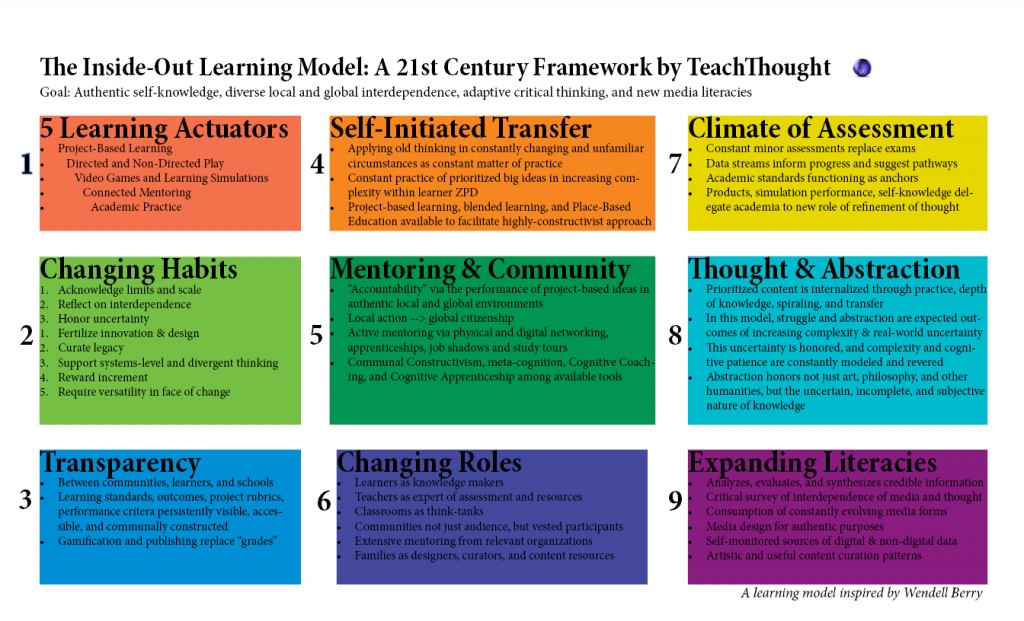
Ran across another great infographic and post, “The Inside-Out School: A  21st Century Learning Model,”  from Teachthought.com.

Here’s the infographic:

More on this later, but I particularly want to point out #7: Climate of Assessment. The first bullet point is, “Constant minor assessments replace exams.”

This is what I see happening in education reform – the move to continual formative assessments, rather than one big culminating assessment, such as an exam or final exam. I suppose people argue that the final exam is a way to make sure the student retains all the content from the term, but I wonder if this is ever really successful. I’d think a more successful model for ensuring a student retains content is to constantly build on it, week after week. Cramming for one exam doesn’t ensure that the content is learned beyond the exam. Yet, working with content, either building on it or doing more project based learning where the content is lived, may better ensure that the content sticks.


Taking Standardized Tests for a Living

No one I know takes standardized tests for a living. So, why are we using standardized tests to see if you’re going to be good when we don’t have standardized tests after you take them?

…It’s infected the entire ecosystem of education.

If we can get parents and kids and teachers and administration to talk about it…then change will start to happen.

-Seth Godin

This is a powerful quote for me to see today, as I’m heading off to a district curriculum meeting (a parent “advisory” committee, where, honestly, parent input is sought because they legally have to. I don’t think it makes one whit of difference, but if I don’t participate, I don’t get a voice.)

Tonight, we’re reviewing proposed Advanced Placement courses. I will likely be skewered when I say that I disagree with this approach. I don’t like AP classes because – and this is fully acknowledged – they are teaching to a test. AP classes give a set curriculum to schools that cannot be changed. AP classes are a mile wide and a centimeter deep. As a professional historian, I have worked against courses like this my entire professional life because students take these broad history survey courses and don’t like them. Thus, they think they don’t like history.

OK, that’s a blog for another post. This one is about standardized testing.

I’m an excellent test taker. Give me a standardized test about anything – nuclear physics, calculus, English literature, whatever. I could take it and probably do pretty welll. Do I know anything about the subject? Nope. But I can take tests.

I love this quote from Seth Godin. Check out the entire video posted in a blog by Josh Gans, “Learning Should Fit the Child.” (As Gans acknowledges, the video is by Ericsson and is a little bit marketing, but hey, it still has excellent content.) The video is worth your 20 minutes.

The blog post is worth your time, too. Memorizing isn’t useful. Learning how to find the information is useful.

Power


It’s Not Just Me!

Wow – I’m not alone in my dislike for AP History courses. As I was doing some research to submit a proposal to an education technology conference, I ran across an interesting “Roundtable” on teachinghistory.org about AP history courses.

Seems even AP History teachers aren’t always fond of AP courses. Their reasons sound quite similar to mine:

  • too much content too fast
  • teaching to multiple choice tests doesn’t teach anything
  • survey course doesn’t allow deep, meaningful work
  • etc. There are many more good reasons.

As a professional historian, I find these broad survey courses to be worthless. Does a student need to have a general sense of history? Of course. Do they need to learn this much this quickly? No way.

I’d much rather see students learn to understand the present through the past. Select a current event. Find the relevant history that brought us to where we are today. Dig deep. Find primary sources that build an argument and explain a situation. Give me a History Day project over an AP test any day.

I will be bringing this up at a curriculum night at the school. I fear I will be hooted out of there for daring to question their precious AP classes. I just find it interesting that 5 of the 6 teachers presented in that roundtable dislike the AP classes.