Just ran across this video produced by a group of middle schoolers. I particularly like the part where they say,
- Let me show you
- Let me sing it
- Let me create it
- Let me record it
- Let me program
- etc.
It’s worth the 6 minutes. HT Scott McCleod

Just ran across this video produced by a group of middle schoolers. I particularly like the part where they say,
It’s worth the 6 minutes. HT Scott McCleod
When I was in high school, we lived in fear of open book tests. They were much harder than “regular” multiple choice tests. The teachers that gave them were also well known for asking us to really think and analyze.
Now, there are open internet tests! Seriously – what a great idea. This post by Jonathan Martin shows exactly why. A theater history teacher did an open internet test with great results. See the post for student comments – seems they all thought it was harder — and better.
…taking the time to think through as a teacher what kind of questions can we ask which will continue to be meaningful assessments when Google and Wolfram Alpha are available is, I think, a highly productive exercise, and, of course, will generate a more authentic assessment experience far more well aligned with the real world of professionals for which we are preparing our students.
The teacher’s rationale for doing this test:
did I really need the students to regurgitate information or could I ask them to utilize Internet resources and their class notes to compose essays based on questions that they helped craft?
It’s a great idea. It’s more closely aligned to what will be expected of them — yes, in college, and ultimately, in the working world. It’s teaching critical thinking, analysis, digital literacy, writing. The list gets long…. much better test of what students know and how they think than picking a letter on a multiple choice test.
Ran across this incredible concept, the Student Technology Bill of Rights, by Brad Flickinger. Check out both Post 1 and Post 2. I won’t quote him here, but just highlight my favorites. (And will be taking them along to kids schools. Wish me luck!)
#3: “I have the right to submit digital artifacts that prove my understanding of a subject” hits home at our house right now. Many previous posts have discussed the Pre-AP World History class that my daughter will take next year. Text. Text and more text. Nothing wrong with some text, but we have decided that she will just do projects visually and digitally. I’m tired of having to constantly advocate for digital/visual assignments. It’s just what’s going to happen.
#5: “I have the right to access social media at school. It is where we all live, it is how we communicate — we do not use email, or call each other. We use Facebook, Twitter and texting to talk to each other. Teachers and schools should take advantage of this and post announcements and assignments using social media — you will get better results.” This is so true.
#7: “I have the right to be taught by teachers who teach me and demand that I use 21st Century Skills.” So true. My kids’ assignments should not look like the work I did 30 years ago when it is so clear that teaching to all kids modalities and using 21st century tools work better.
#9: “I have the right to be protected from technology.” Yup. It is now the school’s responsibility (along with home) to teach digital citizenship. Teach kids to start building a positive digital footprint.
#11: USE THE CLOUD. Yes, please. I almost cried when my son said he had to buy a flashdrive for school. REALLY???? I refused. And this when the teachers use Google Apps for Education daily. Why not the students? (footnote: this will be changing soon!!)
#12: Let them text: if a kid wants to write by texting, why not? It’s EXACTLY the same argument I heard when I was teaching, although in this case is was whether to let students write in the cultural dialect they spoke at home. I let them. They were writing, communicating, thinking. We also taught “educated” English, but didn’t cut them off from who they were.
These are great. Thanks, Brad!
HT to Patrick Larkin (@bhsprincipal) for this great 5-minute excerpt from a talk by Will Richardson. Mr. Richardson challenges his audience, Are you going to be BOLD or OLD?
I found two takeaways:
FIRST POINT: The 21st Century Literacies from the National Council of Teachers of English. The three of these I find most compelling, largely because they are not being met in the two schools I know best,
It’s not easy to develop proficiency with anything if you can’t use it. If you have a computer in your pocket that gives you access to libraries full of information — yet you aren’t allowed to use it during the day? How can you learn how? You learn on your own, without the guidance of teachers and adults in your life.
How can you learn to create and critique multi-media texts if you aren’t allowed to use these tools for assignments? If you aren’t allowed to look at them?
Let’s not even start with learning the ethical responsibilities. In some schools, it’s like plugging their ears: if they can’t hear it, it’s not making a sound! If you never let the kids use the tools of technology (which, right now, are social media, cell phones, mobile devices, etc.,) then there’ll never be a problem. Right? Nope – wrong.
SECOND: Mr Richardson is addressing a room of teachers. In his remarks, he tells the teachers that they should be the “Learning Leaders” – they can convince parents that the kids will be ok, that they’ll get into college. That it’s the right thing to do to have kids who are passionate, deep learners – kids that love to learn.
But what about my situation? I’m the parent. But in our case, it’s the schools that need convincing. I’m not having much luck at this. I’m met with comments like, “If we let them use their phones, they’ll text the answers,” or “We can’t do projects (digital, multimedia, etc.) because that won’t help them get ready for the AP test.” Or teachers who can’t see any reason a student should get an iPad because all the apps are games that aren’t helpful. Or a principal who leaves all technology innovation to the teachers, who’s never been on Facebook. A school district where webpages are three years out of date. A high school that doesn’t require – or even encourage – teachers to post homework, test schedules, etc. online for kids to access. High school current events classes that only use the print newspapers. A district that won’t look at BYOD because it won’t be equitable – instead of figuring out how to make it work
Mr. Richardson – what would you advise me to do? My kids are moving along through school quickly. They don’t meet any of the NCTE standards of literacy. I shouldn’t have to disrupt them from their friends — and yes, from the other very good things that do happen in these schools — to get them to schools that do understand that it is not a “fun” thing to incorporate the tools of technology into schools, it is the RESPONSIBILITY of schools to do so.
I leave you with this quote from Mr. Richardson,
It’s not about passing a test, it’s about solving the problem, about sharing something with the world that changes the world. It’s about doing meaningful, real work. School should be real life.
Thanks to Diane Ravitch for the link to this great article about dyslexia. Many thanks to the author, Steve Dingledine.
The current movement towards using appropriate tools in the classroom, whether it is an iPad, Chromebook, laptop, whatever, is a step in the right direction of allowing students with dyslexia — or any other learning disability, difference, or even just students who learn best in different modalities (visual, auditory, kinesthetic, etc.) — the chance to really be successful in school. A learning difference should not equate not being successful at school and in life.
…many dyslexics have other cognitive skills in abundance, including visualization and intuition. They can also see problems and solutions in the big-picture frame and can detect obscure patterns in unique and, at times, revolutionary ways.
The education system owes it to these kids – those with dyslexia or any other sort of learning difference – to adapt the SYSTEM to the kids. The kids shouldn’t have to suppress or ignore their natural skills in order to learn.
Dyslexics and other non-conformists need time and space to grow within school contexts. Their creative genius and divergent thinking needs to be incorporated into classrooms and not stifled.Their teachers need to have the flexibility and freedom to nurture their strengths and talents while helping them to reach their potential on their terms.
Like the author of the post, I am a textual learner. His wife is dyslexic. My daughter has not been diagnosed with dyslexia, but has considerable trouble with text based learning. She is a strong visual learner. I really appreciated this thought:
Our society, unbeknownst to me beforehand, is heavily geared to text-based learning and work activities. The emphasis on reading text, which creates “winners” and “losers” through standardized tests and entrance exams…
My (many) previous posts about my daughter’s choice for an advanced social studies course next year have focused on the responsibility of the schools to provide an adequate education for all learners — not just text based learners. It’s going to be a struggle to get them to accomodate my daughter’s needs, but why should just the kids who are text based learners have access to the advanced content and be considered “smart?”
Hopefully we’ll see things changing as schools move more towards allowing and encouraging students to make use of technology tools and the paradigm shifting that happens (or should.)
The other 3 (human) members of my household are all visual learners. They see everything from numbers to dates to stories in their heads as pictures. My daughter sees all numbers, letters, days of the week, months, etc., as color. This is odd to me, as I am very much a word person. I don’t see pictures – I see words. (You’ll notice my blog is far more words than visuals.)
Yet, for my daughter especially, school is very much a word based place. She works twice as hard as a word based person to read – every word is turned into a picture. Her move to the high school has just exacerbated this problem. If you’ve read previous posts, she wants to take Pre-AP World History next year.

Does this look enticing for a 21st century visual learner?
We looked at the book – it’s deadly. Print. Pages and pages of tightly spaced words with no visuals. Class assessments are totally writing based – essay, tests, etc.
The teacher told me it was because it would be what the kids would find in college. I don’t disagree with the need to learn how to read advanced texts and be able to write essays. But is that really the only way to learn content and demonstrate understanding? Why does a high level history class have to focus on words only? Where are the visuals?
There are others who feel visual learning is valid. I just read a blog post about a teacher who has his students study a painting and read it as an essay about the time in which is was made:
He challenged students to think of a painting as an essay – in the sense that it captures not in words, as an essay does, but through a visual image, some aspect(s) of the life, history, and culture of a particular historical period from the point of view not of a writer but of an artist.
Awesome idea, and certainly a very valid way to learn concepts and history.
Another blogger wrote about the digital storytelling assignments she does with her high school students. In this case, students are given a topic and have about a week to put together a two minute digital presentation. Kids can use iMovie, Keynote, etc., anything that let’s them express their understanding of the topic in a digital mode. Visuals are considered key.
I would argue that these projects are a better assessment of a student’s understanding of a topic than a mere essay. If you check her rubric and watch the samples, you’ll see that the students aren’t slacking. They do have to write: no digital storytelling project would be complete without a script. They have to organize their thoughts in a storyboard. They have to also find appropriate visuals to express their ideas. They have to cite all sources. Some of the samples are more narrative or biographical, but you certainly could make these projects into something like a 5-paragraph essay with a strong thesis and supporting arguments. Like those who argue that giving students a public audience for blogs, the whole class watches the videos and is even quizzed on the content!
Digital storytelling can be used with all ages and subjects. The product doesn’t have to be a polished 2- or 10-minute video. Shelly Terrell writes about an online course she’s teaching (to 250 people!) about digital storytelling. She lists a number of quick ways to get started (such as having students pull out their cell phone and tell/write a story about a picture on their phone) and a myriad of resources for building digital stories.
I can easily see the problems in assigning a digital project like this: access to a computer lab, teaching students about the software, etc. But why not make it an option?
I know my daughter will gravitate to study fields that are more visual and less towards the word based content. I’m sorry that history, which she really enjoys, won’t be an option if her classes continue to be offered in these exclusively text based formats. The teacher next year thinks he’s really helping her by teaching her how to learn the way he thinks she needs to. I think he’d do her a lot more good by letting her express her understanding in a format that makes more sense to her.
I had the good fortune to attend another Apple education seminar at Little Falls High School . Last spring, I attended a morning session where the Project REAL plan was presented and the 5th grade teachers and students who piloted iPads were there to show what they had done. Last year, there were approximately 40 people in attendance.
This year’s seminar was a full day. Teachers presented about what they had been doing, then we had time to visit with students and teachers at tables. The IT staff answered specific technical questions. This time, there were over 250 people at the session, and more than 550 people were watching the livestream. Wow!
Thankfully, they recorded the morning session which had about 12 teachers presenting different aspects of how they have used iPads this year. Watch it for yourself and see the great stuff happening in Little Falls!
It was a great day with many interesting stories. If I wasn’t already convinced that schools need to move to this direction, I am now.
Here’s a quick list of highlights for me:
The FCC published the Digital Textbook Playbook on Feb. 1, Digital Learning Day. The Playbook (and other resources) are designed to provide schools with resources for building their own digital learning environment.
I’m just reading the Playbook and am seeing great quotes. I’ll post the quotes here as a place to keep them.
The dynamic in many classrooms around the country remains decidedly 20th Century:
teach the paper textbook, test the students at a fixed point in time, and move on. There also remains a
profound disconnect between the learning that happens in school and that which takes place out of
school. – p. 6
A modern day approach to digital learning is a personalized experience that dynamically identifies and addresses each student’s unique learning needs in a manner appropriate to their learning interests, styles, and aptitude, and does so anytime and anywhere.
The most important component of successful digital learning conversions has been strong, collaborative leadership.
Too often technology and digital learning is added on top of the existing practices, challenging already
busy curriculums and overwhelming busy teachers. Instead, successful digital learning implementations
require modifications to the curriculum to replace ineffective practices with those that best leverage the
technology. – p. 14
— from the Digital Textbook Playbook, published by the FCC, Feb. 1, 2012
Math was created to solve problems not to complete redundant worksheets.
Jan. 28, 2012
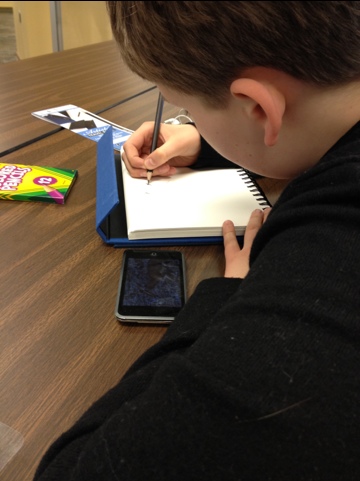
I dragged my son to an educational technology conference this afternoon. He brought along some stuff for drawing. But, did he want to draw a bunch of adults in the room? Nope. Well – he pulled out his iPod and found a photo of an animal to draw.
Gotta admit I wouldn’t have thought of doing that.
 My Wired Life