SRA – Individualized Reading

Nostaglic post from Audrey Waters about the SRA Reading Cards of my childhood.

First, Audrey Waters is awesome. She is even far more snarky than I am, and for that, I love reading her stuff.

Second, this post traumatized me! But, caused me to think.

Waters talks about the SRA program through the concept of personalized learning. She brings up B. F. Skinner’s “programmed learning” concept. Yup, that’s definitely what it was/is (I guess it’s still around).  I totally see her point here: kids were often “rewarded” when they finished other work by getting to go to “THE BOX.” You read, answered questions, and checked it off, “DONE!” Then, on to the next one. Step by step.  There’s no creativity, no freedom of choice. I can’t remember the questions about the reading, but I’m sure it was basic, low-level reading comprehension.

She points out it’s often strong readers who loved this program, not the kids who struggled and were always reading the orange (or blue or green – whatever colors were the easier cards.) I can see that, too.

Box of SRA reading materials, ca. 1973. Image from an ebay posting.

Box of SRA reading materials, ca. 1973. Image from an ebay posting.

I see all this, and will look at SRA in a new light. Yet, I loved the SRA Reading program when I was a kid. LOVED. I mean it made me very happy to get to do SRA reading. Why? Because, for me, it was personalized. I got to go at my own pace. It was torture for me to sit through reading classes in the early grades. I had been reading on my own since I was three. Reading with a class caused me tremendous anxiety and frustration. I just wanted to READ. Not hear other kids learn how to read!  With SRA, I could read as fast and as far ahead as I wanted, instead of getting told to stop reading ahead. Admittedly, this was something I could do very well and it got me strong positive feedback. So, why wouldn’t I love it?

I see her point, and look at the website, see that they now have a digital version! One potential positive with the digital – maybe – would be that kids who weren’t enthusiastic readers wouldn’t have to show everyone what color they have. It’s possible. And, the kids who liked to read far ahead, they can do that, too, without being teased. (This never happened to me, but it did to my son. It is just as traumatic as seeing you’re behind.)

Thanks, Audrey, for that trip down memory lane!

Letter to a School Board about Test Refusal

Courtesy Fort Worth Squath. CC license

Courtesy Fort Worth Squath. CC license

It’s testing season again. I have had conversations with a few parents about opting out, or as I’m seeing it now — refusing the test. Because my daughter is a senior, she doesn’t have to take them. My son (a freshman) is at a private school, so no tests. My family’s days of test refusal are over, but I dug up the email I sent to the school board last year explaining why we opted out. To be clear, my daughter was a junior at the time. She was very involved with the decision. It was not something we forced on her.

We sent a version of this to our state legislators as well.

Our Letter to the School Board

To the ISDxxx School Board and others,

This past school year, we opted our daughter out of MCA testing, and wanted to let you know why. She’ll be a senior next year, so no testing. We would definitely continue to opt out of MCA testing if she was younger.
We have long felt that there is too much emphasis on standardized testing that takes away from real learning. We were grateful that the Legislature changed the graduation requirements last spring, so she could opt out this year.
Here’s why we chose to opt out:
  • Test taking skills: when our daughter was in 8th grade, her math teacher told us she spent 3 weeks preparing the students for the MCA test. THREE WEEKS of valuable class time teaching them how to take a test?
  • 19th century skills: standardized, fill-in-the-bubble multiple choice tests test one type of learning and encourage memorization. They do little to allow students to demonstrate 21st century skills, such as creativity, critical thinking or collaboration.
  • Lifelong Skills: We’ve been in the workforce for over 25 years. We have yet to need to take a multiple choice test as part of our jobs. I’d prefer my kids were taught the skills needed in the current and future workforce, which include not only 21st century skills, but things like computer coding, visual literacy and creativity, and digital citizenship.
  • Teacher Merit Pay: basing teacher pay on student test scores is offensive to teachers and students alike. It encourages focus on test taking skills over and above less “data” like creativity. Our kids are more than a number on a test, and that is why we pay fantastic teachers to get to know our kids as people.
  • Stress/Anxiety: I hear from teachers and students about the stress and anxiety these tests cause. Teachers hate making kids take tests, kids hate taking them. Why put everyone through this for such little gain?
  • Delay in reporting: With the MCAs, tests are taken in the spring. Results come back months later, thereby practically useless.
  • Profit: the only people who profit from these tests is the companies who make them. They are expensive, there’s no accountability and there are proven errors. Why are we paying these companies so much money? This goes for the MCAs and the AP tests — cash cows for those companies.

We realize the School Board doesn’t make the decisions about the MCAs. We will also send this to state legislators, who in spite of not being educators, make the decisions about these tests that so impact our children.

The Board does make the decisions about teacher merit pay. This issue is complex, and I don’t pretend to understand it. However, I’d encourage you to reward the wonderful ISDxxx teachers based on things that really matter: the relationship they build with students.

Classroom Stress

Wonderful opinion piece by a women whose family is spending 6 months in Norway. Her son has ADHD, but has not been taking meds while in Norway. Her son has no sign of ADHD. Why?

What accounts for this dramatic change? Neither his diet nor the amount of “screen time” — two factors sometimes implicated in the rise in ADHD — has changed significantly. What has changed is his school experience.

Bold is mine.

What’s the difference? More recess, small class sizes, lack of chaos and no testing. Less time in school, field trips and more unstructured time.

It’s a quick read and worth it.

SXSWedu

Just back from a crazy trip to Austin, TX for SXSWedu. I admit I was beyond excited to get a chance to go to the legendary conference.

Here’s the highlight reel:

Reading digital text

There is much controversy about the efficacy of reading on a device. In the past few months, a couple of “studies” have come out showing that students don’t learn as well when reading digital text. This session took issue with these studies, and I applaud them. I am oversimplifying their points here:

  • One major point was that comparing reading on a device to print is like comparing apples and oranges. It is not the same type of reading, usually. Device reading is often for a completely different type of content.
  • Point two: it is crucial that we teach students how to read on a device. The skills of digital reading need to be taught.
  • Point three: digital text offers advantages including immediate feedback.

For someone who builds digital materials, it’s important to note that we need to use digital text to enhance the reading experience. Things like customizable fonts/sizes, audio narration, highlighting, taking notes – all these things are important.

The founder of Curriculet was part of the session. It was very interesting to hear why he founded the company in response to what he saw as a lack of good digital content when he was a teacher/principal.

NatGeoEd.org

maps

Tile map activity from NatGeoED.org

Went to a fun playground booth by National Geographic. Great activities and demos about using geographical concepts with kids.

Kahoot

What can I say about Kahoot besides that I love it? They are coming out with some new features in the next few months that will make it even more useful for my needs.

Student Data

Student data and data privacy were big buzz topics at this conference. I should have attended more sessions about this. I need to do more on this topic. Hoping there is some of this conversation at ISTE as well.

Final Keynotes

The last day was 4 keynotes.

The first was the director of the Grammy Museum talking about the importance of music education. I agreed.

Sal Khan spoke. I have never heard him speak at a conference, and he was awesome. He’s very funny, a great speaker, and has a great story to tell. I knew lots about Khan Academy, but it was great to hear from him about their recent things and plans for the future.
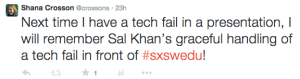
Screen Shot 2015-03-13 at 2.23.25 PMHowever, the best part was the tech fail. He was showing a video about a kid who used Khan Academy to not only catch up in high school but get ahead. The kid just accepted a full time job at Khan Academy (he has gradated from college now…) The video didn’t work. The audio did, but not the video. The tech guys tried three times, nothing. Sal just gracefully plugged through and kept going. Fortunately, the audio was the most important part, but the lesson here was watching him deal with the potential melt down of his talk. He rolled with it and was inflappable. I will remember that for the next time my tech fails — fortunately, it will not be in front of hundreds of people!

Overall Thoughts

This was only the 5th SXSWedu, building off a very successful brand for the Music and Film events. I believe I heard there were 8,000 people for the EDU event. After ISTE with 15,000+ people, this one felt small – but that’s not a bad thing. I was able to get in to sessions with no problem and the venue was easily accessible without being overwhelming. Attendees were an interesting mix of some teachers, more administrators and lots of edtech company folks.

Sessions were a mixed bag, but that could be because of the sessions I chose. I naturally gravitate to the technology sessions, but with one exception (the digital reading one), there was nothing new or even that interesting. I started attending sessions that were far more out of my normal subjects (such as the student data session), and that was better. Still, the sessions I attended were not all that inspiring.

As I’m learning, the best experiences come in more direct connections. The most valuable conversations happened in the Playground, where a handful of vendors were set up. It wasn’t an Exhibit Hall (which was oddly open only during one afternoon???) although it was people with commercial products. It felt more like a demonstration area. There was a space for short talks and another for hands-on interactive experiences. This was where the folks from Kahoot and National Geographic were located.

Overall, I think SXSWedu has great potential, but at this point, it feels a little unfocused and it needs to find its stride.Not being quite as teacher centered at ISTE, the conversations were bigger and more theoretical.  Unlike ISTE, SXSWedu has potential to have a bigger museum presence. We felt that conversations about informal learning and how museums are a great partner option would be welcome here. Next year we’ll propose a session!


Choir and Technology

I’m currently at a conference, although not really. My daughter is singing in a national honor choir (congrats!) and I’m here as her “chaperone.” Basically, it means I have a ton of freetime while she is in rehearsal!

As chaperone, I can go to sessions and concerts. I was excited to see a fellow blogger Chris Russell presenting today. (To be clear, Chris is truly a blogger with useful information. I just happen to vent on a WordPress site from time to time….)

I’ve seen Chris present number of times at education technology conferences, but really enjoyed seeing a presentation in a music conference setting. Many different kinds of jokes from this perspective!

It’s pretty clear that choir classrooms are not the first to jump on the technology bandwagon (except for Chris!) He did a great job setting up why it’s crucial to be using technology. He points out (very accurately) that the kids are using technology in your class already, whether you like it or know it.

I especially appreciated two thoughts. One was a phrase I haven’t heard before — but just loved and will use (with credit, of course!) The concept of technology integration vs. outtegration. He feels that most of the tech use in music/choir classes has been outegration — a recording made outside of class, or listening outside of class. Instead, the use needs to be in class.

Second, was attributed to someone I neglected to note – but the quote was, “Are you here to learn or are you here to change?” This is a great way to think about technology in classrooms. We should never be using tech in a classroom just for learning the same way we always have. Does the choir classroom look the same way it did 50 years ago? Instead, technology allows us to change  the way the classroom looks and the way the learning happens.

The rest of the session covered 9 excellent strategies for stepping in to the shallow end of the SAMR model: substitution and augmentation. This is a great way to approach a group of people who aren’t comfortable with tech. There were definitely a few of those people sitting by me.

The audience asked some great questions. It seemed to me that it was a group of folks hungry for information about this topic. It is definitely scary to some, but this wasn’t a group that seemed resistant – quite the opposite. It was clear that some of them were familiar with the concepts, had used some of the tools. They were there because they were excited by the possibilities and wanted to learn more. I left feeling very positive about the direction this is going. I think there will be many more opportunities for Chris to share his knowledge with this group!

Dear Student Letter

Posting this “Dear Students” letter to keep it in my list.  She has great one-liners, such as

I’m sorry that you are forced to sit for six hours each school-day despite research that reveals the detrimental cognitive and health effects of excessive sitting.

This teacher puts into words what I feel, but cannot say — not being a teacher. It’s what I’ve seen happen to my daughter, in particular, as she went through a traditional high school setting. Of course, she needs to take some responsibility for her own education, but watching these last four years has given me an entirely new perspective on the kids who don’t appear engaged in school.

My personal world view held (past tense) that academics were the be all and end all. The measure of success was your GPA, where you went to college, etc.  Of course, you’d be engaged in school and get As. Kids who didn’t were just lazy.

Watching my daughter’s journey through school, especially high school, has changed my perspective tremendously. A kid who is “shut down”, doesn’t do homework or participate in class likely has a very good reason. It may be the “problems at home” excuse we hear about. This is certainly a legitimate reason and a very real situation for many students.

The one reason I’ve never heard from her school is “problems with school” — not that my daughter is having problems in school, but that the school set up itself is the problem. No one has ever suggested that the reason she’s shut down and not engaged is because the school atmosphere is overwhelming (2000+ kids in one space for 6 hours?) or that the emphasis on test prep (be it the state tests or AP tests) might lead to a type of learning that is not enticing beyond the drive to get a 4.0 GPA.  Could it be some of the reasons mentioned in the Dear Student letter?

My daughter with ADHD and dyslexia became a classic shut-down learner (see Dr. Richard Selznick’s writings for more) after 9th grade, and totally shut down after 10th. School was (continues to be) a major (I’d say THE) contributing factor in depression and anxiety issues. Yet, right now, she is directing a full-length student produced musical with 70 cast members. She has the entire show blocked in her head — exactly where 70 kids will be on stage, how she wants the songs to sound, the set to look and more. She’s actively making decisions, working with a production team of peers, and directing a cast of her peers (much harder than an adult directing high school kids). She was forced to choose between two best friends for the lead. Frankly, I think this is a tremendous learning experience — and honestly, more valuable life skills than some of the academic work.

I don’t buy the “blame the victim” attitude that it’s all her fault that she’s not engaged in school. (And that is what I often hear. Most of her teachers have been caring and understanding, but the system does not allow for any flexibility unless one pushes VERY hard. That’s a topic for another post.) I certainly couldn’t tolerate the conditions in which she has endure  to be at school. It’s true that some kids thrive in school — which is awesome. But, just because some kids look and act like they don’t care does not mean they are bad kids or not worth it. Look deeper — there’s likely a pretty valid reason and we owe it to these kids to meet their needs. Maybe, just maybe, it’d be worth our time to make some of these bigger, systemic changes like mentioned in the Dear Student letter that would mean all learners would be engaged, have a positive experience, and grow into thoughtful, caring and successful adults.

Traditional Learning

Again, from the MOOC I’m taking about e-Learning Ecologies…. this course is really far bigger than e-learning. It’s about transforming education to the 21st century.

Great quotes:

Long-term memory in traditional education is remembering it until the day after the test.

This one is fabulous. The goal of the learning is learning how  to find information. If a student has researched, found the information, and presented it somehow,

The empirical details [about a subject] are irrelevant. They don’t need to be remembered because you can always look them up again.

Maverick Superintendent

My local school district is looking for a new superintendent after a long tenure (17 years, I believe). The current sup is much loved and revered by some — he’s done a great job keeping the district fiscally sound and has weathered the ebbs and flows of student enrollment. He closed schools early on and is now having to add space. He’s led the district through significant demographic change and is responding to the changing demands. He saw the introduction of the first 1:1 iPads in the district this year.

I did have the opportunity to participate in a focus group to give input on the new hire. No idea if they’ll listen to anything we said…. Just saw this great article about a maverick sup in NJ — THIS Is what I’d like!

Why? Highlights:

…we’ve redefined what public education should look like, to include creative problem solving and social and emotional well-being to be as important as academic success.

…we reframed what teaching and learning looks like by focusing on project-based learning.

I ask teachers all the time, if you can Google it, why teach it? Because we have so much information today. How do you help kids navigate that? That’s critical thinking and creative problem solving.

[businesses] want kids who can solve problems and think critically.

I am not anti-testing. I’m concerned about the policies associated with the testing regime and how they may detract from the quality and purpose and the use of tests.

Let’s bring this guy in!!!