E-Learning Affordances

I’m taking a MOOC called E-Learning Ecologies. At first, I wasn’t sure it was interesting or applicable, but I am finding it to be a fantastic experience. I don’t take MOOCs to get the certificate — I take them to get the knowledge. I don’t have time to do the level of work for the certificate, but I certainly enjoy being exposed to the new ideas and concepts. This is just a place for me to jot down some notes from this week’s conversations.
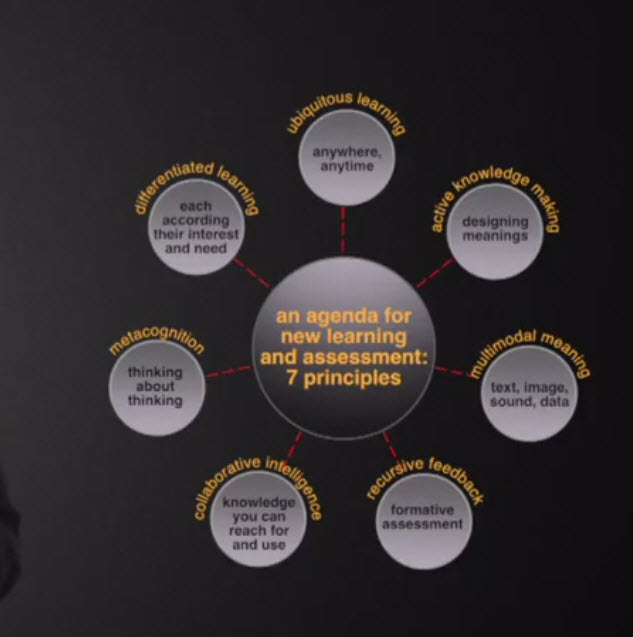
The 7 E-learning Affordances

The 7 E-learning Affordances

This course is putting forth 7 E-Learning Affordances. (See image). These are completely applicable to my work and to my shifting views of education.

Today, I’m watching video lectures about students as content creators as opposed to content consumers. The concept is quite basic.

  • Traditional learning: hand a student a textbook, asking them to read a chapter and spit back the info on a test.
  • Content creators: assign students to report on a topic. They talk about a report, but it could be a written report, a video, a poster, etc.

Assessment changes, too. It becomes irrelevant to be able to recall a series of facts. If you did all the research, you learned how to find the facts — a much more valuable skill. The  capacity/ability to produce a scientific artifact — becomes the evidence of learning, not the memory. “The test that just assesses memory is not as important as the test of what you actually did.”

While this concept is not at all new to me, I liked how they explained it. There is, as well, the need for me to find others who reference this type of thinking. For example, when I talk to people at my kids’ schools, it always goes better if I can cite a professor or academic work.

Balance of Agency

Here’s a great example in the shift of balance of agency — many years ago, there was Casey Kasem’s Top 40. We were told the top 40 songs. Now, everyone has music on their phones, create their own playlists — create their own top 40.

This is a shift from centralized agency to distributed, where people build their own.

Another great example is video games v. film/tv. In a video game, your actions have an impact on the narrative. In a film or tv show, you have no impact on the narrative. And — the video game industry is now apparently larger than Hollywood!

How does this impact education? This shift to active learning has to be reflected in schools. Kids are used to defining their own narrative, be it a playlist, a video game or learning. If learning does not adjust, we have problems.

More about Student Choice/Freedom

Sam Tanner writes,

High school students are not used to freedom in academic work.

I agree, and am pleased that he has just done the assignment he knows pushes them. They are in charge of demonstrating their mastery, in whatever way works best for them.

Saw a blog post today with a similar message, “Demonstrating learning doesn’t have to look the same for every student” by Amber Teamann. She talks more about elementary students, but the theory is the same.

In our particular situation, the vast majority of assignments at my daughter’s high school involve demonstrating her mastery of the subject through a prescribed, teacher led task. At least in her experience, it’s been a rare instance when she could do this in whatever way she wanted. In most cases, Mr. Tanner’s class being the exception, she’s struggled with this – as have her peers. They have been so trained to do what they were told that they cannot think for themselves.

In her particular situation, the way she’s being asked to demonstrate mastery is through word-based tests. This is not her strength, and she has not always done “well” (when measured by grades.) This can lead to a learned helplessness, so eventually the student stops trying. Learning becomes all about the grades and performance on tests, not about learning and analyzing the material.

Yet, when she found the confidence (in Mr. Tanner’s English classes) to explore and explain her mastery as she wished, she created elaborate projects that accomplished the goal: show what she learned. She integrated an entire trimester’s worth of learning into one art project.

This is life, people. There isn’t a teacher always telling us what to produce. Yes, certain jobs require this, but for the most part, we choose the jobs that fit us. We develop solutions to problems. We communicate to others — and we often choose to do this in a way that suits our personality and strengths. Why aren’t students encouraged to do this, too?

Stealth PBL

I have a ton of respect for teachers who teach they way they know is right, in spite of all the pressure on them to teach the status quo. Fortunately, my daughter has had one of these teachers. It has had a significant impact for the better.

Here’s a recent blog post he wrote about the project he assigns to most of his classes. A couple of paragraphs explain why he does this and its impact.

Here’s what he does:

I inflate the point total, give the students a list of the state standards we were supposed to meet as a class, and allow them two weeks to assemble everything that they accomplished in the class as evidence that they worked to meet said standards. At its core, the project is an interpretation of project-based learning which, at its core, is a response to Dewey’s theorization of experiential or authentic learning. This approach has always seemed a more authentic assessment of what a kid actually got out of reading literature or writing essays with me for the duration of a semester.

At this school, this project is significantly different than what most classes require. As I’ve discussed in many previous posts, the amount of multiple choice testing is ridiculous. I’ve bored this particular teacher with rants about this many times in the past (poor guy). I am always so impressed that he just does what he knows is best. He understands these kids and gets great results.

It also seems fantastically out of place in a high school. Tests and worksheets are far more expected than an open space for students to express content in their own way. Veteran colleagues or well-trained students are often baffled or dismissive when I explain the project to them.

How do kids react?

The final project frustrates and confuses them because they aren’t sure what they are supposed to do. High school students are not used to freedom in academic work.

That last sentence is key (emphasis is mine.) So much of high school is doing what the teacher wants in order to get the best grade in order to get into college. Kids don’t get much chance to explore their own thinking. It’s so much about memorizing and spitting back.

I still don’t get why spitting information back is preparation for college or for life after college. In my job, I never have to spit back information (and I’m a historian!) I’m always problem solving, creating solutions, finding information and developing better ways of doing things.

I have to say, it has been gratifying watching my daughter do the final project for this teacher (she’s had two classes with him where she’s had to do this project.) She wasn’t frustrated or confused. I honestly have never seen her put as much time, thought and effort into a homework assignment. Both times, she spent hours creating her project.

Her projects were just that — creative. Not rote. They were both visual representations of the course content. They were not literal, they were abstract. While one did involve words, the words were secondary to the visual and tactile representation. The words were part of the art. When asked about it, she could totally explain how the project reflected what they learned in class. She was able to create and think, rather than just spit back in a prescribed manner.

I’m just grateful these kids had the opportunity to work with him.

Achievement Gap or Culture Gap?

Great article in the Washington Post by James Boutin, a teacher near Seattle, “We are trying to close the achievement gap all wrong.”

I served on a couple of committees for our local school district. We’d get extensive reports about the “achievement gap” — how the test scores of certain ethnic groups were lower than the scores of the majority group. Were there big differences? Yes.

But I kept asking why the only measure of success was these certain tests. The admins looked at me like I was crazy. The other parents also looked at me like I was crazy. I tried to explain there were two reasons I asked this question:

  1. Standardized tests test a certain type of learning and not necessarily the kind of learning that is, in the end, valuable.
  2. Standardized tests are culturally specific. They are often culturally biased and reflect the values of the majority culture. Besides, how do we know that other cultures valued succeeding on these tests?

Boutin’s article explains this much more eloquently than I ever did.

Ironically, I would say schools continue to disservice students because they’re so hellbent on closing the achievement gap of standardized test scores.

Students who have to spend the vast majority of their day doing reading, writing, and math instruction geared toward helping them pass tests lose valuable opportunities to practice other skills and learn things critical to being human and participating in American civil society. Why don’t we spend more time teaching students about interpersonal communication or nutrition or personal finance in public schools? Why do we still cling to a curriculum that is outdated and thin?

He goes on to talk about how different groups value post-secondary education. He gives an example of a student who wasn’t looking to go away to college because the family needed them close. As he discusses in this quote, the culture that values individual success isn’t the culture of all the students.

It reminded me that I come from a family and culture that puts great import on individual success. Different people and cultures will define success differently, and our public schools must be a place that accommodate those differences, particularly regarding how we talk to students about their post-secondary life and aspirations.

Early in my career, I had the good fortune to work closely with a group of Ojibwe people. The cultural values around home, family and success were so different from mine. Going away to college was not desirable – it brought back memories of the days when Ojibwe children were forcibly taken from their homes to go to boarding schools. Kids who did leave for college often returned before graduating, as they found it difficult to live away from their family and culture.

I’m sure there are many cultures in today’s schools that have similar cultural values. Why is the mainstream culture measure of success the only one we value? Why is that the only way to get ahead?

Positives of ADHD

LOVE this article about Scott Barry Kaufman about ADHD, “The Innovative and Creative Power of ADHD”.  I’ve heard him speak, and I find his messaging about ADHD to be so wonderful and empowering.

Listen to the audio interview – it adds much more to the article.

Kaufman says that parents need to work with schools to identify learning formats that don’t stifle creative thinking.

He talks too about students needing some autonomy in their education. I don’t see either of these things happening in the large public high school we interact with. It’s driven in large part by rule following, fill-in-the-bubble tests and classes that don’t value creativity. I won’t go on and on now, I’ve done that in the past. I think I’ll just go get Kaufman’s book

I’ve blogged before about Scott Barry Kaufman

Communication vs. Writing

This blog is a great place to story some of my other writing. Here is another response I wrote for the MOOC, “The Art of Teaching History.” The prompt in this case was, “What are the obstacles to teaching writing?”

Communication isn’t just writing

The prompt this week is about obstacles to helping students become better writers. I certainly support helping our students become better writers, but I feel there is a gaping hole in the conversation in the videos. Our old definition of writing is the obstacle. We must think about communication, not just writing.

The videos solely address formal, academic writing. Journals, when assigned, are still an academic writing exercise. As a few threads here have addressed, the world has shifted, and students are exposed to many different types of communication media: Twitter, blogs, videos, Tumblrs, Instagram, etc. The list is endless and ever changing.

I am glad to see a few threads here addressing the issue I see. Some of the threads here are disturbing, because the blame for students not being able to write is being placed on our students and their use of technology/digital information. That is simply not fair to our students, and shows a lack of being able to think forward. We cannot continue to live in the past and expect students to perform in school the way we, as adults, were taught. We — the adults — need to also learn from where the world is going.

I am not saying students shouldn’t learn to analyze and evaluate. They need to learn to communicate their thoughts and knowledge, including this analysis and evaluation. It is our expectations of how they communicate this that must change. Is the standard 5 paragraph essay still necessary? What about a 90 second video? A powerpoint/prezi or some other presentation? It takes more skills to communicate visually. They must still get their ideas out in an orderly manner. They must make a thesis and support these ideas. Using visuals, doing a presentation, or some other mode of communication is JUST as valuable — and perhaps in our increasingly visual world — MORE important than just being able to write.

Teaching other modes of communication also allow us to differentiate the classroom, and perhaps allow students to shine in different ways. We cannot limit our world to text. Students with certain learning disabilities or those who are creative/artisitic may show you a different side of themselves when presented with the opportunity to use other modes of communication. Students who are well versed in writing are done a disservice if they are not encouraged to explore other modes of communication.

Writing is merely the beginning. By limiting ourselves in teaching history to this mode of communication, we limit our students.

“Successful” Students

The following is a response I wrote for a Coursera MOOC I’m taking, “The Art of Teaching History.”

In the video I’m responding to, the instructor talks about what he thinks makes a “successful” history student. I admit I bristled at this a bit. Who defines a “successful” student? I’m sure there are many definitions/thoughts about success. What is “successful” for one student is different than might be for another. I tried to watch the video with an open mind.

Anyway, here is the response I posted on the course forums:

A “Successful” History Student

I struggled with the definitions given for “successful history students.” They were:

  1. Knows history/significant knowledge of history
  2. Reads and writes well
  3. Thinks analytically and historically

I do agree with #3, but the first two give me pause. In my work, I teach and develop content about state history primarily for 6th grade students. Perhaps these definitions of success apply better at an older age — more like undergrad — but I can’t apply them to 6th grade, middle school, or even to high school.

If the knowledge of history was the measure of success, we’d be testing facts. We don’t want to do that. We want to engage students in history, give them a sense of their place in the world and how the past has influenced where we are — where THEY are — today. For 6th graders, we strive to build a base of historical knowledge, of course, but our measure of success is not that they know the date of statehood. We want them to understand the factors that created the state, what were the positives and negatives about how the state was made. Who were the players? How do past events impact them today. We want them to understand the “So What” questions — why does it matter that we study history. We want them to know HOW to find historical detail and information. It is not necessary that a 6th grader memorize minute details, dates and more.

I also feel strongly that teaching history is part of the process of creating readers and writers, but this is a text-centric approach. Students today need to be able go beyond text and into visuals, audio and more. Our culture is moving from only text into communicating strongly through visuals (images, art, video) and sound. Students of today need to be as fluent – if not more so- with these modes of communication. They also need to be able to express their knowledge through these modes. Producing a video requires many skills: organizing information, determining important and non-important information, creating a thesis, writing a script, choosing appropriate visuals and audio and more. This, to me, is far more than writing, and we as educators and parents are responsible to see that students can do all this. Focusing on the academic historical essay is doing a disservice to all students except those planning on graduate work in history — and can be saved for the high school or undergraduate work.

A veteran teacher turned coach shadows 2 students for 2 days – a sobering lesson learned

This is a fascinating article. It is sobering, and as a parent, makes me incredibly sad. The comments are, as all comments are, mixed. Some make me furious, some are insightful.
To those commenters who blame the students for not learning, I ask you to talk to students. Those students in your class who “don’t care” may actually have serious issues at home, have a learning disability or mental health issues, or a myriad of other issues that interfere with learning. Or, maybe, one too many teachers rolled their eyes at them, and the kids no longer feel valued. I hope my kids never have you for a teacher.
I happen to be a parent of one of these kids. She is intelligent, creative, thoughtful and caring. She started school as an enthusiastic student. She will hopefully graduate this year, but she is a different person after being part of the factory school system that rewarded rote memorization over creative analysis. She has ADHD and works 10 times as hard as other students to maintain interest in topics that are not naturally interesting to her. Do not blame her for not being interested in every subject in school. I bet you weren’t either, and that’s why we – as adults – choose to be attorneys or scientists. We don’t study everything.

To those who support lectures, I hope you realize that the world has changed. While some lecture is still valuable, our entire world has shifted to a far more visual place. We access information differently. We process information differently. And that’s ok. It doesn’t all have to be the same as it was 20, 30, 60 years ago in order to be valuable. How dare you say you can teach if you are unwilling to learn new things?

After watching our daughter hammered down by a school system that does not reward her learning style, we purposefully chose a different school for my son. His class periods are long, but he says he never, ever sits for the whole time. He never goes a class period without interacting (verbally or physically) with the teacher and other students. His school builds in daily opportunities for students to move around the building and engage in learning other than classroom. He is given ample time to complete homework in school, and rarely has more than an hour of work at night. This means he can continue with his outside interests, which includes singing, composing/arranging music, piano, and reptiles. His learning at home is as valuable as his learning at school, and school supports this.

grantwiggins's avatarGranted, and...

The following account comes from a veteran HS teacher who just became a Coach in her building. Because her experience is so vivid and sobering I have kept her identity anonymous. But nothing she describes is any different than my own experience in sitting in HS classes for long periods of time. And this report of course accords fully with the results of our student surveys. 

I have made a terrible mistake.

I waited fourteen years to do something that I should have done my first year of teaching: shadow a student for a day. It was so eye-opening that I wish I could go back to every class of students I ever had right now and change a minimum of ten things – the layout, the lesson plan, the checks for understanding. Most of it!

This is the first year I am working in a school but not teaching…

View original post 1,889 more words