
Visual Learners and Digital Storytelling

The other 3 (human) members of my household are all visual learners. They see everything from numbers to dates to stories in their heads as pictures. My daughter sees all numbers, letters, days of the week, months, etc., as color. This is odd to me, as I am very much a word person. I don’t see pictures – I see words. (You’ll notice my blog is far more words than visuals.)

Yet, for my daughter especially, school is very much a word based place. She works twice as hard as a word based person to read – every word is turned into a picture.  Her move to the high school has just exacerbated this problem. If you’ve read previous posts, she wants to take Pre-AP World History next year.

Does this look enticing for a 21st century visual learner?

We looked at the book – it’s deadly. Print. Pages and pages of tightly spaced words with no visuals. Class assessments are totally writing based – essay, tests, etc.

The teacher told me it was because it would be what the kids would find in college. I don’t disagree with the need to learn how to read advanced texts and be able to write essays. But is that really the only way to learn content and demonstrate understanding? Why does a high level history class have to focus on words only? Where are the visuals?

There are others who feel visual learning is valid. I just read a blog post about a teacher who has his students study a painting and read it as an essay about the time in which is was made:

He challenged students to think of a painting as an essay – in the sense that it captures not in words, as an essay does, but through a visual image, some aspect(s) of the life, history, and culture of a particular historical period from the point of view not of a writer but of an artist.

Awesome idea, and certainly a very valid way to learn concepts and history.

Another blogger wrote about the digital storytelling assignments she does with her high school students. In this case, students are given a topic and have about a week to put together a two minute digital presentation. Kids can use iMovie, Keynote, etc., anything that let’s them express their understanding of the topic in a digital mode. Visuals are considered key.

I would argue that these projects are a better assessment of a student’s understanding of a topic than a mere essay. If you check her rubric and watch the samples, you’ll see that the students aren’t slacking. They do have to write: no digital storytelling project would be complete without a script. They have to organize their thoughts in a storyboard. They have to also find appropriate visuals to express their ideas. They have to cite all sources. Some of the samples are more narrative or biographical, but you certainly could make these projects into something like a 5-paragraph essay with a strong thesis and supporting arguments. Like those who argue that giving students a public audience for blogs, the whole class watches the videos and is even quizzed on the content!

Digital storytelling can be used with all ages and subjects. The product doesn’t have to be a polished 2- or 10-minute video. Shelly Terrell writes about an online course she’s teaching (to 250 people!) about digital storytelling. She lists a number of quick ways to get started (such as having students pull out their cell phone and tell/write a story about a picture on their phone) and a myriad of resources for building digital stories.

I can easily see the problems in assigning a digital project like this: access to a computer lab, teaching students about the software, etc. But why not make it an option?

I know my daughter will gravitate to study fields that are more visual and less towards the word based content. I’m sorry that history, which she really enjoys, won’t be an option if her classes continue to be offered in these exclusively text based formats. The teacher next year thinks he’s really helping her by teaching her how to learn the way he thinks she needs to. I think he’d do her a lot more good by letting her express her understanding in a format that makes more sense to her.
The Real World

I’ve been reading more and more criticism about Apple’s announcement on January 19. The critics are the pundits – those well respected names in the educational reform/tech world. The criticisms  vary, but focus on a few similar themes:

  • Apple didn’t revolutionize education
  • The tools are too proprietary
  • The copyright issue with iBooks Author is a killer
  • There are no social tools in the new products – no back and forth conversations, no shared authorship, etc.

I agree with all of it. They are, of course, correct in their assessment. Apple didn’t revolutionize education, the tools work only on iPads, the copyright rules are ridiculous, and there are no social tools.

But does that make the announcement a failure? Not in my mind.

The education tech/reform thought leaders don’t live in my world. While I wish what they wanted would happen, my world is years behind. Not only are the schools I see not ready to move away from textbooks, they aren’t ready to move to digital textbooks. They aren’t ready for the cloud. They don’t see the need or advantage of using technology. They see only the problems with digital: too expensive, too complicated, they’d have to teach differently, the kids would cheat, etc. These schools aren’t ready to move away from the teacher as the expert. They aren’t ready to allow other forms of assessment (to be fair, their hands are tied by NCLB.) They don’t see the need to teach students about digital literacy. They are afraid the students know more than they do.

(I will be flamed for criticizing teachers. I am not doing that. I am criticizing a system that doesn’t not empower teachers to look for new tools. A system that rewards test scores, not creativity. )

This is the world I see:

  • Kids aren’t allowed to use the $1.99 or free graphing calculator on their iPhone because they might text answers to friends. Instead, they have carry around an extra device – for $125.
  • NO CELLPHONES allowed in class. The teacher will take them for the day, or they are given to the office for a parent to pick up.
  • Teachers don’t see any use for technology tools for students, or they see technology as only a distraction.
  • The primary use of any technology in the classroom with students is for word processing and internet research.
  • Biggest advantage of giving iPads to students would be to free up the tech staff from managing servers – not because of the learning.
  • Students aren’t given accounts on Google apps because no one can think of a good use.
  • Honors  high school courses are taught without any use of technology. It’s all reading texts and taking multiple choice and essay tests.
  • The goal of the honors courses is to prep kids for the Advanced Placement tests and college – not to think critically about the content, access primary sources, collaborate with others, create projects, etc.
  • Can’t do a BYOD program because a few kids don’t have devices (instead of figuring out a way to get them devices.)
  • Teachers telling me they’ve taught this way for years and it’s worked. Why change?
  • Current events classes are taught by reading local papers in print with an “occasional” trip to the computer lab to read other papers.
  • Teachers not knowing how to connect a laptop to a wireless network.
  • Teachers only have Internet Explorer on their school owned laptops – no alternate browsers. (THIS ISN’T 2002! Give them more tools!!!!)

You see? This is the world I see every day as a parent. I spend my days reading the writings of thought leaders, talking to teachers all over the country (via social media, reading their blogs, etc.) about the innovative things they are doing with iPads, social media, BYOD, etc. Then, I go into my kids’ schools and to teacher trainings and see something totally different. It’s frustrating for me, and I know it’s frustrating for teachers and schools to have one more thing thrown at them.

That’s why I think the Apple announcement is a big deal.

  • Apple  – a mainstream, common name – promoting some of these technologies, that to the mainstream education world are new, different, game changing, is a very big deal.
  • Big name publishers FINALLY come out with a textbook that is starting – just barely- to take advantage of the digital medium is a big deal. It is a big deal to these districts that just can’t figure out how or why to move to a digital instructional model.
  • Making iTunes U freely available to K-12 schools is a big deal. This is a tool that many people know. It’s not some scary sounding software like Moodle that people who aren’t comfortable with technology find intimidating.
  •  The iBooks Authoring tool is a big deal. Yes, it’s only for iPad. Yes, it’s only available for Lion. No, it doesn’t have any social/collaborative authoring capabilities. YET. But, it is a great tool for teachers to tiptoe into. It’s familiar. It’s Apple. And students? The possibilities for students to create “books” as assignments and projects is huge.

I have the utmost respect  and admiration for the thought leaders in the education reform /ed tech area. I read their blogs daily.  I have learned so much from them. I am convinced that they are laying the path for where education has to go.

But, I would like to invite them to come to my world. I also have a ton of respect and admiration for the teachers I encounter daily. Their plates are already full, and we’re asking them to totally change how they do their job. Come talk to the teachers I talk to. Have them help the teachers I train learn how to find a wireless network. Teach them that there are different browsers  – the Internet Explorer isn’t  the internet. Model the new tools to the teachers and to the students. Show them positive uses of technology tools. Help them feel comfortable with a new look at education.

The real world is far behind. I’m hoping Apple’s announcement is a small step towards validating the new educational reality.

TIES Report #1

Just off two days at Minnesota’s version of ISTE – the TIES 2011 Conference. I’m exhausted. There are million things running through my head. TIES definitely isn’t ISTE, which is some ways is a relief. It was a much more manageable size: 3000 as opposed to 15,000 people. I also appreciated being able to see people I knew and make connections with people that I can connect with in person later.

A few highlights:

  • Keynote speaker today was Gabe Zichermann who was a pinch hitter for an ailing Jane McGonigal. He is an awesome speaker. The quote of the conference: “Do our kids have ADD or is the world just too slow?” It’s worth watching his keynote when it’s up, or catching his TED talk.
  • Last session of the conference for me was with Doug Johnson, the technology director at Mankato Public Schools. Turns out I had met him on a trolley at ISTE. Small world. He’s a great speaker, and had thought -provoking things to say. I think this was my favorite session. Check out his blog.
  • I caught a session by the Superintendant and Tech Director for the Little Falls schools. I had the good fortune to be able to visit them last spring, and I was looking forward to hearing what had happened since then. It sounds like they’ve had a successful rollout of a 1:1 iPad program. What impresses me most about them is their philosophy and how they did the 1:1. It truly was about engaging students and providing them with the skills they needed. It’s worth hearing them speak about their project, or at least checking out their e-book.


More to come after I get some sleep!

Theater

In a recent MindShift post, “Educators: Define Achievement,” Tina Barseghian interviews different teachers for their personal definitions of achievement.

One of the teachers she talked with mentioned how much time schools spent focusing on weakness. As she points out, NCLB is making schools focus more intently on basics. While on the surface this may seem the answer, it seems to me that those areas of weakness may get stronger if a child spends time gaining confidence and participating in subjects that energizes them for learning.

I found her third interview relevant and leads me to a non-technology post!  Ed Allen is a drama teacher at a school in Philadelphia. His description of the learning that takes place when students produce a theater production sounds very similar to the 21st century skills we discuss so often. Creativity? yup. Critical thinking? yup. Collaboration? you bet. Communication. oh yeah.

Any and all disciplines could learn from this:

Next time you can, stop in to watch a show practice, a choir practice, a band rehearsal, or an art class. Watch what happens. Watch the kids. Then think about how the pedagogy that you witness in these settings might work very well in any discipline. And feel free to sing, dance, play, or paint along!


What if we replaced standardized tests with the requirement to write and produce a play?

favorite #pencilchat posts

  • “I just wasted the entire afternoon drawing Angry Birds. #pencilchat” @Patrick_M_Len
  • “All my kids have their own pencil. They can even use them in their bedrooms on our wireless paper network. #pencilchat” @barrydahl
  • “Kids need fresh air and real interaction. If unsupervised they’ll just sit inside writing notes to their friends #pencilchat” @145lewis
  • “How do you make sure students stay on task when they are using pencils? #Pencilchat” @jetfighter

#pencilchat

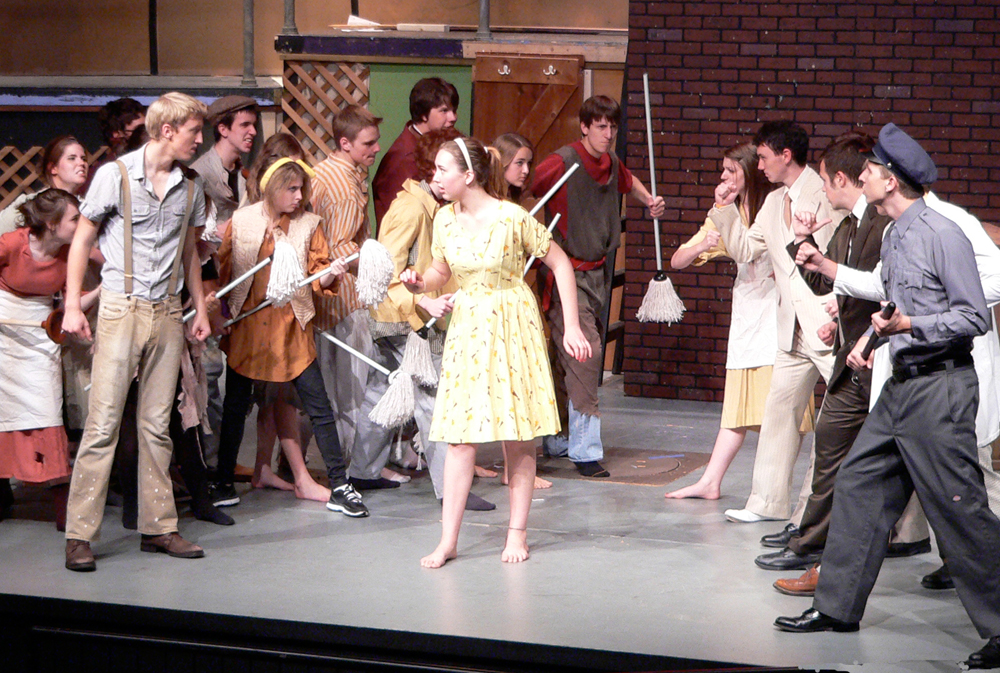
I’ve been busy all weekend with a theater production at our local community theater. Kids and husband in the show, I’m on the board and moved them to a new online ticketing system that launched with this show. It’s been a little all-consuming.

So I’m late coming to #pencilchat, although I saw bits of it over the weekend. It is hysterically funny, terribly sad, obviously frustrating, and incredibly intelligent.

If you haven’t, go to Twitter and search for #pencilchat.

Liz Dwyer has a great post about #pencilchat for a quick summary.

Lessons Learned

My Uncle Bub passed away earlier this month.  As we’ve been remembering him, we’ve talked about all sorts of things he taught us all. He was a natural teacher. If he took my son fishing, he’d patiently show a 10-year-old how to clean the fish, even if it would’ve taken Bub 1/10th the time to do it himself.

One time, I had a flat tire. As Bub made his living as a mechanic, patching the tire was a very simple task — for him. Not so for me. But did he just do it for me? Nope. He made me patch it myself, so I knew how to fix it myself next time.

Uncle Bub and I were from different worlds. Me: urban, “professional”, over-educated, tech/gadget geek. Bub: rural, mechanical, high-school, never sent an email or browsed the web.

Although Bub wasn’t big on 21st century technology,  one of the best stories I heard about him during the funeral was a great illustration of why we need to be teaching critical thinking skills. The story was told by one of the many locals who hung out at Moe’s Garage:

One time, this guy brought his Cadillac in for Bub to fix. Something wasn’t working right. Bub checked the car’s computer, and told the guy the computer said it needed to be checked at the dealer. So he did. The dealer told him the problem was one of a couple things, all expensive. The guy told him he needed to check with Bub.

Bub checked the car, listened to it run, and said he didn’t think these other things were the problem. He suggested checking a couple of wires. Of course, he didn’t do it – he showed the guy how to do it. So, the guy replaced a couple of wires, and voila, the car worked fine.

Moral of the story – just because the computer said something is so, doesn’t mean it is. Exactly why students need to be taught critical thinking skills when using technology!

Biggest Impact

Interesting post from Emerging EdTech about a survey of educators about what technologies have the biggest impact on teachers.

The three were:

  1. Teacher professional development
  2. Providing a computer and internet access for every student
  3. Mobile Technologies

These aren’t a surprise and it is definitely worth paying attention!

I sit on a district curriculum committee as a parent rep. This week, the Media Specialists made their presentation about curriculum plans for the next seven years. (OK, just that is totally unfair. How can a group who deals with technology plan out seven years?)

The media specialists got it. They knew why technology and digital literacy are so important. It was very clear to me that they are often speaking to people who don’t understand – to the teachers in the district. They did a survey of the teachers. Comments on the survey made it clear that teachers don’t feel it is their responsibility to teach the concepts of digital literacy, critical thinking about sources, etc.

Professional development is key. It is essential. Don’t forget it! Without it, those other two (which are also incredibly important) are worthless.