Getting Through

Parents and teachers should do everything possible to help kids get through high school without hating it.

-Gary Stager

Saw a recent tweet from Scott McLeod referencing this post by Gary Stager.

Wow. That is exactly what I’m facing right now with my 16-year old. How can this be? How can Gary Stager know this?

I don’t know the context of the entire post (great bits of wisdom he is sharing with parents from a Colorado school) but this bit really hit home. While I’m grateful that it appears that I’m not the only one in this situation, it is dreadfully sad that this is even an option!

My daughter (a junior) already hates high school. And honestly, who can blame her? Her every movement is questioned, regulated and controlled. She is told what she is supposed to learn, how she should learn it and how she has to demonstrate that learning. It’s even worse that the type of learning/assessment expected is largely rote, heavy reading and standardized multiple choice testing — all of which is difficult/boring for most kids, not to mention kids with attention deficits and dyslexia. For creative kids, this is enough to suck the soul out of learning and kill their spirit.

Yet, she’s blamed for not working hard enough.

Huh — have you ever seen her work on the lines to a play? unwrap a very difficult passage in a choral piece? curate visuals for her blog or develop a playlist? Watch her taking pictures sometime. She can work, she can focus. She just can’t do it on stuff that isn’t interesting. But she’s told that all the things she finds stimulating aren’t valid. Not explicitly, but truly, that’s what traditional schooling tells us all the time, everytime you enter a class, take a test or do homework.

I don’t blame the teachers. Most of them have their heart in the right place. They just have unrealistic workloads, too many standards to teach, and ridiculous pressure for these tests. Please give them some space to do what they want to do, why most of them went into the profession.

So, Gary Stager, how do I get my daughter through these last two years of high school?
Extracurriculars

I ran across two things with opinions about “extra” curricular activities yesterday. I have lots of opinions about extracurriculars!

Yes, academics are important, but are they everything? I don’t think so. In my experience, it seems some of the better life learning lessons come from the extras. Like what? Like how to work hard, how perseverance pays off, team work, critical thinking, thinking on your feet, planning, and on and on. No, it’s not learning how to solve a calculus equation or what battles were in the Civil War or how to write a 5-paragraph essay. Those are important, but so are the other lessons that come from the extras.

First thing I saw yesterday was a blog post, “9 Ways a Theater Degree Trumps a Business Degree.” I don’t know this blogger, but I certainly liked what he had to say. Skills learned from a theater degree are definitely applicable in the “real” world. Being on time. Thinking on your feet. Being resourceful. Being a team player. and more.

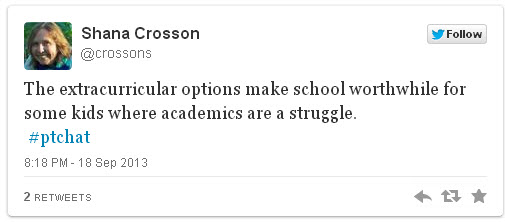
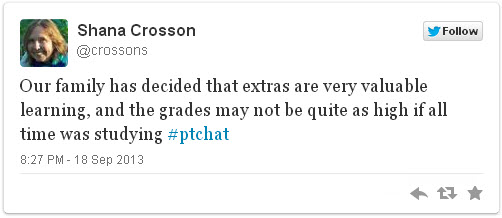
Second thing yesterday was #ptchat (a chat on Twitter. super fun.) The topic for yesterday was the balance between leisure and academics. The twitterverse lit up! I was happy to see lots of support from the teachers/admins in the chat for the extras. I was a little concerned by some of the emphasis on academics — that those always have to come first. There was some good conversation. (See the archives for all the tweets)

My input below:

tweet1

tweet2tweet3

Re-Entry

I’ve made no secret of the fact that I dread the start of school. For example:

Image

That’s a rather light-hearted look at why I dread school. I dread the schedule, getting kids up way too early, needing to be places on a strict schedule. I far prefer the less intense, self-driven schedule and “program” of summer. My kids are always super busy no matter what we do, but in the summer it’s doing things they love.

That’s the key. School isn’t something they love. It’s something they endure because they are supposed to. Yes, yes, I know. They need to learn how to do school to go to college, to work, etc., etc. They need to learn to “get along with people” and it exposes them to new things. Guess what. All this happens in the summer, too, when they’re doing things they love.

My concern with school is that I see them learning to do what they’re told. They learn that they are supposed to ingest content and spit it back in the way the system wants them to. Often (at least for my daughter) it’s in the form of a multiple choice test. I see very little evidence of the buzzwords that should be obvious: critical thinking, creativity, collaboration and communication.

One of my favorite bloggers wrote about this same feeling this week (My Summer of Confusion). He is much more eloquent than I am. He is also a former teacher and a leader in the education reform thinking, so he carries much more weight than I do. Here are his thoughts as his kids start school this year:

I’m less and less confident that the emphasis of their time in school will be dedicated to inquiry, to exploring their passions, to helping them create real, meaningful work that lives in the world and just maybe changes it for the better. As much as their teachers might want that, the reality is as a system, we’ve hunkered down against any real innovation, cut budgets and vision regarding technology, and decided to pursue the more traditional paths for “excellence” as in number of AP tests taken, high state test scores, SAT scores.

He acknowledges that he is the outlier, that most parents seem to want more AP classes, “rigor” and high test scores. I, too, have acknowledged many times on this blog that I know I’m the outlier. I don’t want more tests, I don’t want more AP classes. I want my kids to create art to communicate, produce videos to express their thoughts, create solutions to problems in their communities. It doesn’t matter one bit to me if they can get a 4 or 5 on an AP test. Richardson has the same experience I do:

…whenever I say that some of the most important learning that our kids can do in school is almost impossible to quantify and fold into a list, there’s little response. The subject gets changed.

The emphasis in the quote is mine.

I run into the need for “quantifiable results” all the time. I just reviewed a short report on an iPad pilot project in our district. One of the main indicators of a successful pilot was “increasing test scores.” There were a few other indicators, such as increased engagement, but the main measure was these test scores. It is exceedingly disappointing to know that that is how they are measuring success. Technology is a tool that increases our ability to move away from needing “testable” knowledge. Yet, that is how they measure success. Tragic.

Interestingly, though, I’m not so sure I’m the outlier. I’m not sure I’m the only one who doesn’t want more tests, more moving away from the arts and creativity. I think, i’m just the only one willing to speak up. At a recent meeting with a number of parents, I brought up my concerns about the over-reliance on testing. I expected to be ignored, as usual. But instead, the parents agreed with me! We had a short, but powerful, conversation that made it very clear to me that others feel the same way. Now, we just have to speak up and make them listen.

We have a lot of work to do.

Self-Regulation: American Schools Are Failing Nonconformist Kids | New Republic

Definitely worth a read: “Self-Regulation: American Schools Are Failing Nonconformist Kids | New Republic” by Elizabeth Weil.

When my daughter was in kindergarten (she starts 11th grade tomorrow), my husband and I were horrified by the expectation that all these 5 and 6 year olds were expected to sit still. Too bad we didn’t act on our impulses and start thinking more critically about the education system at the point – our daughter would’ve been better served. Instead, she learned how to sit still, look like she was learning, and how to play the game.

My daughter isn’t one of those kids who had trouble sitting still when she was supposed to. We never had issues with her behavior. I wish we would have. I’m not sure that knowing how to tow the line, sit in a circle and listen passively to an adult is what she needs to develop life skills. Even more, she has mastered the skill of looking like she’s paying attention when she really isn’t. That’s not a good skill to learn. Thanks for teaching her that one. 


Trusting Test Scores

The results of the 2012-13 MCA’s were released today to much fanfare – -and excuses.

The passing scores dropped significantly. One source said that reading proficiency of white students went from 82% last year to 65% this year.

The excuses? That these are “harder” tests based on the Common Core standards.

“These are two completely different tests, kids are asked to do completely different types of tasks on this test, but it’s a much more challenging and difficult test.”

– Brenda Cassellius, Minnesota Education Commissioner

Basically, that means the definition of “proficiency in reading” changed from last year to this year. How is that fair to kids? Some kids will take a look at these scores and be really distressed. Other kids will seem indifferent — but do you really think they are? How could this possibly make kids want to work harder? The kids who are used to scoring in the top percentiles may or may not be impacted, but you can be sure that a kid who was always “Proficient” before and now isn’t is going to feel this and be demoralized.

It just confirms to me that these tests are ridiculous and a waste of time. Please, spend more time teaching my kids instead of testing them.

More Thoughts about Multiple Choice

After my rant about multiple choice tests, I’ve noticed a number of other blog posts about multiple choice tests.

  • “In Defense of Multiple Choice Tests” by Natalie Barlett on Edudemic talks about the need to make choices in all aspects of our lives. She addresses a study that shows that multiple choice is a good tool to help students remember new and old info. She outlines a number of ways that well written multiple choice questions can be used in classrooms. 

    I don’t disagree with this — what I don’t like about the current multiple choice assessments is that there is so much weight put on these assessments, and that they are almost the sole measure of a student’s learning.

  • In “The Real Problem with Multiple Choice Questions” by Terry Heick on TeachThought, the issue is that they create the illusion of right v. wrong. In a world changing at a rapid pace, Heick sees this as the true problem with these questions.

…when a multiple-choice question is given to a student in hopes of measuring how well he or she understands something, it manufacturers the illusion of right and wrong, a binary condition that ignores the endlessly fluid nature of information.


Maps

Just a link to this great blog post about maps that has been circulating on Facebook for the last few days: 40 Maps that will Help you Make Sense of the World

I particularly like this quote acknowledging visual learners:

If you’re a visual learner like myself, then you know maps, charts and infographics can really help bring data and information to life. Maps can make a point resonate with readers and this collection aims to do just that.

Sacrifices

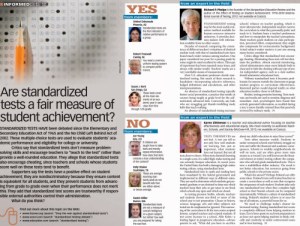
I read a fascinating discussion about standardized tests in an unexpected place — the Costco Connection. They asked the question, “Are Standardized Tests a Fair Measure of Student Achievement?”  (This issue also includes an article about Sal Khan and Khan Academy.)

Article from the August 2013 edition of Costco Connects

Article from the August 2013 edition of Costco Connection

The “expert” argument against the question was by a teacher and author, Karen Zittleman. I was particularly drawn to her argument that the pressure and reliance on the tests is unwarranted and is actually damaging.

She quotes Alfie Kohn, suggesting that parents question the level of standardized test by asking,

“What did you have to sacrifice about my child’s education to raise those scores?”

This is a perfect question. After hearing about three weeks being spent on test prep, computer labs restricted to testing and more, guess what I’ll be asking this year!!

Will Smartphones replace our Memory?

After my post about Google and multiple choice tests, I was pointed to this article by David Pogue in the Scientific American Magazine, “Smartphones Mean You Will No Longer Have to Memorize Facts.”

I’ve been challenged on the thought that I’ve said that kids don’t need to memorize facts. (I never actually said that — just said that memorizing facts shouldn’t be how we base assessment.) I do love this quote from Pogue,

As society marches ever forward, we leave obsolete skills in our wake. That’s just part of progress. Why should we mourn the loss of memorization skills any more than we pine for hot type technology, Morse code abilities or a knack for operating elevators?

He also talks about the rise of calculators in math classrooms. I remember that paradigm shift distinctly. In junior high and high school, we were absolutely NOT allowed to have calculators. My dad had an early calculator (I believe it was a Texas Instruments and cost about $75) that I thought was awesome, so I’d use it at home — but never ever would’ve brought it to school. A couple of years ago, I had to buy my daughter a $100 graphing calculator. They never go to math class without it after about 7th grade. I will NOT be buying one for my son – he can get a $1.99 app for his iPad that does more than the $100 calculator.

Memorizing? Yes, we do need to have some basic facts in our brains. No argument. But should all our assessment be based on this? Should kids be taught to analyze and find facts, rather than recall? Can you learn facts (relevant facts) better by solving problems and creating projects than random, out-of-context multiple choice tests? You can answer for yourself.

Vacation Learning

We’re recently back from a 10-day, 2000 mile road trip. Officially, it was a vacation, including visiting with family, picking up my daughter from camp and staying with friends. We had a lovely, relaxing time – even if the weather wasn’t always fully cooperative!

As I think about all we did over the 10 days, there was a tremendous amount of learning along with the fun. And guess what — the learning was FUN!

  • Geography We drove from Minnesota to Michigan and back, taking different routes there and back. We had the 13-year old do some of the navigating. He kept the maps (yes, real paper, fold-out maps) in the back with him and kept an eye on where we were going and what we were passing. He also used our iPhones to help find routes and restaurants. One afternoon, we saw three Great Lakes within a couple of hours.
  • History Since I am a historian, I talked about what I knew about the history of the areas we drove through. (I just can’t help it.) Not that I knew specifics about the area, but I knew general concepts about the fur trade, the reservation system, etc. We visited a couple of local museums that certainly helped put the details in the right place.
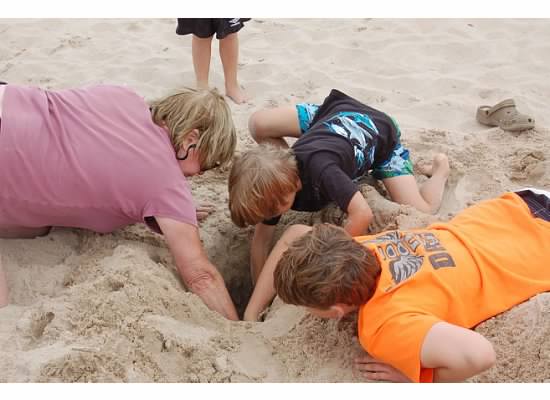
  • Science SandcastleWe walked through sand dunes, forests and beaches,looking at trees, rocks and critters. The weather was a significant factor in our adventures, meaning the kids had to be observant and think ahead. We built sand castles, exploring the powers of sand, water and gravity.
  • Art I learned long ago to bring a camera on hikes and activities. It can often engage a reluctant teen. Fortunately, I didn’t have a reluctant teen, but the camera was put to good use throughout the trip. We also built cairns of rocks, made sand castles and drew pictures with sticks on the beach.
  • Language Arts With hours in the car, we listened to two different books. One book had themes that were similar to another book, so we spent time discussing the similarities and differences, and the motivations of the authors. I wish I had gotten the kids to blog about the trip, but alas, that didn’t happen.
  • Music Music happens anywhere my kids go, and this trip was no exception. I had asked my 13-year old to make some good playlists for the drive, and we discussed why he had picked certain songs. My daughter was returning from a musical theater camp, so we discussed things learned.
  • Phy Ed Lots of hiking, swimming, and games!

Certainly not all our learning fell into these neat subject categories! You can’t learn about the geography of the Great Lakes without learning about history and science. Sand castles are as much art as science, as well as phy ed.

Exhibit label at the Great Lakes Shipwreck Museum

Exhibit label at the Great Lakes Shipwreck Museum

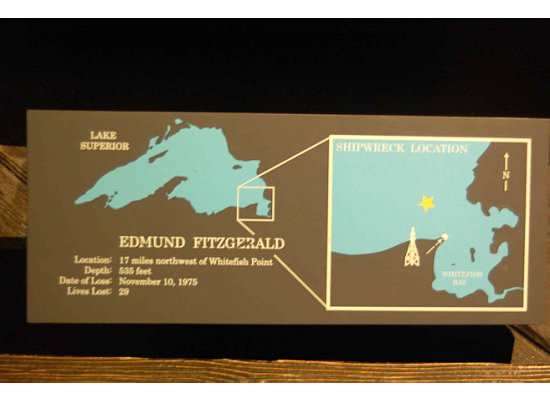
We took a special trip to learn about the sinking of the Edmund Fitzgerald. We saw objects, videos, photos. We were on the edge of the U.S., close enough to see Canada. We spent time in the car tracking the Arthur M. Anderson, the last ship to see the Edmund Fitzgerald. It just happened to pass the museum while we were out watching. It also happened to get into port in Superior shortly before we got there. (Freaky!) We tracked the ship’s path, learned about knots and UTC (shipping time.)

What else? Lots of free exploring and inter-generational experiences. The kids were creative. They got “bored” and had to find something to do. They were active, cooperative and collaborative.

While I won’t tell the kids, it seems to me that this vacation was as much about learning as it was about relaxing and having a great time. What a great way to learn!