Stop Stealing Dreams

Do check out Seth Godin’s recent education manifesto, “Stop Stealing Dreams.”

There are many quotable quotes, but here’s just one, about multiple choice tests. Frederick Kelly created multiple choice tests in 1914 as a way to literally assign factory workers.  He said:

In the words of Professor Kelly, “This is a test of lower order thinking for the lower orders.”

Yup. And we still do it.

DIfferentiated Testing

Interesting article in a New York Times School Book (“Students Learn Differently. So Why Test Them All the Same?”, Feb. 17, 2012) about the New York State testing requirements. This particular teacher blogger is an ESL teacher, and his description of teaching to the test is distressing. (Not the teacher — but the fact that he had to totally design a course to help kids pass the test.)

In his case, he is dealing with English language learners, and it is (well, should be) that testing needs for this population should be different. Not only do we teach to the test for native English speakers, for the same happens to newly arrived immigrants, when truly, there must be more important things for them to learn.

I think the concept Mr. Goldstein presents is valid for native English speakers, as well. Any teacher knows that kids have different learning styles. Some kids need pictures, some need to hear it. Some need to move things, some need to see words.

But I don’t think standardized tests come in different learning styles, do they? They heavily favor the text based learner. The kids who read and process text easily. Standardized tests exclude the visual thinker, the kinesthetic learner. How is that fair?

Student Technology Bill of Rights

Ran across this incredible concept, the Student Technology Bill of Rights, by Brad Flickinger. Check out both Post 1 and Post 2. I won’t quote him here, but just highlight my favorites. (And will be taking them along to kids schools. Wish me luck!)

#3: “I have the right to submit digital artifacts that prove my understanding of a subject” hits home at our house right now. Many previous posts have discussed the Pre-AP World History class that my daughter will take next year. Text. Text and more text. Nothing wrong with some text, but we have decided that she will just do projects visually and digitally. I’m tired of having to constantly advocate for digital/visual assignments. It’s just what’s going to happen.

#5: “I have the right to access social media at school. It is where we all live, it is how we communicate — we do not use email, or call each other. We use Facebook, Twitter and texting to talk to each other. Teachers and schools should take advantage of this and post announcements and assignments using social media — you will get better results.” This is so true.

#7: “I have the right to be taught by teachers who teach me and demand that I use 21st Century Skills.” So true. My kids’ assignments should not look like the work I did 30 years ago when it is so clear that teaching to all kids modalities and using 21st century tools work better.

#9: “I have the right to be protected from technology.” Yup. It is now the school’s responsibility (along with home) to teach digital citizenship. Teach kids to start building a positive digital footprint.

#11: USE THE CLOUD. Yes, please. I almost cried when my son said he had to buy a flashdrive for school. REALLY???? I refused. And this when the teachers use Google Apps for Education daily. Why not the students? (footnote: this will be changing soon!!)

#12: Let them text: if a kid wants to write by texting, why not? It’s EXACTLY the same argument I heard when I was teaching, although in this case is was whether to let students write in the cultural dialect they spoke at home. I let them. They were writing, communicating, thinking. We also taught “educated” English, but didn’t cut them off from who they were.

These are great. Thanks, Brad!


Bold or Old?

HT to Patrick Larkin (@bhsprincipal) for this great 5-minute excerpt  from a talk by Will Richardson. Mr. Richardson challenges his audience, Are you going to be BOLD or OLD?

I found two takeaways:

FIRST POINT: The 21st Century Literacies from the National Council of Teachers of English. The three of these I find most compelling, largely because they are not being met in the two schools I know best,

  • Develop proficiency with the tools of technology
  • Create, critique, analyze, and evaluate multi-media texts
  • Attend to the ethical responsibilities required by these complex environments

It’s not easy to develop proficiency with anything if you can’t use it. If you have a computer in your pocket that gives you access to libraries full of information — yet you aren’t allowed to use it during the day? How can you learn how? You learn on your own, without the guidance of teachers and adults in your life.

How can you learn to create and critique multi-media texts if you aren’t allowed to use these tools for assignments? If you aren’t allowed to look at them?

Let’s not even start with learning the ethical responsibilities. In some schools, it’s like plugging their ears: if they can’t hear it, it’s not making a sound! If you never let the kids use the tools of technology (which, right now, are social media, cell phones, mobile devices, etc.,) then there’ll never be a problem. Right? Nope – wrong.

SECOND: Mr Richardson is addressing a room of teachers. In his remarks, he tells the teachers that they should be the “Learning Leaders” – they can convince parents that the kids will be ok, that they’ll get into college. That it’s the right thing to do to have kids who are passionate, deep learners – kids that love to learn.

But what about my situation? I’m the parent. But in our case, it’s the schools that need convincing. I’m not having much luck at this. I’m met with comments like, “If we let them use their phones, they’ll text the answers,” or “We can’t do projects (digital, multimedia, etc.) because that won’t help them get ready for the AP test.” Or teachers who can’t see any reason a student should get an iPad because all the apps are games that aren’t helpful. Or a principal who leaves all technology innovation to the teachers, who’s never been on Facebook. A school district where webpages are three years out of date. A high school that doesn’t require – or even encourage – teachers to post homework, test schedules, etc. online for kids to access.  High school current events classes that only use the print newspapers. A district that won’t look at BYOD because it won’t be equitable – instead of figuring out how to make it work

Mr. Richardson – what would you advise me to do? My kids are moving along through school quickly. They don’t meet any of the NCTE standards of literacy. I shouldn’t have to disrupt them from their friends — and yes, from the other very good things that do happen in these schools — to get them to schools that do understand that it is not a “fun” thing to incorporate the tools of technology into schools, it is the RESPONSIBILITY of schools to do so.

I leave you with this quote from Mr. Richardson,

It’s not about passing a test, it’s about solving the problem, about sharing something with the world that changes the world.  It’s about doing meaningful, real work. School should be real life.

 

The Positive Side of Dyslexia

Thanks to Diane Ravitch for the link to this great article about dyslexia. Many thanks to the author, Steve Dingledine.

The current movement towards using appropriate tools in the classroom, whether it is an iPad, Chromebook, laptop, whatever, is a step in the right direction of allowing students with dyslexia — or any other learning disability, difference, or even just students who learn best in different modalities (visual, auditory, kinesthetic, etc.) — the chance to really be successful in school. A learning difference should not equate not being successful at school and in life.

…many dyslexics have other cognitive skills in abundance, including visualization and intuition. They can also see problems and solutions in the big-picture frame and can detect obscure patterns in unique and, at times, revolutionary ways.

The education system owes it to these kids – those with dyslexia or any other sort of learning difference – to adapt the SYSTEM to the kids. The kids shouldn’t have to suppress or ignore their natural skills in order to learn.

Dyslexics and other non-conformists need time and space to grow within school contexts. Their creative genius and divergent thinking needs to be incorporated into classrooms and not stifled.Their teachers need to have the flexibility and freedom to nurture their strengths and talents while helping them to reach their potential on their terms.

Like the author of the post, I am a textual learner. His wife is dyslexic. My daughter has not been diagnosed with dyslexia, but has considerable trouble with text based learning. She is a strong visual learner. I really appreciated this thought:

Our society, unbeknownst to me beforehand, is heavily geared to text-based learning and work activities. The emphasis on reading text, which creates “winners” and “losers” through standardized tests and entrance exams…

My (many) previous posts about my daughter’s choice for an advanced social studies course next year have focused on the responsibility of the schools to provide an adequate education for all learners — not just text based learners. It’s going to be a struggle to get them to accomodate my daughter’s needs, but why should just the kids who are text based learners have access to the advanced content and be considered “smart?”

Hopefully we’ll see things changing as schools move more towards allowing and encouraging students to make use of technology tools and the paradigm shifting that happens (or should.)

Project REAL Revisited

I had the good fortune to attend another Apple education seminar at Little Falls High School . Last spring, I attended a morning session where the Project REAL plan was presented and the 5th grade teachers and students who piloted iPads were there to show what they had done. Last year, there were approximately 40 people in attendance.

This year’s seminar was a full day. Teachers presented about what they had been doing, then we had time to visit with students and teachers at tables. The IT staff answered specific technical questions. This time, there were over 250 people at the session, and more than 550 people were watching the livestream. Wow!

Thankfully, they recorded the morning session which had about 12 teachers presenting different aspects of how they have used iPads this year. Watch it for yourself and see the great stuff happening in Little Falls!

It was a great day with many interesting stories. If I wasn’t already convinced that schools need to move to this direction, I am now.

Here’s a quick list of highlights for me:

  • “The only thing I can’t do on the iPad is print, and boy, am I glad.” — from Dave Girtz, the middle school media specialist
  • Carrie Youngberg, 5th grade, sees increased parent communication when the kids produce a weekly video of the “newsletter.”
  • Anjanette Kraus, High School English, uses Kidblog.org. She’s seen a significant reduction in late work and plagiarism, and thinks the public audience component has improved student writing and engagement. Kids are collaborating on writing.
  • Andy Ward, High School Science, was a sceptic. He was NOT happy about the iPads. He is now a convert. He says he’ll never go back to written lab reports – all his lab reports on done with video. Watch him – he’s quite entertaining!
  • The PE teacher uses an app called Tennis Coach Plus HD to record students practicing skills.
  • Jody Waltman, High School Math and French, demonstrated how she uses Moodle and email. No paper assignements!
  • Gregg Pearce – 5th grade. Gregg was uncertain as he piloted the iPads last year. The tech integrationist suggested just trying it – “unleashing the hounds.”
  • Greg Aker, Middle School social studies, demonstrated how easy it is to create epubs. Little Falls has a goal to not purchase any more textbooks.
  • Nate Swenson, Middle School principal, demonstrated how they use Google Forms for assessment.
  • Adam Smieja, Middle School math, demonstrated Socrative.
  • Karen Warner, High School art, discussed how she has embraced the iPads after being less than enthusiastic. She has student collaboration and student voices as they exchange ideas on the Moodle site. She uses iPads frequently for students to find references to draw.
  • Sarah Shaw, elementary art, has had the kids make digital art portfolios.
  • Shawn Alhorn, 5th grade, had the iPads last year. He loves not having paper assignments. He’s seeing more engagement, students digging deeper into content. He has kids do keynotes for vocab – has seen this reach kids of all learning styles, with significantly improved retention of meaning.


Social Media = Learning?

Not so fast. Fun infographic from Edudemic shows how social media is integrated in the lives of kids ages 12-17. But – social media is not so integrated into their education.

Students like Social Media

How much do students like social media?

The full blog post and the infographic talk a bit about why schools don’t use social media: concerns about bullying, cheating, distraction, etc.

These are all valid concerns. But, I’m betting these things all go on anyway – with or without the technology/social media. Aren’t we better off teaching kids using these tools and thus teaching them appropriate boundaries and uses?

Or, should we continue along this road of ignoring the big elephant in the room, and thus not showing kids how to deal with its implications?


Parent Participation

As a parent, not a teacher or administrator, I often find myself in an awkward position when advocating for technology use in the schools. After all, I’m not the one in the classroom managing the kids. I’m not the one planning the lessons, having to meet standards, and having to change how to do a job I’ve been doing successfully for years.

I am, however, a partner in my children’s education. Our family makes choices on how we use technology at home. Discussions about digital literacy and responsibility are not uncommon. I’ve been advocating for technology use at school for years, although I didn’t really know it. It started with pushing for acceptance of audio books – and that came from helping kids learn the way they learn best, and not forcing one system on them.

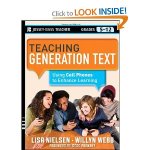
Teaching Generation Text

Teaching Generation Text

A recent blog post by teacher and author Lisa Nielsen lists 12 was kids can use cell phones for learning. She would know – she (and Willyn Web) just published a book, Teaching Generation Text: Using Cell Phones to Enhance Learning


However, the sentence that jumped out at me from this post is one of the rare mentions of the role of parents in integrating technology in schools:

Parents may need to take the lead in allowing their children to use their phones for learning and in educating their teachers and administrators of the value in working toward acceptable use policies.

Wow! That’s the first real encouragement I’ve seen of including parents in the conversation that I’ve seen in the online conversations. Parents aren’t usually mentioned, and if they are, it’s the teachers/administration trying to convince parents that it’s ok to use the tools.

Much of my motivation to get involved came from a short conversation I had with a superintendant of a small district in a rural part of the state. In his short talk at a conference, he talked about how he has successfully worked with the teachers in his schools, and about how essential the parents were in the process. I found him later and asked his advice about being involved. I didn’t want to be seen as an annoyance or to be telling the schools what to do. He told me in no uncertain terms to speak up, to be involved and to keep the conversation going. So I am.

The blog post led me to the authors’ website, www.TeachingGenerationText.com. Right there, on the home page, is a great sentence:

This site is brought you you by Lisa Nielsen and Willyn Webb in an effort to help teachers, parents, and administrators stop fighting and start working with students to use the tools they own and love for learning.

What a great concept, and one I hope we can see moving forward. Include parents (and students!!!) in the conversation and see where it leads.

Quote

Paradigm Shift

One of the primary elements of 21st Century education is that it puts technology into the hands of students, rather than solely in the hands of the teacher. This is a paradigm shift for an educational culture which has put a teacher in the front of the room….

— Christopher John Russell in Practical Technology for Music Education available as an ebook from his blog, Technology in Music Education

Biggest Impact

Interesting post from Emerging EdTech about a survey of educators about what technologies have the biggest impact on teachers.

The three were:

  1. Teacher professional development
  2. Providing a computer and internet access for every student
  3. Mobile Technologies

These aren’t a surprise and it is definitely worth paying attention!

I sit on a district curriculum committee as a parent rep. This week, the Media Specialists made their presentation about curriculum plans for the next seven years. (OK, just that is totally unfair. How can a group who deals with technology plan out seven years?)

The media specialists got it. They knew why technology and digital literacy are so important. It was very clear to me that they are often speaking to people who don’t understand – to the teachers in the district. They did a survey of the teachers. Comments on the survey made it clear that teachers don’t feel it is their responsibility to teach the concepts of digital literacy, critical thinking about sources, etc.

Professional development is key. It is essential. Don’t forget it! Without it, those other two (which are also incredibly important) are worthless.